If your itinerary stays inside central Paris, public transport usually wins for convenience, cost, and stress. Driving only makes sense if you plan day trips to remote spots, need flexible luggage movement, or are visiting multiple regions in one trip. This guide gives a practical decision: when a Paris car rental genuinely improves your plan and when to avoid it. You’ll get clear checks for route value, how rental insurance wording can change your liability, what to expect at pickup and return, and a ready non-driving fallback using trains, buses, and local taxis. Read this to decide before you click “book” — and to know exactly what to verify on the rental company’s final page if you do rent.

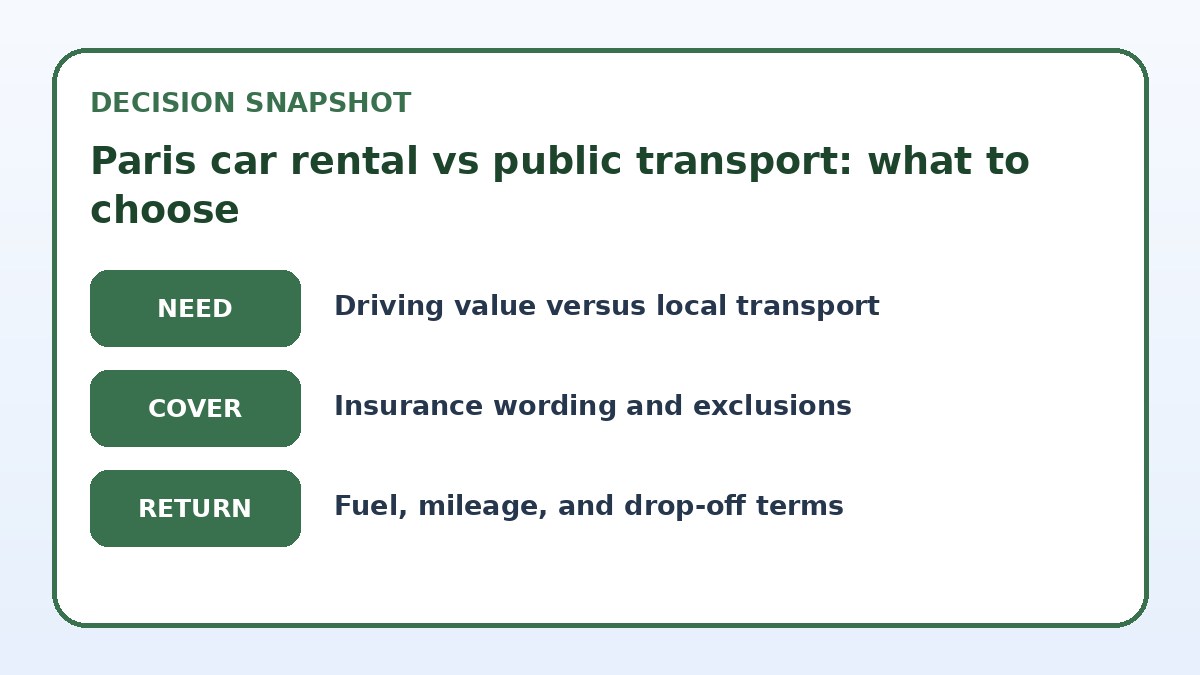
Decide by route value: which itineraries benefit from driving
Start by mapping your daily plans on a simple timeline: central Paris activities, suburban side trips, and any provincial legs. Driving adds value when most of your time is spent outside the city limits or when you will visit several towns in a single day that lack frequent train connections. Factor in the distance between stops, the flexibility you need for early departures or late returns, and whether public transit timetables would fragment your day. If you plan multiple, geographically dispersed day trips (for example, a series of small châteaux, rural wine estates, or coastal villages), a car can cut transit complexity.
Conversely, if your schedule clusters inside the central arrondissements or relies on major tourist corridors served by frequent trains and buses, the car becomes a liability. Urban driving multiplies waits for parking, tolls, and low-emission zone rules; it can turn short urban hops into slow chores. A hybrid approach can work: use public transit for the city and rent a car just for specific day trips. When evaluating that hybrid, check whether rental outlets allow same-day returns and one-way drops without prohibitive fees.
Decide whether driving earns its place
| Mobility strategy | Best for | Cost or friction to check |
|---|---|---|
| Drive everywhere in a rental car | Solo travelers planning multiple rural day trips or multi-stop regional routes | High parking, low-emission zone rules, and insurance exposure; extra time spent on pickup/return logistics |
| Use public transport only | Those staying mainly in central Paris who value low stress and predictable costs | Less flexibility for remote destinations and limited luggage convenience for some routes |
| Hybrid: rent for select day trips, otherwise transit | Travelers wanting city convenience with a few distant excursions | Extra booking complexity and potential one-way drop or hourly rental fees; must coordinate pickup/return timing |
| Public transport plus taxis/rideshares for last-mile needs | Solo travelers who need occasional door-to-door service without car responsibilities | Higher per-ride costs and variable availability late at night or in less-served suburbs |
Check live rental choices only after the route test
Use the exact driver, dates, pickup point, and return plan to compare current conditions.
Insurance wording: what to verify before you sign
Insurance language is where costs and liability hide. Don’t assume category labels like “full coverage” mean the same thing across providers. Verify the rental agreement’s excess (the maximum you could be charged after any claim), what types of damage are excluded (windshield, tires, undercarriage), and whether collision damage waivers (CDW) or supplemental liability protection are optional or bundled. Look for explicit wording about driver age limits, additional authorized drivers, and whether the policy applies in neighboring countries if your route crosses borders.
Also confirm roadside assistance scope and response time language, and whether theft protection requires documented negligence to be denied. If a third-party insurance or credit-card coverage is intended to supplement the rental, read both the card terms and the rental contract to find conflicts — many insurers require the rental company’s own CDW to be declined in writing, or they exclude certain vehicle classes. On the rental company’s final booking page, verify the exact policy text, the excess amount, and the steps for filing claims or disputes.
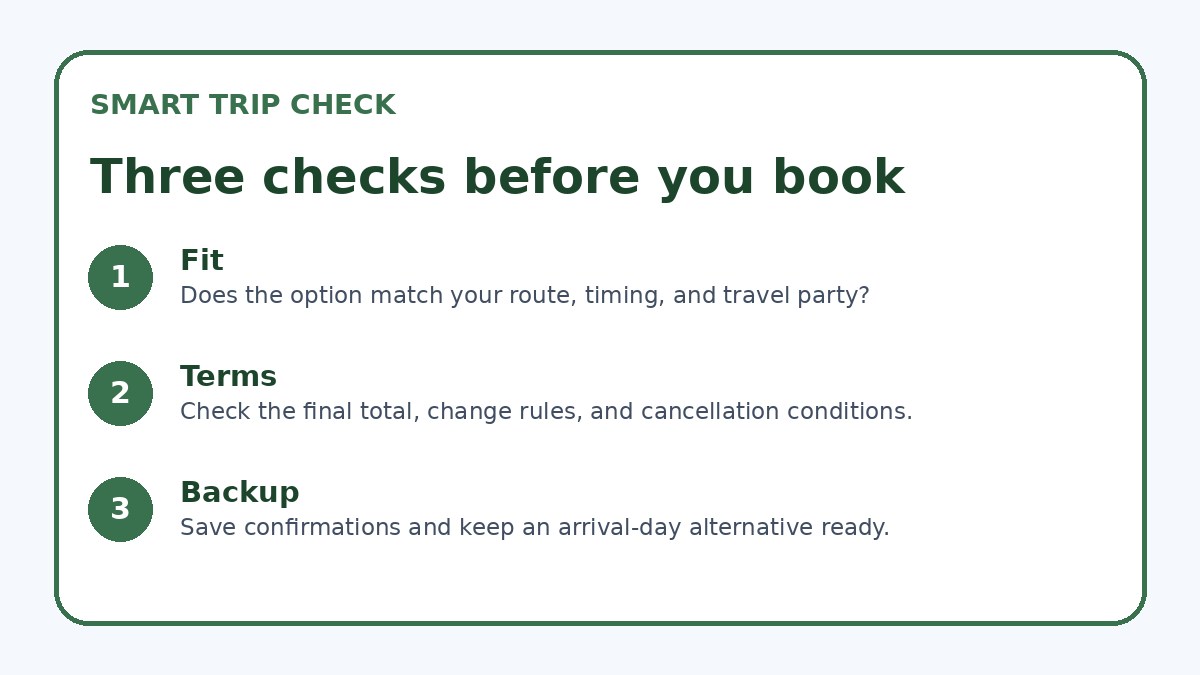
Compare the full rental conditions
Confirm insurance wording, exclusions, deposit, fuel, mileage, and return terms on the final page.
Pickup and return friction: practical checkpoints
Pickup and return are where a smooth rental can still consume half a travel day. Check the exact pickup location and opening hours for the outlet you choose: airport counters, city-center offices, or remote depots have different transfer needs. Note whether the company requires your passport, driver’s license translation, and printed confirmation — and whether they inspect the car in daylight or under time pressure, because detailed condition checks protect you from later damage claims. Ask about out-of-hours returns, fuel policies, and late-return grace periods; ambiguous wording here often leads to extra charges.
Plan your return with time buffers for traffic, fueling, and the final inspection. In city centers, allow extra time to find approved drop zones and to avoid penalties tied to returning in a restricted zone. If you must return at a different location, confirm one-way drop fees and whether this is allowed on the booking page. If pickup is at an airport, verify shuttle schedules or whether the desk is in the terminal; if you prefer to avoid pickup friction, consider renting from a central office near your lodging but check whether prices or vehicle availability differ.
Car rental terms to verify
- Map every day: mark central Paris stops and any destinations beyond the périphérique to assess if driving adds real value.
- Read the rental’s insurance wording on the final booking page: confirm excess amounts, specific exclusions, and roadside assistance details.
- Verify pickup and return locations, opening hours, and any out-of-hours return rules before you confirm the reservation.
- Check low-emission zone (ZFE) requirements and whether the vehicle’s emissions class or sticker is specified on the booking page.
- Compare train and bus travel times for each planned day trip and mark feasible public-transport alternatives as backups.
- If using credit-card insurance, obtain the card issuer’s coverage confirmation and match it against the rental contract’s requirements.
Non-driving fallback: how to plan a car-free Paris itinerary
A credible fallback should get you where you need to go without a car. Central Paris is highly walkable and supported by an extensive metro, bus, and suburban train (RER) network; intercity and regional trains reach most major towns and many popular day-trip destinations. For destinations without direct rail, look for frequent regional buses or scheduled shuttle services. Combine transit with occasional taxis or rideshares for late-night returns or heavy-luggage transfers; they fill gaps without the responsibility of parking and insurance.
Prepare alternatives for each day you’d otherwise drive: list the nearest metro or RER stations to your start and destination points, check last-train times for late returns, and identify a backup taxi rank or rideshare pickup point. Buy a rechargeable transit card or mobile ticket ahead, and download offline maps. If you’ll need to cross regions quickly, compare seat reservations and travel time between trains and driving to decide whether a one-day car hire for a single day trip is worth the added overhead.
Car Rental & Road Trip questions travelers ask
Can I drive a rental car everywhere around Paris, including nearby regions and across borders?
Many rental companies allow regional travel, but rules vary. Before you book, verify cross-border permissions on the final booking page and any required documentation or fees. Some agreements restrict travel into specific countries, require prior notification for cross-border use, or mandate additional insurance. Also check whether roadside assistance or replacement vehicle service applies outside France. If you plan to cross a border, request written confirmation in the rental contract and carry any required permits or proof of supplemental coverage while driving.
How significant are parking and low-emission rules for solo drivers in Paris?
Parking and low-emission zone controls can change the practicality of driving. In central arrondissements, parking spaces are limited and often paid with time limits; enforcement varies by neighborhood. Low-emission zones (ZFE) restrict or charge vehicles without the proper emissions classification. Before booking, confirm whether the rental company provides a compliant vehicle and whether any permits or congestion charges are needed. Check the rental contract for wording about fines and who is liable for traffic or parking penalties issued during your rental period.
If I decide not to rent, what public-transport passes or options should a solo traveler prioritize?
For a car-free plan, prioritize a rechargeable transit card (or validated mobile tickets) covering metro, bus, and RER zones you’ll use. Identify the nearest metro or RER stations to your accommodation and key sites, and check train timings for day trips outside the city. For areas with limited rail service, note scheduled regional buses or shuttle operators and download relevant timetables. Keep a rideshare app or local taxi number for late-night returns or luggage-heavy transfers, and reserve long-distance train tickets in advance when required for seat reservations.
Final decision note
For most solo travelers whose plans center on Paris’s museums, cafés, and neighborhood wandering, public transport and walking offer the best balance of speed, cost, and simplicity. Rent a car only when your route includes multiple rural or cross-region stops that public transport cannot stitch together in a day. If you do rent, scrutinize insurance wording, emission-zone compliance, and pickup/return terms on the booking page so you understand your liabilities and practical obligations. Keep a non-driving fallback prepared—mapped transit alternatives, taxi options, and a short-term rental plan for single day trips—and you’ll keep flexibility without unwanted surprises. Consider checking current availability and conditions on comparison sites such as Trip.com as one of your final steps before booking.
Continue planning
Check current options and final conditions
Use the provider page to confirm live availability, the final total, cancellation terms, and every condition that matters to your trip.
This evergreen planning guide was created with AI-assisted drafting and a structured quality review. It does not display live prices, schedules, availability, visa guidance, or provider rankings. Verify current details before booking. Some links are affiliate links; we may earn a commission at no additional cost to you.