Take the practical route: prioritize a rail-first plan from Osaka to Hiroshima, then layer in buses or rental-car legs only if you need extra local flexibility. For most first-time visitors, trains offer the clearest balance of speed, frequency, and city-center arrival points; buses are typically a lower-cost, fewer-transfer option for travel after hours; and renting a car is best when you want to visit rural sites on a flexible schedule. Start by deciding where you’ll sleep in each city and how many day trips you want, then compare schedules and ticket rules before committing. Below I explain how to weigh speed versus convenience, where to check live availability, and what to confirm on booking pages so you avoid surprises when you arrive.
See current options before you compare the details
Availability and final conditions change. Open Trip.com now or keep reading for the practical comparison.
Decide your overall itinerary and priorities
Start by translating trip priorities into transport choices. If you value speed and predictable city-center arrival, prioritize rail for the Osaka–Hiroshima leg. If budget is the dominant constraint or your travel involves late-night movement, consider highway buses for some segments. If you want to explore rural coastal or mountain sites that aren’t well served by rail, add a rental-car leg for those specific days rather than relying on it for every transfer.
Next, sketch a simple day-by-day plan listing overnight cities, main attractions, and any fixed appointment times (ferries, guided tours, or accommodation check-ins). That map will reveal which connections must be reliable and which are flexible. Use that clarity to decide whether you need reserved seats, early bookings, or a vehicle. Keeping an extra buffer day between long travel legs lowers the stress of missed connections and gives you room to swap modes if schedules don’t match your plans.
Compare trains, buses, and car travel for the Osaka–Hiroshima leg
Trains usually provide the simplest single-step connection between major cities, with departures concentrated at central stations. When comparing train options, check whether a service requires advance seat reservations, whether it stops at the central station you prefer, and how luggage is handled. For first-time visitors, trains minimize navigation in unknown cities because you arrive at major hubs with ticketing and information counters nearby. Always read the final booking page to confirm boarding points, seat assignment rules, and change or cancellation policies.
Highway buses typically cost less and can run outside peak train hours, but they may take longer and use out-of-town terminals. Buses can be convenient if you’re traveling light or if train schedules don’t match your plans. Renting a car adds route flexibility and is practical for reaching dispersed sites, but it transfers responsibility for navigation, parking, and local driving conventions to you. When evaluating a rental, check pickup and drop-off locations, one-way fees, and whether your reservation includes insurance and unlimited mileage.
| Approach | Best for | Tradeoff to check |
|---|---|---|
| Train-focused plan | Travelers prioritizing speed, frequent departures, and central station arrivals | Often less flexible for rural detours and may require seat reservations for peak periods |
| Bus-first plan | Budget-minded travelers or those needing late-night or off-peak departures | Longer journey times and sometimes peripheral terminals requiring extra transfers |
| Car-integrated plan | Visitors wanting flexible day trips into rural or coastal areas not served by rail | More planning for parking, navigation, one-way rentals, and local driving conventions |
| Hybrid plan (train + local car or bus) | Travelers seeking a balance: fast main leg by train with local flexibility by car or bus | Requires coordinating multiple bookings and transfer logistics between modes |
Ready to check the option that fits your plan?
Use your exact dates and traveler details so the provider page can show the current total and conditions.
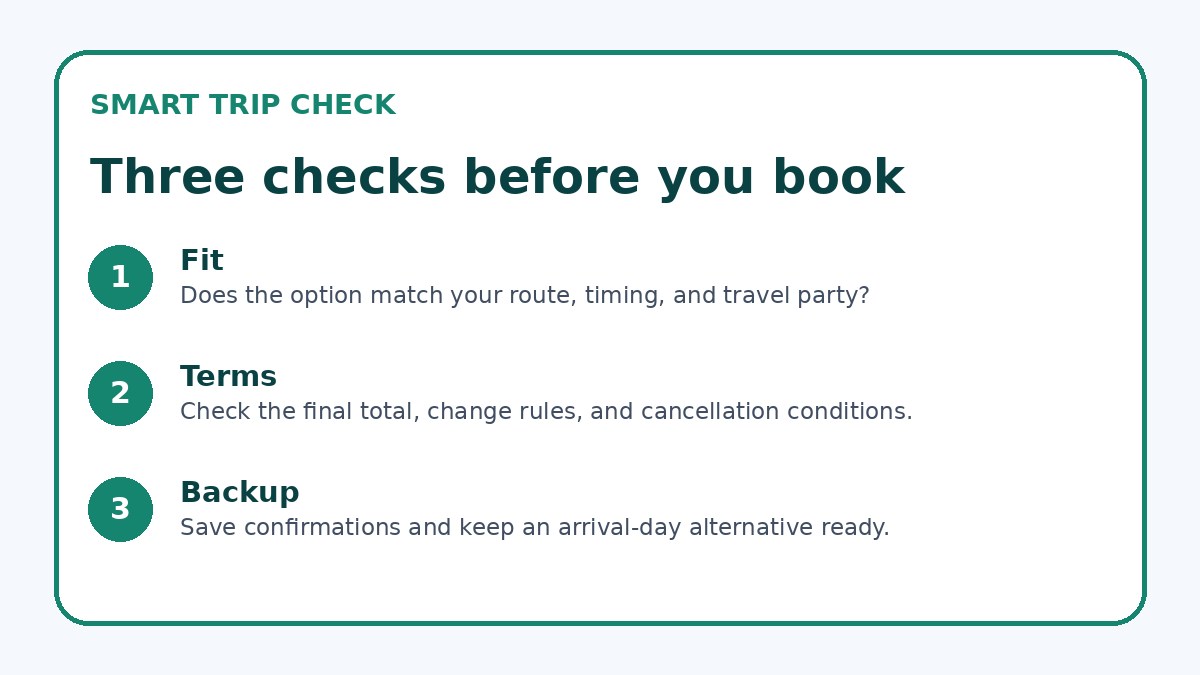
How to build a multi-city connection plan step-by-step
Work backward from each overnight stay to plot how you’ll move between cities. Choose the connection for main-city transitions first—Osaka to Hiroshima—then slot in local legs (for example, day trips to coastal towns). For each leg, list candidate transport modes, required reservation types, luggage considerations, and transfer walking distances between terminals. Mark which legs are time-critical and which are flexible. This lets you mix modes sensibly: reserve the critical train segment while leaving flexible bus or car legs open or bookable closer to travel.
Once you have candidate options, compare convenience factors as well as cost: terminal locations relative to hotels, frequency of departures, and baggage limits. For any option where provider data could change—schedules, seat assignment rules, or baggage rules—note the exact items you must verify on the provider’s final booking page. If you like, use a single calendar or spreadsheet to track tentative reservations, cancellation windows, and the confirmation links for each booking to reduce the risk of overlap or missed legs.
Before you book
- Choose your overnight cities and confirm hotel proximity to the station you plan to use.
- Compare train, bus, and rental-car legs for each segment; list transfer points and luggage implications.
- Check provider booking pages for seat reservation rules, baggage limits, and cancellation terms before paying.
- If renting a car, verify pickup/drop-off locations, one-way restrictions, and included insurance options.
- Save confirmation screenshots and map the walking route from station to hotel in advance.
- Allow buffer time between booked legs and avoid tight back-to-back transfers on your schedule.
Practical tips for first-time visitors on the ground
Pack and manage luggage to match chosen modes: wheeled carry-ons or small suitcases speed transfers between stations and are easier to stow on trains and buses. If renting a car, consider how many bags fit comfortably and whether you’ll need roof storage. Carry printed or screenshot copies of confirmations and a simple map showing how to walk between your hotel and main stations. That reduces time spent asking for directions and helps if mobile data is limited.
Confirm language and ticketing accessibility at departure points—major stations often have English signage and staffed counters, but smaller bus terminals or rural car rental offices may not. Have a phrase or translation app ready for basic terms like reservation, platform, pickup, and luggage. When you’re ready to book, compare current availability on provider pages and, if you wish, check Trip.com for an additional comparison option; always treat that as one source and verify final conditions on the provider’s booking page before completing any purchase.
Frequently asked questions
Should I reserve train seats in advance when traveling from Osaka to Hiroshima?
Reserving seats reduces uncertainty, especially if you need a specific departure time or travel with luggage. Many travelers book reserved seats for the main intercity leg to ensure seating during busy periods and to simplify connections. If your itinerary is flexible or you plan to travel at off-peak times, leaving seats unreserved can work, but verify on the provider’s booking page whether specific services require reservations or charge extra for them. Always check reservation windows and change or refund rules before finalizing.
Is driving between Osaka and Hiroshima recommended for first-time visitors?
Driving can be attractive for reaching rural attractions off the rail network, but it adds responsibilities such as following local driving rules, finding parking, and understanding rental company policies. For a straightforward city-to-city transfer, public transport often removes the stress of navigation and parking. If you choose to drive, plan the route in segments, confirm one-way rental rules, and ensure you know where to park near attractions and accommodations. Verify vehicle insurance coverage and traffic regulations with the rental provider on their booking page.
How do I combine train and bus legs without overcomplicating my plan?
Use the train for the main trunk route between cities and add bus legs for late arrivals, specific local stops, or shorter feeder connections. Identify which legs are time-sensitive and reserve those first. For flexible local travel, leave bus or rental legs bookable until closer to the date, but note cancellation terms. Keep a simple itinerary with departure times and transfer walking directions, and allow padding between modes. Confirm final boarding locations and luggage rules on each provider’s page to prevent surprises on the day.
Final planning note
Building a multi-city ground-transport plan from Osaka to Hiroshima works best when you prioritize the main-city transfer first and then add flexible legs for local exploration. Decide whether speed, cost, or flexibility matters most for your group, then match each leg to the mode that delivers that priority. Reserve the critical segments and keep others open until you’ve confirmed schedules and accommodation locations. Always verify seat and baggage rules, cancellation policies, and pickup/drop-off details on the provider’s booking page before paying. With a simple plan, a little buffer time, and clear confirmation records, first-time visitors can travel confidently between Osaka and Hiroshima and enjoy the region without last-minute stress.
Continue planning
Check current options and final conditions
Use the provider page to confirm live availability, the final total, cancellation terms, and every condition that matters to your trip.
This evergreen planning guide was created with AI-assisted drafting and a structured quality review. It does not display live prices, schedules, availability, visa guidance, or provider rankings. Verify current details before booking. Some links are affiliate links; we may earn a commission at no additional cost to you.