For most first-time visitors deciding between New York City airports for Toronto travel, the practical choice balances door-to-door time and fare flexibility rather than chasing the absolute lowest headline fare. If you value fewer steps and predictable travel time, pick the airport that minimizes transfers and surface travel from where you are staying. If you prioritize lower base fares and can tolerate a longer commute or a connection, prioritize airports with more competition. This guide starts with that route-versus-fare tradeoff and then walks you through routing options, baggage and connection risk, schedule fit, and fare conditions so you can pick the departure airport that matches your priorities and the specific dates and traveler details you’ll enter when you check live availability.

See live routes for your exact travel day
Compare direct and connecting choices with the same baggage and traveler details.
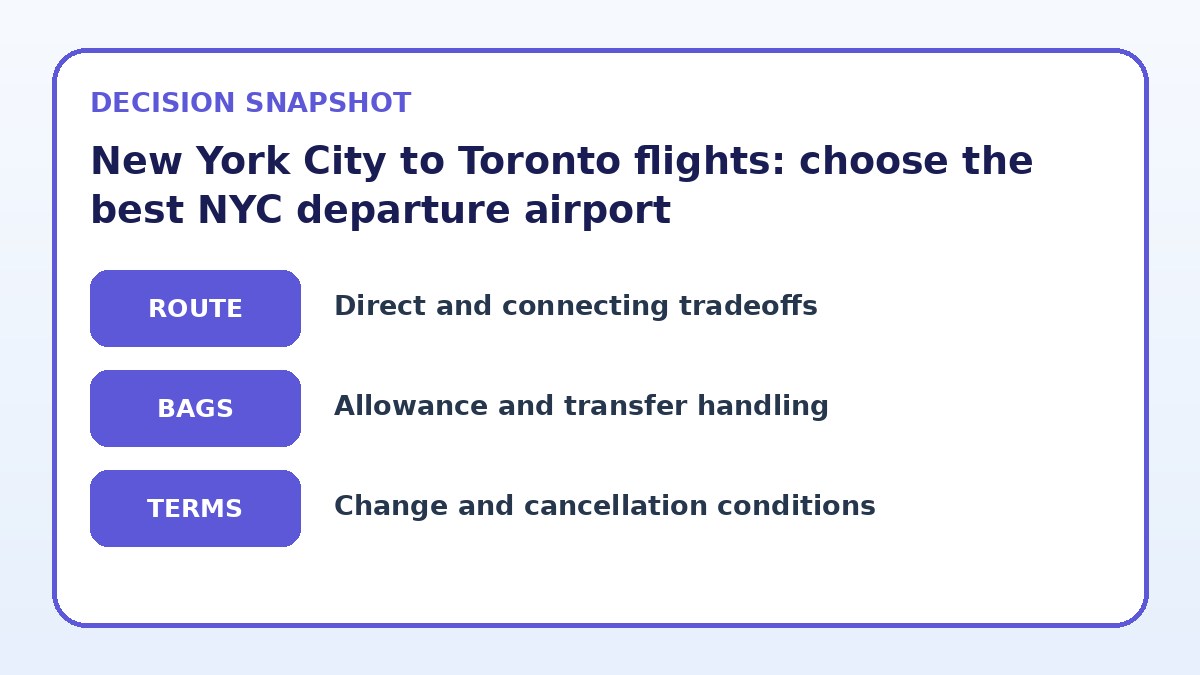
Routing: direct vs. connecting and which NYC airport minimizes transfers
When you compare New York City to Toronto flights, begin by asking whether direct service is available for your dates from each NYC airport and how often it runs. A direct nonstop usually saves both time and the hassle of re-clearing security or changing terminals. However, some departure airports may only offer connecting itineraries for specific carriers or times, so check whether a one-stop option at a particular airport actually adds meaningful time or simply changes terminals within the same airport complex.
For first-time visitors, the airport that keeps you on a nonstop route from curb to baggage claim will feel easier to manage. But if nonstop schedules are infrequent or significantly more expensive, a short, single connection with a reliable minimum connection time can be a reasonable compromise. Compare total door-to-door travel time, including ground transfer to the NYC airport, possible connection windows, and immigration/customs time upon arrival in Toronto, and prefer the routing that feels simpler for your party and luggage situation.
Baggage and connection risk: what to verify before you book
Checked-bag allowances and handling differ by carrier and fare class; do not assume consistent baggage rules across airports even on the same route. If a connection is involved, verify whether your baggage is checked through to Toronto or must be rechecked during a layover. If you see a lower fare at one NYC airport that requires an interline transfer or re-ticketing, that apparent saving may be negated by added risk: missed connections, lost bags, or the need to re-clear security and customs at an intermediate airport.
First-time travelers should also factor in the physical ease of moving bags between ground transportation and terminals. Some NYC airports have long shuttle rides, multi-terminal transfers, or longer walks to check-in counters. Before finalizing a booking, check the carrier’s baggage policy on the booking page, confirm whether bags are included in the displayed fare, and ensure minimum connection times are realistic for your luggage and mobility needs.
Compare flight-selection strategies
| Flight strategy | Best for | Risk to check |
|---|---|---|
| Choose the closest NYC airport to your lodging | Minimizing door-to-door time and stress for short stays | May have fewer schedule options or slightly higher fares |
| Pick the airport with the most nonstop flights to Toronto | Reducing connection and baggage risk with direct service | Could require longer ground travel to reach that airport |
| Prioritize the lowest headline fare regardless of airport | Travelers on a strict budget willing to accept extra travel steps | Higher chance of connections, stricter fare rules, and longer total travel time |
| Select an airport with better late-evening or early-morning options | Travelers needing specific arrival times in Toronto | May be less convenient from your NYC lodging and have fewer ground-transport choices |
Recheck the complete itinerary
Confirm airports, connection handling, baggage, and change conditions before deciding.

Schedule fit: matching flight times to your NYC arrival and Toronto arrival plans
Practical scheduling means syncing flight times to when you can realistically get to the departure airport and when you need to be in Toronto. If you plan to travel from Manhattan, for example, factor in rush-hour variations and the potential for traffic delays or subway disruptions. Flights that leave from an airport closer to your lodging can reduce stress even if the headline fare is higher; conversely, if you’re staying near an airport with sparser service, you might accept a longer ground transfer to access a greater number of daily flights and time-of-day options.
Also consider arrival timing in Toronto: landing early in the day gives you more options for public transit or car pickup, while late arrivals might require overnight stays or limited ground-transport options. When comparing airports, list a couple of realistic departure times from your location and check which NYC airport offers flights that match those times with comfortable connection buffers and acceptable arrival windows in Toronto.
Flight details to verify
- Write down exact travel dates, full names as on passports, and number of travelers before searching live fares.
- Decide how many checked bags you will take and check each carrier’s baggage allowance on the booking page.
- Compare total door-to-door travel time from your lodging to each NYC airport, not just airborne time.
- Confirm whether a proposed itinerary is nonstop or requires connections and whether bags are checked through.
- Read the fare conditions on the airline’s final booking page: change fees, refundability, and seat assignment rules.
- Check Toronto arrival logistics—immigration, customs, and onward ground transport options for your expected arrival window.
Fare conditions: refundability, change fees, and what to confirm on the booking page
Fare conditions matter more than the headline fare when comparing airports. Lower fares often come with stricter change and cancellation terms, and if you book through a third-party site, the fare rules on the carrier’s own booking page can differ. Before committing, verify the exact change and cancellation policy, any reissue fees, and whether seat selection and checked baggage are included. If your travel plans might change, prioritize fares that offer flexibility even at a modest premium.
When provider-specific facts could change, always review the carrier’s final booking page to confirm all terms: the total price with taxes and fees, baggage allowances, change and cancellation costs, and whether connections are protected by the airline. Trip.com or similar search tools are useful to compare current availability and conditions quickly, but complete your purchase on the provider page you trust and confirm all rules there before you finalize payment.
Flight Guide questions travelers ask
Which New York airport is usually easiest for first-time visitors flying to Toronto?
Ease depends on where you are staying. The most practical airport is typically the one that minimizes your ground travel and the number of steps to the gate. For many visitors, that means choosing whichever NYC airport gives you a nonstop or single-connection itinerary with a realistic departure time and convenient ground transit from your hotel or residence. Before booking, map the ground journey at your planned departure time and confirm whether the available flights are nonstop or involve connections that require baggage recheck or terminal transfers.
How should I evaluate a connecting itinerary from one NYC airport versus a nonstop from another?
Compare total door-to-door time, not just flight time. A connecting itinerary may have a lower fare, but factor in the extra time for the connection, the possibility of delays, and whether your baggage is checked through. Also assess the minimum connection time listed by the airline and whether the connection will be domestic-to-international—some connections require additional steps. If the nonstop saves significant time and reduces uncertainty, it may be worth the fare difference for first-time visitors who prefer simplicity.
What exact items should I verify on the airline’s booking page before I complete a reservation?
On the airline’s final booking page confirm the total price including taxes and fees, the precise baggage allowances for each passenger, change and cancellation policies, and whether seats are reserved or assigned at check-in. Also verify itinerary details—direct or connecting segments and terminal information—plus any visa or travel-document notices specific to Canada. If you used a third-party site to compare options, recheck these items on the carrier’s page because policies or available services can differ between vendors.
Final decision note
For first-time visitors choosing between New York City airports for Toronto travel, the most practical pick is the one that balances total travel time, connection simplicity, and fare conditions for your specific dates and needs. Start by preparing exact travel dates, traveler names, and baggage plans so you can compare real itineraries. Favor nonstops if they save time and complexity; favor a different airport only if the schedule fit or fare flexibility better serves your plans. Finally, always confirm baggage rules, change fees, and connection protections on the carrier’s booking page before paying—use a comparison tool like Trip.com if you wish, but verify everything with the airline at checkout.
Continue planning
Check current options and final conditions
Use the provider page to confirm live availability, the final total, cancellation terms, and every condition that matters to your trip.
This evergreen planning guide was created with AI-assisted drafting and a structured quality review. It does not display live prices, schedules, availability, visa guidance, or provider rankings. Verify current details before booking. Some links are affiliate links; we may earn a commission at no additional cost to you.