
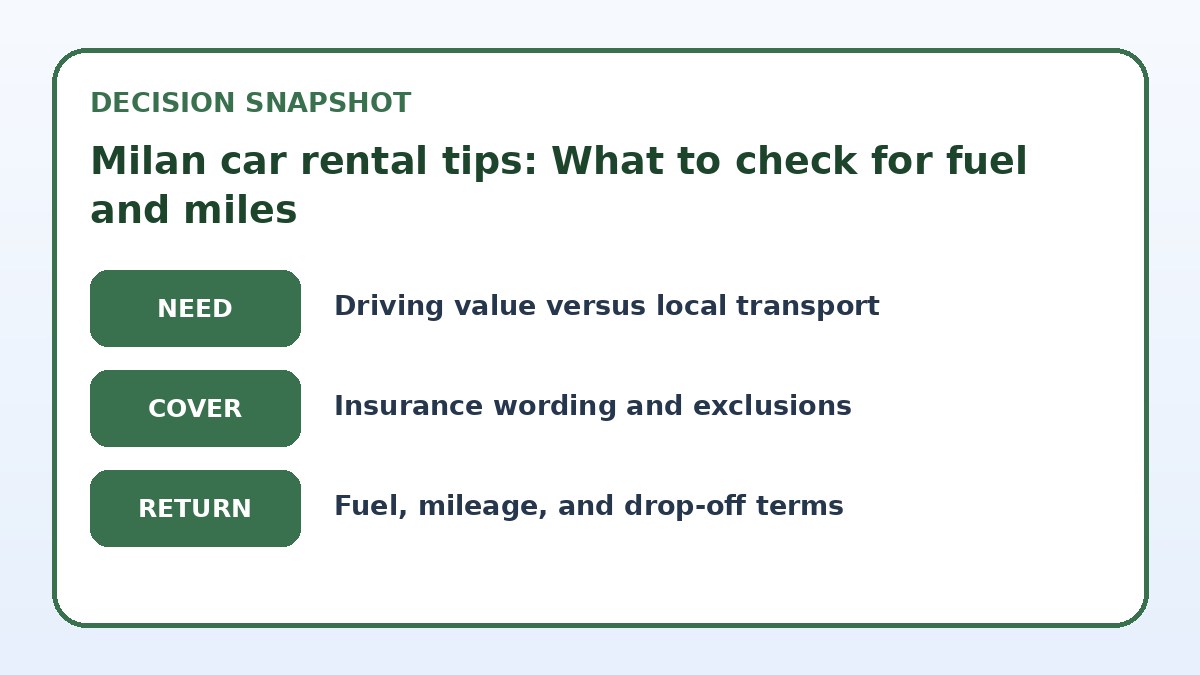
Practical answer first: before you complete a Milan car rental booking for a business trip, confirm the fuel policy, the mileage allowance or per-kilometer charges, and how fuel is handled at return. These three items directly affect expense predictability and the time you’ll need at pick-up or drop-off. Fuel rules determine whether you must refill to a full tank, pay for a pre-purchased tank, or face a refuelling penalty; mileage rules affect whether short city trips or a suburban client visit will incur extra per-km fees. Also check whether the rental agency documents fuel and mileage in your rental contract and how that integrates with your company’s expense reporting. Read the provider’s final booking page and rental agreement carefully — that’s where variable fees and exact wording appear.
See current options before you compare the details
Availability and final conditions change. Open Trip.com now or keep reading for the practical comparison.
Understand common fuel policies and their business trade-offs
Rental companies in Milan typically offer several fuel options: full-to-full, pre-purchase (you pay for a tank in advance), or return-to-full by the company for a fee. Full-to-full is straightforward: you pick up with a full tank and must return it full to avoid refuelling charges. Pre-purchase can be convenient if you want to return the car empty and skip the last refill, but agencies often do not refund unused fuel. Return-to-full eliminates the need to refuel yourself but usually comes with a premium price plus administrative fees.
For business travelers the key decision is between time and cost control. If your schedule is tight—late meetings or early flights—the pre-purchase or company refuel options reduce risk of being late for drop-off. If expense predictability and lower cost matter more, full-to-full combined with refuelling at a local station before return typically minimizes overall spend. Whatever you choose, document the fuel level on pick-up and drop-off with timestamped photos and save receipts to support corporate expense reports and avoid disputes.
Mileage rules: how limits, excess charges, and trip planning interact
Mileage policies vary by car category and rental type. Many standard rentals in Europe include unlimited kilometers for domestic and cross-border travel within certain countries, but premium, luxury, or specialty vehicles may come with daily or total mileage caps. If your Milan itinerary includes trips to nearby cities like Bergamo or lakeside meetings, check whether these trips fall inside the included mileage and whether cross-border travel affects allowance. Exceeding the limit usually results in a per-kilometer surcharge posted on the final rental invoice.
Plan your route and estimate total kilometers before booking: add a buffer for detours and local driving. Use a reliable mapping tool to calculate realistic distances between appointments and factor in urban driving around Milan, where traffic conditions increase odometer readings for short legs. If the quoted mileage seems tight, compare quotes that include unlimited mileage or a higher cap. Remember to verify how the rental company documents odometer readings and whether tolls, congestion charges, and parking are separate from mileage fees and handled through your expense system.
| Approach | Best for | Tradeoff to check |
|---|---|---|
| Full-to-full fuel policy | Cost-conscious travelers who can refuel before return and have flexible time. | Requires an extra stop to refill and careful documentation to avoid refuelling disputes. |
| Pre-purchased fuel | Busy schedules that make a return refill impractical and predictability in time management. | May be more expensive for the actual fuel used and usually non-refundable for unused liters. |
| Company-refuel / return-to-full by provider | Travelers prioritizing convenience and minimal time at drop-off. | Convenience fee and administrative charges often make this the costliest option. |
| Unlimited mileage vs capped mileage | Unlimited: itineraries with multiple city trips; Capped: short city-only travel. | Unlimited protects against overage charges but may come at a higher base rate; capped rates can be cheaper if you stay within limits. |
Ready to check the option that fits your plan?
Use your exact dates and traveler details so the provider page can show the current total and conditions.

Insurance, fuel damage, and refuelling charges to double-check
Insurance terms and fuel-related damage coverage are important but often misunderstood. Collision damage waivers and liability cover the vehicle and third-party claims but typically do not absolve you from fuel-related fees or damage caused by running out of fuel. Some contracts impose penalty charges if the car is returned with less fuel than agreed or if contaminants are introduced. Check the contract language on fuel contamination, refuelling by the rental company, and administrative handling fees to understand potential out-of-pocket exposures.
When booking for business travel, confirm what the provider will require on-site to avoid disputes: the exact fuel policy wording, whether partial refuels are allowed, and how they calculate refuelling charges if you don’t comply. For corporate cards and reimbursements, get itemized invoices from the rental firm that list fuel and administrative charges separately. If the insurer or card provider offers supplemental coverage for fuel or roadside assistance, verify what it actually covers on the booking page before relying on that protection.
Before you book
- Read the provider’s final booking page and rental agreement for exact fuel policy wording and any administrative fees before confirming the reservation.
- Estimate total trip kilometers and compare quotes that offer unlimited mileage versus capped allowances.
- Document pick-up: photograph the fuel gauge, odometer, and car exterior; note agent name and time.
- Refuel before returning for full-to-full contracts and retain the station receipt with liters and timestamp.
- Request an itemized final invoice listing fuel, mileage charges, tolls, and administrative fees before leaving the rental lot.
- Confirm your company’s reimbursement rules for fuel receipts and per-kilometer rates so you can submit expense claims correctly.
Practical checks at pick-up and drop-off to prevent surprises
At pick-up, do a quick but thorough walk-around inspection and record the fuel level and odometer reading. Ask the agent to show the contract clause on fuel and mileage, and request that any pre-existing damage or non-standard fuel level is written on the rental agreement. Take timestamped photos of the dashboard with fuel gauge and odometer visible, plus exterior shots noting any dents or scratches. Save the agent’s name and the rental counter time to document your start point if a dispute arises.
At drop-off, refuel at a nearby station if you agreed to full-to-full—keep the receipt with vendor, date, liters, and price—then return the car during staffed hours if possible so the staff can verify fuel and mileage in person. If you use an unattended return, take the same dashboard photos and keep your final fuel and odometer receipts. Finally, compare the drop-off notes with the contract copy and ask for an itemized final invoice before leaving the lot, or request it by email promptly; this helps reconcile charges with corporate expense policies and avoids later surprises on the credit card statement.
Frequently asked questions
Is full-to-full always the cheapest fuel option when renting a car in Milan?
Full-to-full is often the most cost-effective if you can refill at a reasonably priced station before drop-off, because you pay only for the fuel you use. However, if you lack time or return the car at an unattended hour, pre-purchased fuel or company refuel options offer time savings at a premium. Factors such as price per liter at local stations, whether unused pre-purchased fuel is non-refundable, and administrative fees for company refuels affect the final cost. Always compare the estimated cost difference for your planned mileage and schedule before choosing.
How do I handle mileage charges if I accidentally exceed the rental allowance during business travel?
If you exceed the allowed mileage you’ll typically be charged a per-kilometer excess on the final invoice. To minimize surprises, estimate your total kilometers with a buffer and choose a rate plan with sufficient allowance or unlimited mileage. If you discover you’ll exceed the limit while on the trip, contact the rental company to discuss options—some companies can amend the contract to increase allowance. Keep accurate records of odometer readings and get the excess charge clearly itemized on the final invoice to submit for corporate reimbursement if applicable.
What proof should I collect at pick-up and drop-off to avoid fuel or mileage disputes?
Collect timestamped photographs of the dashboard showing fuel level and odometer at pick-up and drop-off, plus exterior photos of the car condition. Save the agent’s name and the check-out/check-in times, and insist any discrepancies be written on the rental agreement. Keep all fuel receipts with date, station, liters and price. If returning when the desk is closed, email the photos to the rental company and your corporate travel contact right away and request written confirmation of the drop-off readings to reduce the risk of later billing disputes.
Final planning note
For business travel in Milan, checking fuel and mileage rules before you book is a small step with outsized impact on cost control and schedule reliability. Decide whether you value lower cost (usually full-to-full) or convenience (pre-purchase or provider refuel) and match that choice to your itinerary’s mileage needs. Document everything at pick-up and drop-off, keep receipts for reimbursement, and verify the exact language on the rental company’s booking page and contract—that’s where fees and exceptions are stated. When in doubt, choose a rate with generous mileage or clear fuel handling that aligns with your company’s expense policies to avoid surprises on the final invoice.
Continue planning
Check current options and final conditions
Use the provider page to confirm live availability, the final total, cancellation terms, and every condition that matters to your trip.
This evergreen planning guide was created with AI-assisted drafting and a structured quality review. It does not display live prices, schedules, availability, visa guidance, or provider rankings. Verify current details before booking. Some links are affiliate links; we may earn a commission at no additional cost to you.