
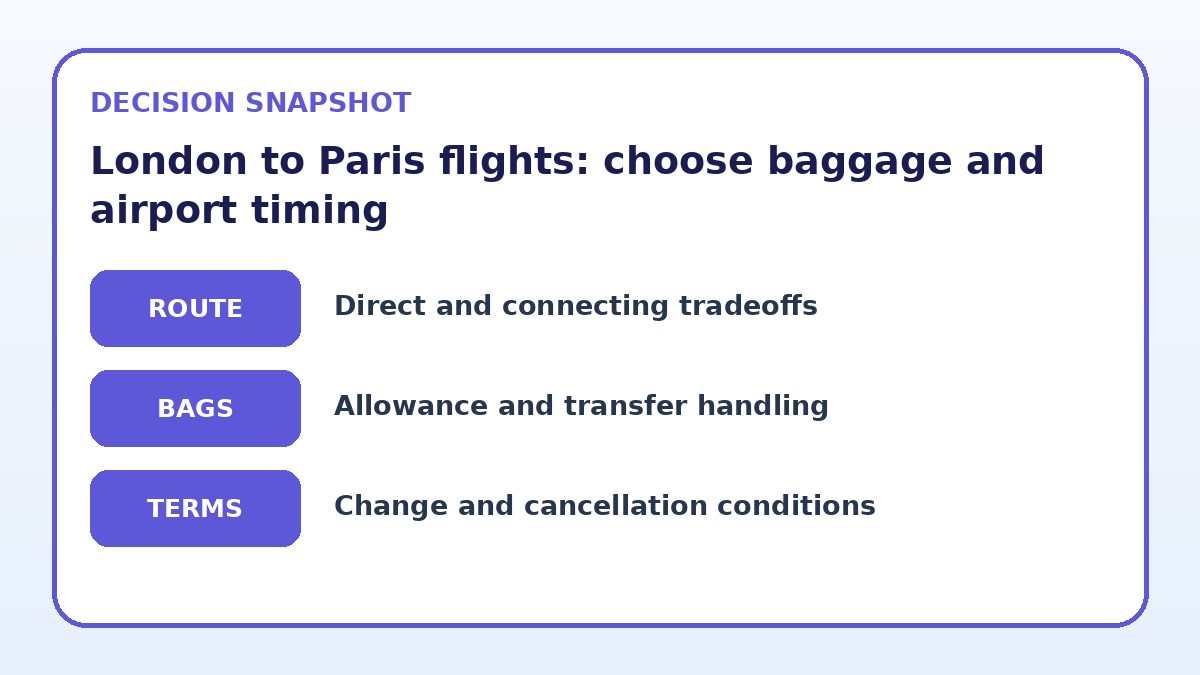
If you’re traveling London to Paris for business, the practical priorities are simple: travel light, choose the right baggage option for your needs, and build airport time buffers that match your chosen route and connection type. Decide early whether a carry-on-only strategy or checked luggage better supports your itinerary—carry-on speeds through airports; checked bags can ease in-city mobility but add time. Next, match airport arrival windows to how you’ll travel (direct flight, connection, or rail/air mix) and to whether you need lounge time, working time, or commute time after arrival. This guide gives a clear starting decision, then walks through tradeoffs—security, checked-bag handling, tight transfers, and last-mile options—so you can pick the approach that keeps you on time for meetings without carrying excess risk.
See current options before you compare the details
Availability and final conditions change. Open Trip.com now or keep reading for the practical comparison.
Choose carry-on versus checked luggage by trip purpose
Start by listing what you absolutely need on the trip: laptop, presentation materials, a change of clothes, chargers, and any documents. For single-meeting or overnight travel, a single carry-on plus a briefcase often covers everything while dramatically reducing time spent at check-in and baggage reclaim. Carry-on lets you skip hold-luggage lines, avoids waiting at the carousel after arrival, and eliminates the risk of your bag getting routed on a later flight. Also consider whether your final location has easy laundry or pressing services—if so, you can pack lighter and rely on same-day services to freshen garments.
Checked baggage becomes preferable when your meeting requires multiple outfits, physical materials, or you prefer not to manage a heavier bag through airports and trains. If you choose to check a bag, pre-pay and select the checked allowance during booking so the fee and tag are handled in advance; this often speeds the drop-off process. Remember that checked luggage adds time at both ends: arrival includes waiting at baggage reclaim and potential delays if bags are misrouted. Factor this into your schedule and keep a compact kit with essentials in your onboard bag in case retrieval is slower than expected.
Build realistic airport timing based on route type
A direct London to Paris flight generally requires different buffers than a multi-leg itinerary. For direct flights, your main variables are check-in, security queues, and any passport control or exit checks. Business travelers who carry only cabin luggage can often arrive closer to departure time, while those checking bags should add time for drop-off. For connecting flights, add significant extra buffer: account for the minimum connection time published by the airports and carriers plus a safety margin to handle late arrivals or slow transfers. When deciding how much extra time to build in, weigh the cost of a missed meeting against the inconvenience of waiting in a lounge.
If your plan mixes rail and air—such as taking the Eurostar or a short flight from a different London airport—compare total door-to-door time including transfers between terminals or stations. Rail-to-air combinations can reduce check-in stress because high-speed trains often deliver you directly into central city locations, but transfers to airports still require planning. Always map the transfer precisely: include walking times between platforms or terminals, luggage handling if you have large bags, and potential peak-hour traffic for taxis or rideshares. Confirm transfer times on provider booking pages and, if helpful, check current schedules on a comparison site like Trip.com for a snapshot of available options.
| Approach | Best for | Tradeoff to check |
|---|---|---|
| Carry-on only | Day trips, single meetings, and quick turnarounds | Limits clothing and physical materials but minimizes airport time and removes baggage-claim risk |
| Checked luggage with pre-paid allowance | Multi-day trips needing multiple outfits or bulky items | Adds drop-off and reclaim time; increases risk if a tight connection is needed |
| Direct flight arrival windows | Simpler logistics and predictable transfers to city center | May cost more or offer fewer schedule choices; still subject to airport delays |
| Indirect/connecting itineraries | Tighter price or routing options and specific carrier preferences | Require larger connection buffers and increase complexity for short business trips |
Ready to check the option that fits your plan?
Use your exact dates and traveler details so the provider page can show the current total and conditions.
Streamline airport processes and reduce variability
Use every available pre-trip tool to shrink time in the airport: mobile check-in, digital boarding passes, and pre-paid baggage tags where offered. Enroll in trusted-traveler gates, fast-track security, or airline business-class services if your employer will cover it and the time savings justify the cost. Keep travel documents and boarding passes in an easily accessible sleeve or phone wallet. Also, have your passport and any arrival forms ready before you reach the counters; repeated searching for documents at security or border control is one of the most common delays business travelers encounter.
Pack to simplify security screening: liquids under 100ml/containers in a transparent bag, laptop easily removable from a sleeve if required, and minimal metal items that trigger additional checks. Wear shoes and outfits that are quick to remove and put back on to speed through checkpoints. If you carry sensitive presentation materials or client information, use secure digital backups and a small lockable pouch for physical documents. Finally, reconfirm check-in counters and security opening times on the airline’s final booking page—airport procedures and counters can change, and you should know where to go before you arrive.
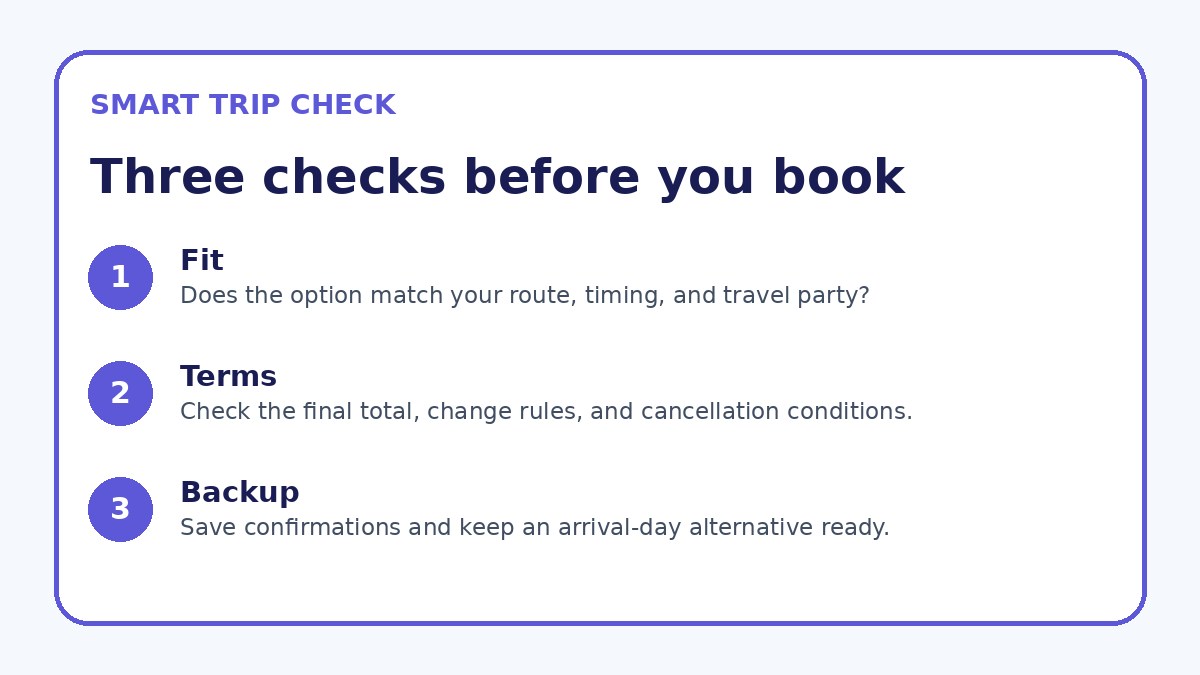
Before you book
- Decide carry-on only or checked bag and purchase the correct baggage allowance when booking.
- Complete mobile check-in and download boarding passes to your phone at the earliest allowed time.
- Pack a compact essentials kit (charger, presentation USB, a fresh shirt) in your carry-on for quick access.
- Leave a 30–60 minute extra buffer beyond airline minimums for direct flights; add at least 60–90 minutes for connections.
- Verify check-in counter opening times, security fast-track availability, and baggage rules on the airline’s final booking page.
- Pre-book ground transport from arrival terminal and note the expected pickup point to save post-landing time.
Plan last-mile and contingency timing in Paris
Once you land in Paris, your workday clock resumes. Decide in advance whether you need immediate ground transport, a quick transfer to a meeting hub, or time in a lounge to work before commuting. Choose arrival airports and flights that place you closest to your meeting location or to an efficient rail connection, and factor typical city transfer times into your plan. If you have a tight schedule, pick flights that arrive earlier in the day to allow cushion for customs, baggage, and transit. Identify a reliable ride option ahead of time and know which terminal or curbside pickup points to use.
Also prepare a contingency plan for delays: a local contact who can reschedule or cover the meeting, an alternative meeting format (call or virtual meet), and a pocket of time in your itinerary that can absorb up to an hour of delay without disrupting critical commitments. If you must retrieve checked luggage to access materials, add extra time in your plan for baggage claim and a buffer before any ground transport. Before finalizing tickets, verify baggage drop-off and arrival procedures on the carrier’s page and on any airport transfer provider pages you’ll rely on.
Frequently asked questions
How much time should I allow at London airports for a direct flight to Paris?
Allow time for check-in or bag drop, security, and any passport control. If you travel with carry-on only and have mobile check-in, arriving 60–75 minutes before departure is often sufficient for many business travelers, but this depends on the terminal and time of day. If you need to check luggage, arrive earlier—typically 90–120 minutes—to allow for queueing at the bag-drop desk. Always check the airline’s stated recommended arrival times and airport advisories on their booking page, and add extra buffer if missing onward commitments would be disruptive.
Can I rely on business lounges to buy extra time for work on arrival?
Lounges can be a productivity boost when you need stable Wi-Fi, quiet, or a place to refresh, but they aren’t a substitute for poor planning. If you plan to use lounge access as contingency time, factor in transit to the lounge, potential entry queues, and opening hours. Confirm lounge access rules with your ticket or card provider before travel. For short turnarounds, prioritize a boarding time and baggage strategy that reduces the need to rely on lounge time as your main buffer.
How do I compare direct flights versus connecting options when timing is critical?
Compare total door-to-door time: include time to reach the departure airport, recommended pre-departure arrival buffer, flight time, potential transfer times, and ground transport at arrival. Direct flights reduce transfer uncertainty but may have less convenient times; connecting itineraries sometimes offer better schedule matches but require larger buffers for missed connections. Evaluate the cost of extra buffer time versus the risk of missing meetings. Also check the carrier’s minimum connection times and the airport layout on the provider’s booking page to assess transfer speed.
Final planning note
Organizing baggage and airport time for London to Paris flights is a practical tradeoff between speed and what you must carry. For tightly scheduled business trips, a well-packed carry-on and mobile check-in substantially reduce airport exposure and the risk of luggage delays. When checked bags are unavoidable, pre-pay allowances and larger buffers protect your schedule. Always plan total door-to-door time—inclusive of transfers, security, and last-mile travel—and verify check-in counters, baggage rules, and any lounge access details on the airline or booking page. If you want a quick way to compare current options, Trip.com can show available flights and basic conditions, but confirm key details on the carrier’s final booking page before you commit.
Continue planning
Check current options and final conditions
Use the provider page to confirm live availability, the final total, cancellation terms, and every condition that matters to your trip.
This evergreen planning guide was created with AI-assisted drafting and a structured quality review. It does not display live prices, schedules, availability, visa guidance, or provider rankings. Verify current details before booking. Some links are affiliate links; we may earn a commission at no additional cost to you.