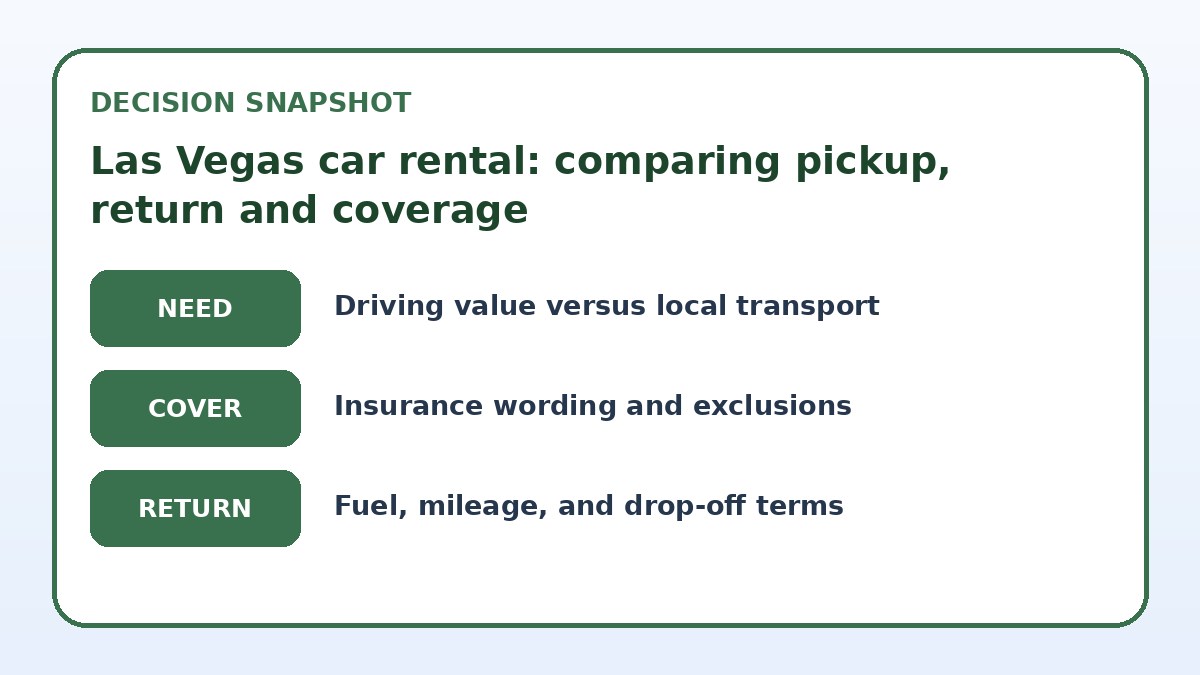
If your trip to Las Vegas is for meetings or events, the practical question is simple: will renting a car save time or add friction? For many business travelers, a rental makes sense only when it shortens consolidated travel between the airport, off-Strip meetings, and regional sites without adding unpredictable handoffs. The main friction points are pickup and return logistics at Harry Reid International Airport and downtown locations, insurance wording that changes who pays for damages, and time lost for fueling and inspections. This guide gives the bottom-line decision up front, then walks through route value, insurance language to verify, pickup/return friction to expect, and a reliable non-driving fallback. Use these checkpoints during booking and confirm the exact terms on the provider’s final reservation page before you commit.
Route value: when driving improves your business itinerary
Driving pays when your schedule includes multiple stops in different neighborhoods or outside the core Strip loop where rides have long waits or high surge multipliers. If you need early-morning visits to suburban offices, the predictability of a car matters; for evening functions that end late or run past public transit hours, having your own vehicle reduces dependency on third-party availability. Consider how meetings cluster: a single off-Strip client plus a daytime convention is a stronger case for a rental than a sequence of downtown appointments close together.
To quantify value, map each appointment and estimate door-to-door time with and without a car, including pickup and return overhead. Include walking to a rental counter or waiting for airport shuttles, and compare that to typical rideshare wait times at your locations. Don’t forget parking—many hotels and venues charge for short-term parking by the hour. If driving adds more than 20–30 minutes per leg after these factors, a rental likely doesn’t improve an efficiency-focused business schedule.
Decide whether driving earns its place
| Mobility strategy | Best for | Cost or friction to check |
|---|---|---|
| Full rental for entire trip | Travelers needing frequent, flexible regional mobility and multiple off-Strip stops. | Higher pickup/return overhead, parking costs, and potential insurance complexity to verify. |
| Rideshares and taxis | City-center meetings concentrated on the Strip or downtown with unpredictable timing. | Variable cost during peak times and less control for early or late-night regional trips. |
| Short-term car share or one-way rentals | Those who need a car only for a portion of the trip without full-day commitment. | Availability can be inconsistent; may still require pickup and return time and location planning. |
| Hotel/event-hosted or pre-booked car service | High-stakes meetings where reliability and corporate billing are priorities. | Less flexibility for ad-hoc stops and often higher per-trip cost than self-driving. |
Check live rental choices only after the route test
Use the exact driver, dates, pickup point, and return plan to compare current conditions.
Insurance wording: what to verify before you accept coverage
Insurance on the rental contract is where surprises occur. Before choosing collision damage waivers (CDW/LDW), check three documents: your employer’s corporate rental policy, the payment card’s rental coverage terms, and the rental company’s contract exclusions. Key phrases to seek are 'primary' versus 'secondary' coverage, which dictates whether the rental company or your card handles claims first, and explicit exclusions for roadside assistance, undercarriage damage, tires, windshield, and off-road use. If your corporate policy covers rentals but only when used for business, confirm whether you must register the rental under a corporate account or provide prior authorization.
On the provider’s final booking page, verify deductible amounts, the process for reporting damage, and whether signing the waiver removes the card’s protections. Also confirm if there are geographic restrictions—for example, taking the vehicle into neighboring states or on unpaved routes—and any penalties for late returns. If anything is ambiguous, call the rental firm and request a written clarification emailed to you so the terms are clear before you drive away.
Compare the full rental conditions
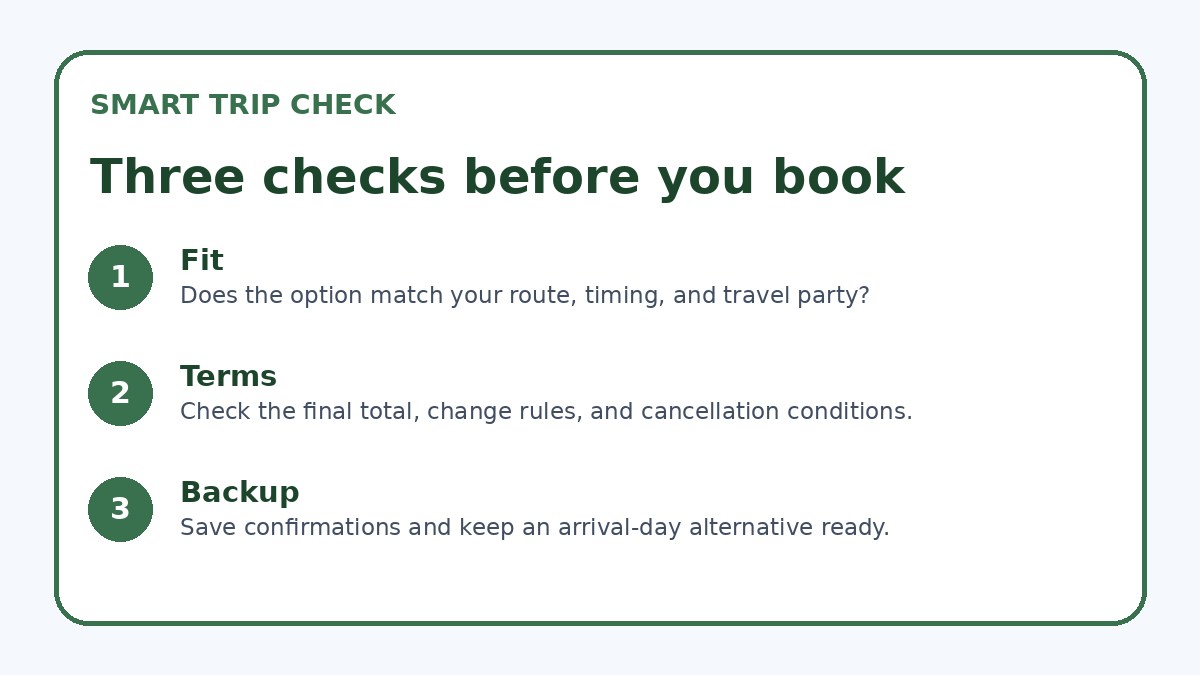
Confirm insurance wording, exclusions, deposit, fuel, mileage, and return terms on the final page.
Pickup and return friction: airport counters, off-airport shuttles, and inspection queues
At Las Vegas airport, pickup friction varies by counter location and shuttle frequency. Some off-airport lots require a shuttle ride and a small waiting window; on-airport counters may be farther from gates than expected. Anticipate busy periods: convention-heavy days, holidays, and event nights raise queues for both check-in and vehicle inspection. When planning pickups around a tight meeting, build a buffer for queue time, paperwork, and the initial walk-around inspection. If you expect to arrive late at night, confirm whether counters close or switch to after-hours instructions.
Return friction often hides in the inspection and key-drop process. Many companies require you to park in a designated lot for an agent inspection, which can add time if there’s a queue. Self-service return and key-drop options speed the process but leave you responsible for photographic proof of the car’s condition; use your phone to photograph mileage, fuel level, and any preexisting marks. On the final booking page, check whether the provider charges late-return grace periods, after-hours drop fees, or needs fuel level evidence to avoid refueling penalties.
Car rental terms to verify
- Map each appointment and estimate door-to-door time with and without a rental, including expected pickup and return overhead.
- Confirm your corporate rental policy and the payment card’s rental coverage; request written confirmation of primary or secondary status.
- On the provider’s booking page, read the fuel policy, mileage limits, deductible amounts, and any geographical restrictions.
- Ask the rental firm for the exact pickup location at the airport and typical shuttle/walk times; record after-hours procedures if arrival is late.
- Photograph the vehicle’s condition, mileage, and fuel level at pickup and again at return; keep timestamps and agent names if inspected.
- Compare total expected costs including parking, tolls, inspection time, and potential after-hours fees before committing to a full-day rental.
Non-driving fallback: practical alternatives for business travelers
When a rental isn’t clearly advantageous, build a fallback plan combining rideshares, airport shuttles, and hotel or event-host transport. Rideshares are efficient for point-to-point trips on the Strip or short runs downtown, and many hotels offer shuttle service to the convention center or airport that can be scheduled in advance. For predictable recurring trips—daily commutes between a hotel and a single meeting location—arrange a standing rideshare pick-up window or ask a venue to recommend a reliable car service with corporate billing.
Also consider short-term car shares or on-demand rentals that let you grab a vehicle only for the legs that need flexibility, avoiding full-day pickup/return overhead. If you rely on rideshares, pre-load payment and set default pickup points that are easy for drivers to find. Finally, keep a printed or digital contact list for transportation alternatives and check real-time availability on a comparison site such as Trip.com before your trip, then confirm the provider’s final terms on their booking page.
Car Rental & Road Trip questions travelers ask
Will my corporate insurance cover a rental car in Las Vegas, or do I need the rental company’s CDW?
Corporate coverage varies widely. Start by asking your company travel or risk manager for the corporate rental policy and whether coverage applies for business use in Nevada. Then check your company’s requirements about signing waivers and whether your payment card must be used for the rental to trigger coverage. If the policy is ambiguous about deductibles or specific exclusions (glass, tires, off-road damage), call the rental company’s booking line for clarification and get the exact waiver wording to compare. Always confirm these details on the final reservation page before pickup.
How much extra time should I budget for pickup and return at Las Vegas airport during a convention?
Allocate extra buffer time on top of standard travel estimates during conventions: allow at least 30–60 minutes for pickup if counters are off-airport or queues form, and plan 20–40 minutes for return if an agent inspection is required. If the provider offers self-service return, confirm whether you must wait for verification or can use a key drop. These windows depend on shuttle frequency, counter staffing, and traffic between terminals and lots, so verify the provider’s estimated pickup and return times on the booking page and factor them into your meeting schedule.
Can I avoid refueling or inspection fees when returning the car late at night?
Some companies accept after-hours returns without inspection if you follow their documented procedure, but you remain responsible for fuel level and vehicle condition. Before you return, confirm the after-hours process on the rental agreement page: where to park, whether to use a key drop, and whether photos suffice as proof. Photograph the fuel gauge and car condition with timestamps, and keep a copy of the drop-off location or agent confirmation email. If the final booking page lists after-hours fees or penalties for missing an inspection window, weigh those costs against extending the rental until an agent is available.
Final decision note
For business travelers, the decision to rent in Las Vegas should hinge on whether the car saves measurable time and uncertainty versus reliable alternatives. If your schedule has multiple off-Strip stops, regional errands, or early starts that rideshares won’t cover predictably, a rental often wins. If meetings cluster on the Strip or downtown, or if pickup/return time would erode a tight agenda, choose a rideshare, hotel shuttle, or pre-booked car service instead. Before you book, confirm insurance roles and exclusions, exact pickup and return locations and procedures, fuel and mileage rules, and any after-hours fees on the provider’s final reservation page. Use the checklist above to ensure you’ve covered practical details and keep a non-driving fallback ready.
Continue planning
Check current options and final conditions
Use the provider page to confirm live availability, the final total, cancellation terms, and every condition that matters to your trip.
This evergreen planning guide was created with AI-assisted drafting and a structured quality review. It does not display live prices, schedules, availability, visa guidance, or provider rankings. Verify current details before booking. Some links are affiliate links; we may earn a commission at no additional cost to you.