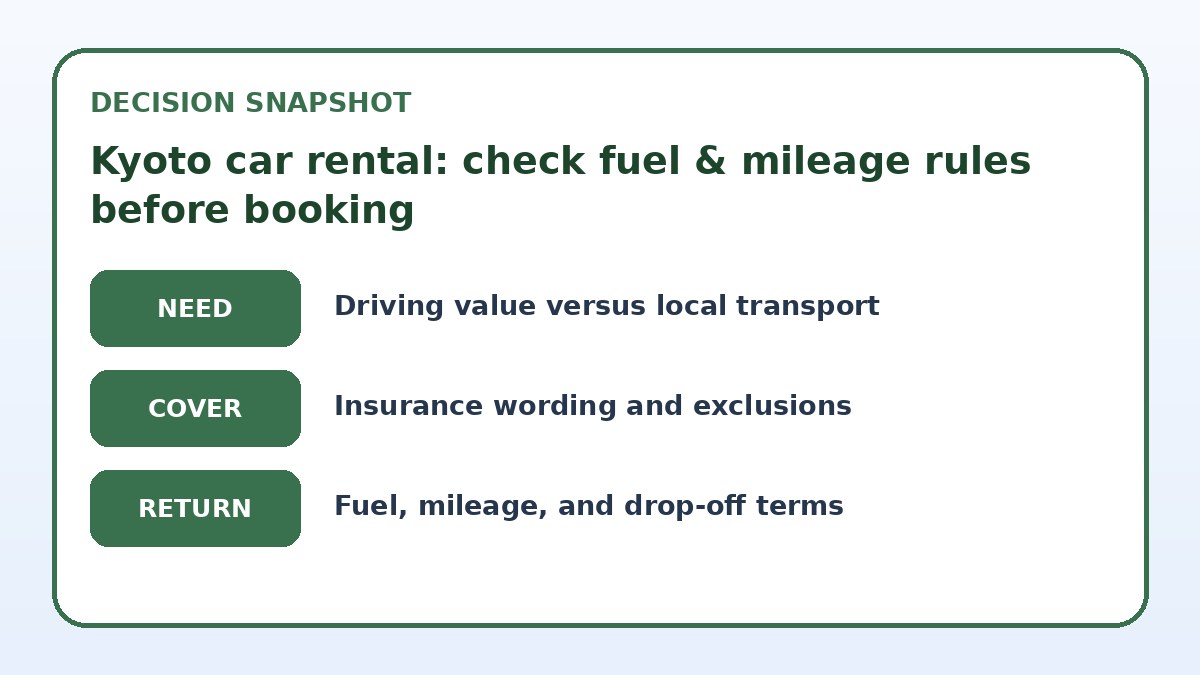
Practical answer: before finalizing a Kyoto car rental for business travel, verify the fuel policy (full-to-full vs charged refuel), the daily and per-rental mileage allowance, and exactly how refuelling charges and odometer disputes are calculated. These three items determine whether you’ll pay predictable costs or risk surprise invoices after the trip. Also confirm insurance, corporate billing options, and whether the rental agreement allows cross-prefecture travel and toll card use. Gather screenshots or PDF copies of the rental terms and the car’s odometer at pickup. If you’re booking through a company portal or a third-party site like Trip.com, use the supplier’s booking page to confirm provider-specific rules, and keep those pages available for expense reconciliation.
See current options before you compare the details
Availability and final conditions change. Open Trip.com now or keep reading for the practical comparison.
Understand Kyoto fuel policy types and how they affect bills
In Kyoto car rental agreements you will typically encounter full-to-full, full-to-empty (prepaid), and provider-refuel options. Full-to-full is the cleanest for business travellers: you pick up the car with a documented fuel level and return it at the same level, paying only for pump fuel you use. Prepaid fuel charges give convenience but can result in overpaying if you don’t exhaust the tank; the company rarely refunds unused litres. Provider-refuel options leave the company refuelling after you return the vehicle and applying administrative fees on top of fuel costs. Which is best depends on the length of the trip, planned daily driving, and your willingness to refuel before return.
To choose, weigh convenience against auditability. Full-to-full requires the simplest proof — photos of the gauge and a timestamp — which fits corporate expense audits. Prepaid fuel may simplify returns for tight schedules but makes precise expense reconciliation harder since the prepaid amount may not match what you actually consumed. If you expect variable driving, full-to-full offers the most defensible accounting. Whatever you select, confirm how the supplier documents fuel level at pickup and what evidence it accepts for disputes; if that detail is not on the booking page, request it before you complete the reservation.
Mileage rules: daily limits, excess fees, and trip planning
Mileage allowances differ between standard leisure rentals and business-oriented contracts; some agreements include a generous per-day allowance while others impose tight kilometre caps. For intercity travel from Kyoto to surrounding prefectures, estimate your route kilometres and compare them to the rental’s included mileage. If your itinerary includes multiple day trips, longer drives to meetings, or offsite visits, pre-purchasing additional kilometres or selecting an unlimited-mileage option (if available) can simplify expense forecasting. Remember that toll roads are common around Kyoto and will add predictable cost but not affect mileage allowances — tolls are separate line items in expense reports.
When comparing options, calculate total expected kilometres and add a buffer for detours, local errands, and GPS inaccuracies. If your company reimburses per-kilometre travel rather than covering rental excesses, verify which kilometre figures the supplier uses for billing: some use the odometer while others may bill by rental-day averages. Keep pickup and drop-off odometer readings in your expense file. If you suspect odometer discrepancies later, an immediate, polite call to the supplier with timestamped photos usually resolves misunderstandings without escalating to the corporate travel manager.
| Approach | Best for | Tradeoff to check |
|---|---|---|
| Full-to-full fuel policy | Travellers who want transparent, auditable fuel costs and are willing to refuel before return. | Requires time to refuel before drop-off and clear photo evidence; not ideal if return schedule is tight. |
| Prepaid/refill-on-return (provider-charged) | Busy itineraries where returning the car quickly is a priority and you accept simplified returns. | Can lead to overpayment or administrative fuel fees and is harder to reconcile against actual usage. |
| Unlimited mileage option | Long-distance or multi-day business trips with unpredictable driving needs. | Often more expensive upfront; compare to per-kilometre charges to see which saves money for your route. |
| Tight-per-day mileage cap with low base rate | Short, local meetings around Kyoto where daily driving is limited and cost-sensitive. | Risk of sizeable per-kilometre excess fees if plans change and longer trips are required. |
Ready to check the option that fits your plan?
Use your exact dates and traveler details so the provider page can show the current total and conditions.
Insurance, corporate billing, and what to verify on the booking page
Insurance options influence how fuel and mileage disputes affect your out-of-pocket exposure. Basic liability is standard, but collision damage waivers, excess reduction, and roadside assistance differ by provider and can change the financial outcome of disputes following a billing discrepancy. For businesses that prefer centralized billing, check whether the supplier supports corporate accounts or third-party chargebacks, and whether insurance choices alter who is billed for ancillary charges like refuelling or excess kilometre fees. Confirm exactly what documentation the supplier needs to waive or reduce disputed charges.
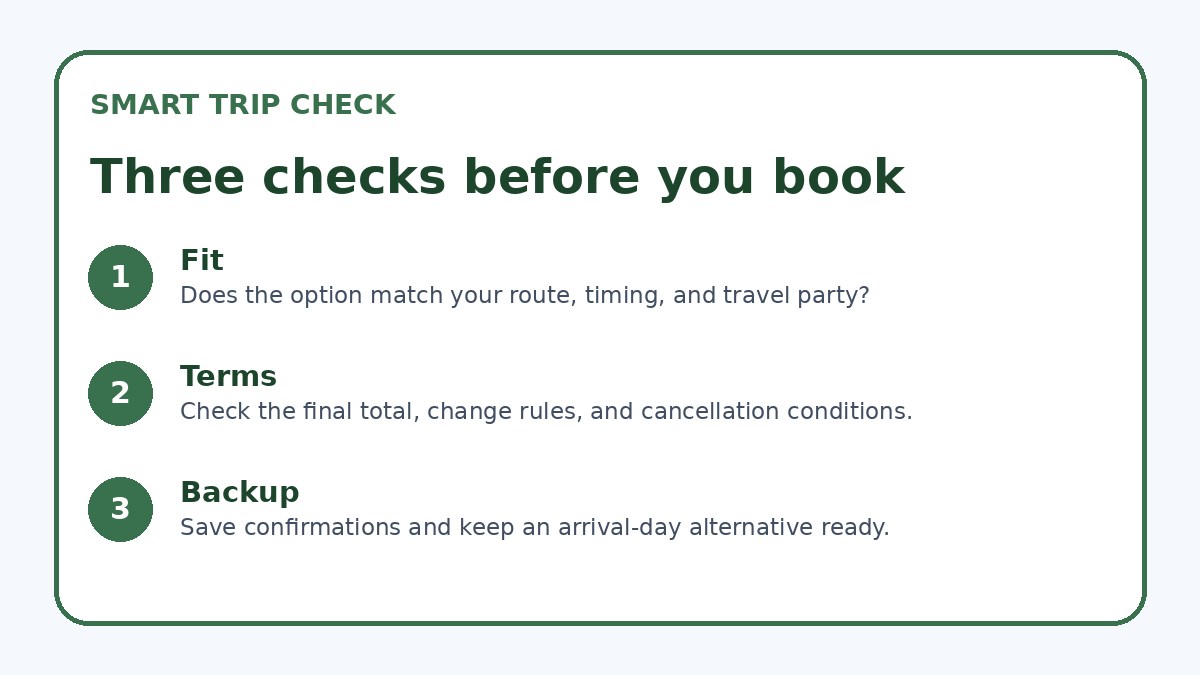
On the booking page or confirmation email, look for explicit language about fuel policy type, per-kilometre rates for excess mileage, insurance deductibles, and whether tolls and administrative refuelling fees are itemized. If any of these points are ambiguous, contact the rental provider and ask them to put the clarified terms in writing or in the reservation notes. Keep a copy of the final booking page and any correspondence: expense auditors and accounts payable teams will want provider-stated terms when processing reimbursements or contesting bills.
Before you book
- Confirm the fuel policy type (full-to-full, prepaid, or provider-refuel) on the supplier’s booking page and save a screenshot of that text.
- Estimate total trip kilometres, add a 10–20% buffer, and compare to the rental’s included mileage or consider buying extra kilometres.
- Photograph the odometer and fuel gauge at pickup with a timestamp and the reservation number visible for expense audit evidence.
- Keep fuel receipts when refuelling and match them to the pickup fuel level photo before returning the car.
- Ask the rental agent to note any discrepancies on the condition report at pickup and to initial any manual corrections in your presence.
- If your company requires corporate billing, confirm account billing, insurance coverage, and who handles tolls and administrative fees on the booking page.
Practical pickup and return steps to avoid disputes
At pickup, inspect and photograph the fuel gauge, odometer reading, and any existing damage — include wide and close-up shots, and a photo showing the rental agreement or key tag with the reservation number in the same frame for context. Request the agent to confirm the recorded fuel level and odometer reading on the printed condition report before driving away. If the agent’s printed record disagrees with your photos, ask them to correct it. For company trips, keep a digital folder with those photos, the printed rental conditions, and the booking page; this package is your first-line evidence in any billing dispute.
Before returning the vehicle, top up the fuel level to match pickup if you chose full-to-full, and keep the fuel station receipt. Arrive at the drop-off station with time-stamped photos showing the odometer and fuel level. If the supplier performs a post-return inspection without you present, request a time-stamped inspection report or a photo from the agent. If charges appear on your corporate card that you didn’t expect, compare them to your returns documentation immediately and escalate to the supplier with the evidence. If necessary, involve your travel manager or accounts payable to prevent duplicate or incorrect billing.
Frequently asked questions
How do I prove the fuel level and odometer reading if the rental company charges me after return?
The strongest evidence is time-stamped photos taken at pickup and drop-off showing the odometer and fuel gauge, ideally with the reservation number or key tag in frame. Keep fuel receipts and the printed or digital rental condition report. If the company posts a charge you disagree with, compare their inspection report to your photos and receipts and raise a dispute immediately with the supplier, attaching your documentation. If the booking was through a third-party site, include screenshots of the supplier’s booking page terms; Trip.com can be used to compare options but verify final terms on the supplier’s page.
Should I prepay fuel to save time when I must return the car quickly?
Prepaying is convenient when time is the priority, but it can be less economical because you may pay for unused fuel with limited refund options. For short returns with tight schedules, prepaid fuel reduces stress and avoids a last-minute station visit, but keep in mind that corporations auditing expenses may question the reconciliation. If you choose prepaid, document the decision and keep the return receipt or confirmation; if expense control is the priority, full-to-full with a quick local refuel before drop-off usually yields more accurate accounting.
What should I verify about mileage if my Kyoto trip includes prefecture-to-prefecture meetings?
Estimate your full itinerary kilometres including round-trips and likely detours. Check whether the rental includes a daily mileage allowance or unlimited kilometres, and find the exact excess-per-kilometre rate on the booking page. If your route crosses prefectural boundaries frequently, unlimited mileage or a high included kilometre package often prevents surprise fees. Confirm whether the supplier bills by odometer or by a per-day average and keep your odometer photos at pickup and drop-off to support a correct charge.
Final planning note
When renting a car in Kyoto for business travel, the clearest way to avoid unexpected bills is to confirm fuel policy, mileage limits, and insurance deductibles before you book. Full-to-full fuel policies paired with photos and fuel receipts give the most defensible record for corporate expense processes; prepaid options save time but complicate reconciliation. Calculate expected kilometres and decide whether pre-purchased kilometres or unlimited mileage makes financial sense for your itinerary. Finally, always save the rental booking page, photographed odometer and fuel-level evidence, and any written confirmations from the provider — those items are what resolves disputes quickly with accounts payable or the rental company.
Continue planning
Check current options and final conditions
Use the provider page to confirm live availability, the final total, cancellation terms, and every condition that matters to your trip.
This evergreen planning guide was created with AI-assisted drafting and a structured quality review. It does not display live prices, schedules, availability, visa guidance, or provider rankings. Verify current details before booking. Some links are affiliate links; we may earn a commission at no additional cost to you.