For most solo travelers, the first question is simple: will renting a car in Kuala Lumpur reduce stress or add friction? In the city center and on familiar routes, the answer is usually no — KL has dense traffic, paid parking, and good public transport for many visitor needs. But if your plan includes early-morning departures to the Cameron Highlands, flexible stops along the west coast, or day trips to Taman Negara where transit options are limited, a car can be liberating. This article gives the practical decision up front, then walks through pickup and return friction, insurance wording to read carefully, route value for common daytrip options, and a realistic non-driving fallback. Follow the checklist and verify the specific pickup/return policies on the booking page before confirming a reservation.
Deciding whether to drive — route value for solo travelers
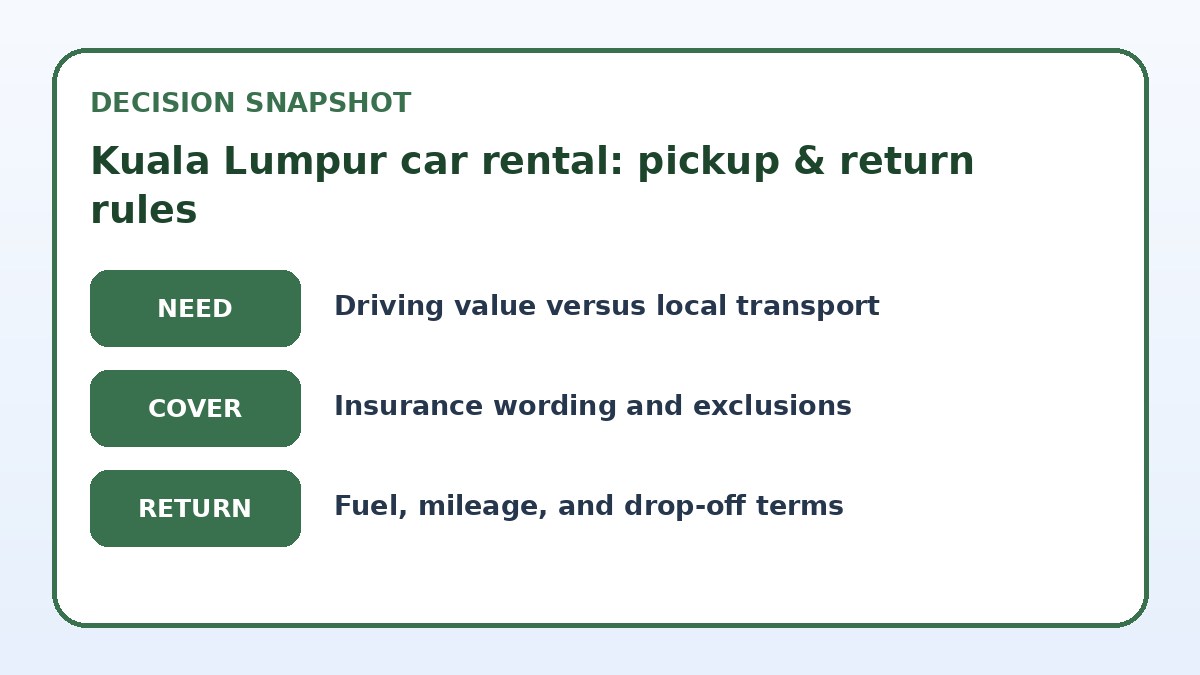
Start by mapping your core itinerary and labeling each day as 'urban', 'regional', or 'rural'. Kuala Lumpur city-center days—visiting KLCC, Bukit Bintang, museum circuits, and nearby suburbs—are usually better done by ride-hailing or transit because traffic, parking costs, and one-way street systems eat time. Regional days, such as heading north to the Cameron Highlands, west toward Port Dickson, or east for longer rainforest routes, are where a car offers clear time savings and flexibility for independent stops.
Assess travel time versus transit frequency: if a daytrip requires multiple connections, early departures, or destinations with sparse taxis, a car increases control. Also evaluate parking availability at each stop; tourist sites sometimes have paid lots, while dense shopping and dining areas may restrict long-term parking. For solo travelers concerned about fatigue, factor in driver-only responsibility — longer drives reduce sightseeing energy and increase safety risk, so plan realistic driving segments and consider splitting long transfers into two days.
Decide whether driving earns its place
| Mobility strategy | Best for | Cost or friction to check |
|---|---|---|
| Rent a car for entire trip | Travelers prioritizing freedom for multiple regional daytrips and flexible timing. | Higher parking, fuel, and stress from urban driving; more pickup/return paperwork and deposit holds. |
| Rent a car for selected legs only | Solo travelers who need a car for specific daytrips but want city days without driving. | More complex logistics: extra pickups/returns and potential one-way fees between locations. |
| Public transit and ride-hailing | Visitors staying mainly within Klang Valley or focusing on urban sightseeing. | Less flexibility for remote sites and reliance on schedules or availability during off-hours. |
| Coach/tour-based transfers | Travelers wanting guided or scheduled access to regional attractions without driving. | Fixed schedules, limited stops, and less privacy compared with self-driving. |
Check live rental choices only after the route test
Use the exact driver, dates, pickup point, and return plan to compare current conditions.
Insurance and liability — what words to check on the booking page
Insurance descriptions often use terms that matter: collision damage waiver (CDW) usually reduces your financial exposure but rarely removes it entirely; excess or deductible defines the out-of-pocket maximum you’ll pay after a claim. Look for explicit statements about single-driver coverage, named additional drivers, and whether the policy covers third-party liability. Pay attention to exclusions: off-road use, driving under influence, or using unpaved logging tracks can void coverage.
Also confirm whether roadside assistance is included and what response times or limits exist. If a supplier offers third-party insurance add-ons or super-CDW products, read the conditions on the provider’s final booking page: note whether the add-on is insurance or a damage waiver from the rental company, whether it replaces the excess, and any required local police reporting procedures after an incident.
Compare the full rental conditions
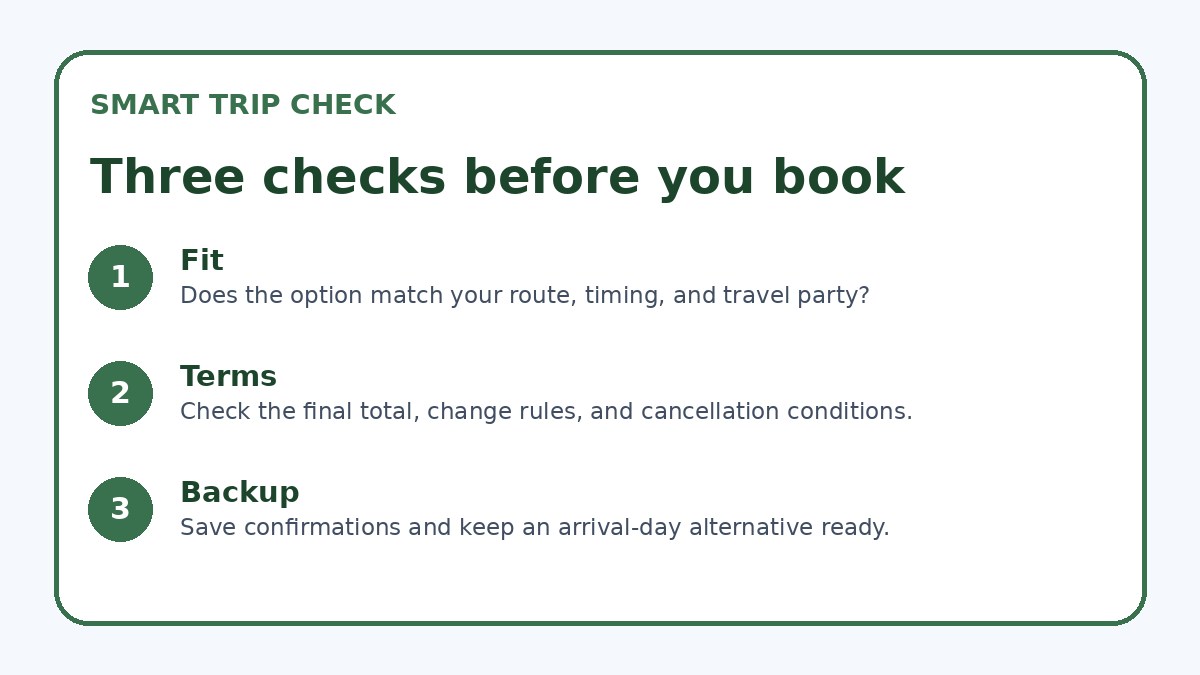
Confirm insurance wording, exclusions, deposit, fuel, mileage, and return terms on the final page.
Pickup and return friction — common pain points and how to avoid them
Pickup friction for solo travelers frequently takes the form of wait time, unexpected holds on your card, and unclear vehicle inspection processes. Confirm opening hours for the pickup location, especially if you arrive late at night; many airport counters are 24/7 but third-party locations are not. Ask whether the supplier requires a physical credit card imprint or preauthorization and how large the deposit hold will be. Request a walk-around inspection checklist and take time-stamped photos or video of existing damage — this step reduces the risk of being charged for preexisting scratches.
Return issues commonly arise from fuel policy misunderstandings, after-hours drop-off fees, and local taxes or airport surcharges. Verify whether the car must be returned with a full tank, whether refueling service charges apply, and if returning at a different location incurs one-way fees. If you may be late, confirm the grace period and the penalty rate per hour or day. For airport returns, check whether you must park in a designated rental return area to avoid towing or fines, and keep evidence of the return time.
Car rental terms to verify
- Confirm pickup and return location hours and whether after-hours drop-off is allowed at your chosen branch.
- Verify the required deposit type and amount, and whether debit cards are accepted or credit card preauthorization is mandatory.
- Read the fuel policy carefully: determine required return fuel level, refueling charges, and receipts rules.
- Check insurance wording on the provider’s final booking page for excess amounts, named drivers, and excluded road types.
- Inspect the vehicle with the agent, take time-stamped photos of all sides and the interior, and save inspection notes or a checklist copy.
- Note the supplier’s late-return grace period and penalty rates, and record the return time and confirmation number at drop-off.
Fallbacks if you choose not to drive — realistic non-driving options
Kuala Lumpur’s transport ecosystem gives solo travelers good non-driving alternatives. The integrated rail network (MRT, LRT, KTM Komuter) covers most central and suburban corridors efficiently for daytime sightseeing. Ride-hailing apps and taxis are convenient for late nights or when you want direct point-to-point travel; compare estimated fares and wait times to a car rental day rate when deciding. For regional trips, consider coach services to major hubs and local tours that handle transfers and guiding — these remove driving responsibility and simplify logistics.
If you plan multi-destination exploration but prefer not to drive, mix modes: rent a car for a single critical leg and use public transport for city days, or book day tours for remote natural areas where public transit is sparse. When relying on non-driving options, prioritize accommodations near rail or major bus terminals to minimize first-mile friction. Also check luggage limits for long-distance buses and whether ride-hailing is readily available at your arrival point before skipping a rental.
Car Rental & Road Trip questions travelers ask
Do I need an international driving permit to rent a car in Kuala Lumpur?
Requirements vary by rental company and your home country’s license. Some suppliers accept foreign full driving licenses in English while others ask for an International Driving Permit (IDP) alongside your license. Before booking, check the provider’s final booking page for exactly which documents they require for primary drivers, and confirm whether photocopies are acceptable or the documents must be originals. Keep digital and physical copies of all identification and the booking confirmation when you pick up the vehicle.
How strict are fuel policies and will I be charged extra for a partially filled tank?
Fuel policies range from full-to-full to pre-purchase options that charge a refuel fee plus administration. If the contract says full-to-full, you must return the car with the same level as pickup or face refueling charges. If pre-purchase fuel is selected, you may not be refunded for leftover fuel. Always check the precise fuel policy language on the supplier’s booking page and keep fuel receipts if you refuel before return to avoid disputes.
What should I do if I find damage after taking the car or when returning it?
If you discover damage at pickup that wasn’t recorded, document it immediately with time-stamped photos and request the agent add it to the inspection checklist before you sign. If new damage appears during or after your rental, report it promptly to the rental company and local authorities if required by the contract. Follow the reporting and claims steps listed on the supplier’s final booking page and keep all incident reports, repair invoices, and correspondence. This documentation protects you from disputes over responsibility.
Final decision note
For solo travelers, the right choice about Kuala Lumpur car rental hinges on itinerary shape and tolerance for pickup/return friction. If your trip centers on KL’s urban attractions, transit and ride-hailing typically reduce hassle and parking costs. If you need flexibility for regional daytrips, a car can be worth the extra paperwork — but only after you verify insurance wording, deposit rules, fuel policy, and after-hours return options on the rental’s booking page. Use the checklist to close gaps at pickup, document the vehicle thoroughly, and consider renting for specific legs rather than the entire trip to balance control with convenience.
Continue planning
Check current options and final conditions
Use the provider page to confirm live availability, the final total, cancellation terms, and every condition that matters to your trip.
This evergreen planning guide was created with AI-assisted drafting and a structured quality review. It does not display live prices, schedules, availability, visa guidance, or provider rankings. Verify current details before booking. Some links are affiliate links; we may earn a commission at no additional cost to you.