If you’re a business traveler monitoring Honolulu travel deals, use price alerts as a planning tool — not a trigger to buy immediately. Set alerts for specific dates, class of service, and hotel categories so the signals you receive are directly comparable. Before you click “buy,” compare the same travel dates, passenger count, refund rules, baggage allowances and transfer times across bundle and separate-booking options. That upfront comparison prevents false savings where a lower headline fare omits essentials that add cost or risk. This article shows what to compare, how to interpret alert signals, and when a packaged offer is actually the cleaner, lower-risk choice for a business trip to Honolulu.
Test package value fairly
| Booking approach | Best for | Tradeoff to check |
|---|---|---|
| Complete packaged bundle (flight+hotel+transfer) | Travelers who value single-point customer service and simplified changes | May hide exclusions or fees; compare final cancellation terms and inclusions before assuming a net saving |
| Flight plus hotel booked separately | Travelers prioritizing flexibility to change one element without affecting the other | Requires more time to compare and manage; potential savings can be offset by separate baggage or transfer fees |
| Low-cost carrier flights with independent hotel | Cost-sensitive travelers willing to trade flexibility and comfort for lower headline fares | Often lower upfront cost but extra charges (bags, seat assignments) and connection risk can add time and expense |
| Corporate negotiated fares and preferred hotels | Business travelers whose employers require policy compliance and streamlined expense processing | May limit options or price competitiveness; verify whether preferred rates include flexible terms that match your schedule |
Check current package and separate options
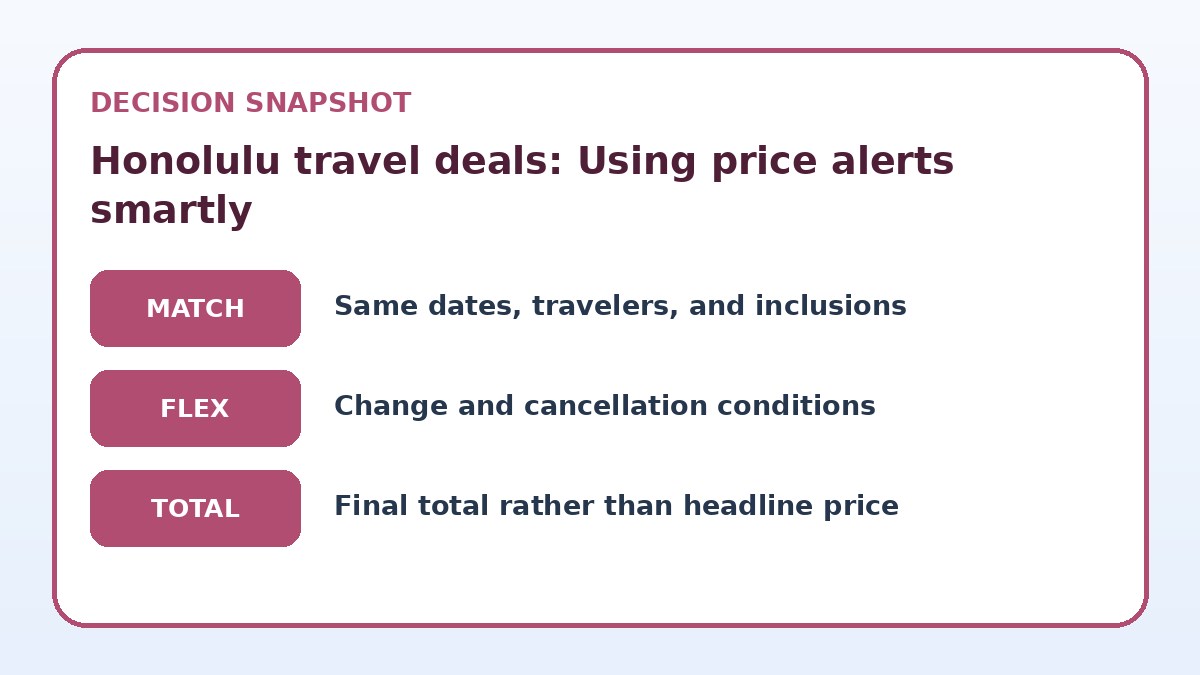
Use identical dates, travelers, room needs, baggage, and flexibility so the comparison stays meaningful.
What to compare before judging a Honolulu package
Start by lining up equivalent items. Match the exact travel dates, number of travelers, itinerary direction (roundtrip or one-way), and cabin or room types. Don’t rely on headline fares or package summaries that omit fees. For flights, check baggage allowances, seat assignment rules, and whether the fare allows changes or refunds. For hotels, verify room type, breakfast inclusion, and any resort or parking fees that might appear at checkout. If the package lists transfers, confirm who operates them and the cancellation policy.
Also compare operational details that affect business trips: flight arrival windows relative to meetings, minimum connection times, and hotel proximity to client sites or conference venues. If the package mixes low-cost carriers with long connections, the small sticker price can cost you time and stress. Finally, standardize your comparisons by creating a checklist so each package and separated booking is evaluated against the same set of conditions and total out-the-door price.
How to set price alerts that reduce impulse buying
Make alerts specific and limited. Create separate alerts for outbound and return legs, for cabin class, and for desired hotel tiers or neighborhoods. Narrow triggers to meaningful thresholds — for example, a change of more than a set percentage of your target fare or a switch from a nonrefundable to a flexible fare class. Use silence windows: mute alerts during busy working hours so you’re not tempted to react emotionally to a push notification during a meeting or after a long day.
Treat alerts as signals, not offers. When one fires, open a comparison worksheet rather than a checkout screen. Note the total cost, change and cancellation terms, transit times and any add-ons required to match what you need for business travel. If the alert represents a minor saving but forces you into a tight connection or a nonrefundable fare, it’s usually better to wait for a more suitable option that preserves flexibility.
Look past the headline total
Compare inclusions and change conditions before deciding whether a package is genuinely useful for this trip.
Deal comparison checklist
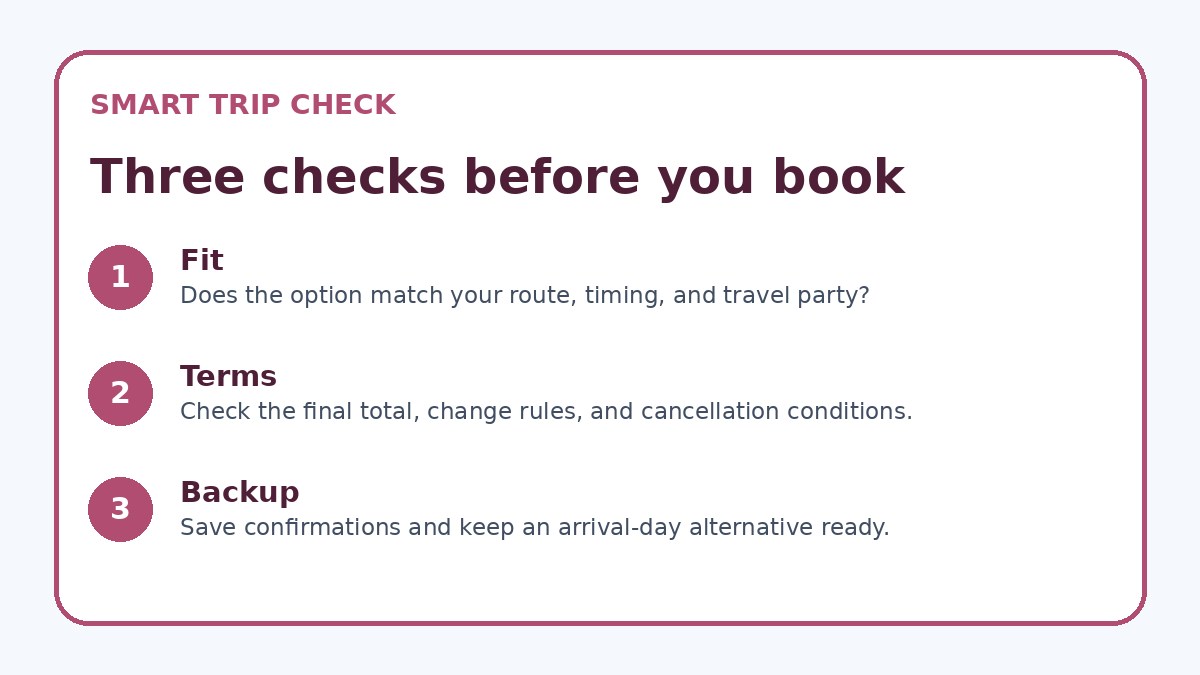
- Match dates, passenger count, and cabin or room type across package and separate options before comparing totals.
- Add mandatory extras (checked bags, seat fees, resort or parking charges) to the headline price to get true cost parity.
- Verify change and cancellation terms on the provider’s final booking page, including refund timelines and penalty amounts.
- Check arrival and departure windows against meeting schedules; avoid itineraries that risk same-day delays for important commitments.
- Confirm who provides on‑trip support (airline, tour operator, or third-party platform) and note contact procedures in case of disruption.
- Align bookings with company travel policy and ensure invoices and supplier details meet expense-reporting requirements.
Package versus separate booking: inclusions and flexibility
For business travelers, the main values of a package are convenience and simplified recourse: booking one supplier for flights, hotel and transfer can make itinerary changes and support easier. But packages vary widely in what they include. Confirm whether the package price covers checked baggage, seat selection, Wi‑Fi, breakfast, and transfers. If any essential item is excluded, compute its cost separately and add it to the package price so you’re comparing apples to apples.
Flexibility is often the deciding factor. Separate bookings can give you the ability to swap hotel nights or change just a flight leg without affecting the rest of the trip. Conversely, a package may offer bundled flexibility or a single-point customer service line that simplifies rebooking after a cancelled flight. Check final terms on the provider’s booking page: cancellation penalties, change fees, refund processing timelines, and who handles disruption claims.
Traveler-specific value: choosing what matters for work trips
Identify what you cannot compromise on: reliable on-time arrival windows, a hotel with a quiet workspace and good internet, or easy airport transfers that avoid long waits. For each alert you receive, score the option against these hard requirements. An attractive headline fare that arrives late in the evening or forces a red-eye connection may be a false economy if it undermines productivity the next day.
Also consider company policy and expense reporting. Some organizations require refundable fares or specific hotel classes; others cap nightly rates. Align your alert parameters and comparisons with those policies. If you’ll need to claim per diem or client billing, make sure the booking terms (invoices, supplier names, and itemized charges) meet expense rules before you commit to an apparently lower-priced bundle.
Travel Deals & Booking Strategy questions travelers ask
How long should I let a price alert run before deciding to book for a short business trip?
For short business trips, run alerts until you see options that meet your nonnegotiables: arrival window, refundable or changeable fare class if required, and a hotel that supports work needs. There’s no fixed time; instead, let the alert horizon cover typical fare volatility for your route — often several weeks to a couple of months. If an alert shows a fare that technically saves money but fails on flexibility or schedule, treat that as a pass and wait for a better match rather than booking solely to lock in a lower number.
If a package looks cheaper, what exact provider pages should I check before booking?
Open the final checkout page for each provider involved: the package vendor’s detailed terms page and the airline’s fare rules and baggage policy for the flights included. Also view the hotel’s booking conditions shown on the supplier page. Verify cancellation and change fees, what constitutes a refundable amount, who handles rebookings after disruptions, and any mandatory local fees. If transfer services are included, confirm the operator and cancellation policy. These final pages show the concrete contract you’ll be bound to if you complete the purchase.
Can I use Trip.com to check packages and separate bookings while using alerts?
Yes — you can use Trip.com as one of several tools to check current availability and compare bundling options, but treat it like any other intermediary. On whichever platform you find a deal, verify final terms directly with the operating provider where possible. Platforms can change inclusions or fees at checkout; confirm baggage rules, change policies, and supplier identities on the provider’s final booking pages before relying on a quoted package for business travel plans.
Final decision note
Price alerts are powerful for Honolulu travel deals if you make them precise and use them as decision triggers rather than instant booking cues. For business travelers, the difference between a true saving and a false bargain often lies in the small print: baggage rules, cancellation penalties, arrival times, and who provides support after disruption. Compare like with like by matching dates, travelers, inclusions and terms; score each alert against your nonnegotiables; and verify the provider’s final booking page before committing. When in doubt, choose the option that preserves schedule certainty and company-policy compliance rather than the lowest headline fare.
Continue planning
Check current options and final conditions
Use the provider page to confirm live availability, the final total, cancellation terms, and every condition that matters to your trip.
This evergreen planning guide was created with AI-assisted drafting and a structured quality review. It does not display live prices, schedules, availability, visa guidance, or provider rankings. Verify current details before booking. Some links are affiliate links; we may earn a commission at no additional cost to you.