For most solo travelers, the practical choice for Florence to Milan transport comes down to how you want the trip to fit your day: take a direct train for simplicity, choose a coach if you prefer lower-stress boarding and single-luggage handling, or combine regional and faster segments when station locations or timing make sense. Start by mapping door-to-door time, not just ride time: factor transfers, luggage handling, last-mile options, and where you'll be arriving and departing in each city. This article gives a clear short answer up front, then walks through the tradeoffs—terminal fit, luggage friction, timing flexibility—and provides a disruption backup plan you can use if your chosen option becomes impractical. Verify schedules, station addresses, baggage rules, and transfer options on the provider’s booking page before you finalize anything; for a quick comparison of current availability, you can also look at Trip.com.
Terminal fit: start and end points matter more than the vehicle
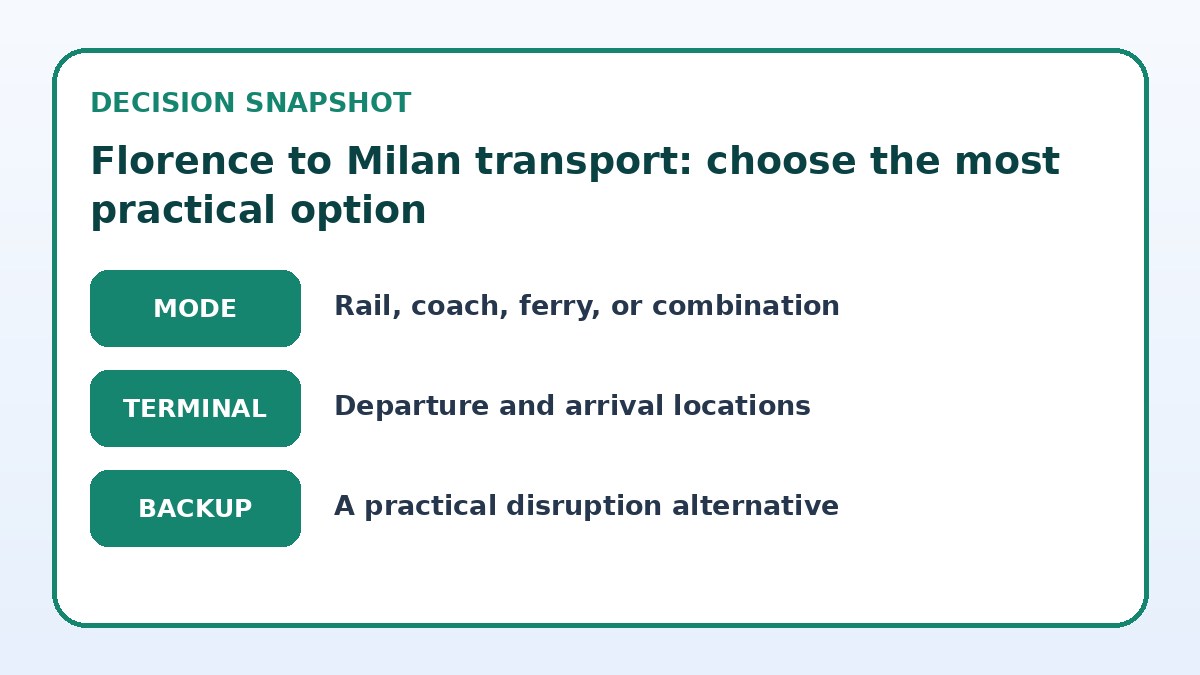
A route’s practicality hinges on where you start in Florence and where you want to end up in Milan. Train stations are typically central, while some long‑distance coaches stop at peripheral hubs or near motorway exits. Before booking, map the precise station or stop addresses against your accommodation and planned activities. A slightly slower option that drops you at a more convenient location can save time and taxi costs. Remember to check how long the local transfer will take at each end, including time to navigate larger stations, find platforms, or walk between coach bays and public transport.
Also think about arrival time of day. A midday drop-off gives many easy public transport choices, while late-night arrivals—especially at peripheral coach stops—may limit safe, quick options for solo travelers. If arriving at a central station, you’ll usually find more frequent, well-lit onward transport and clearer signage. When reviewing provider pages, confirm exact stop names and, if possible, look at photos or maps of the terminal area so you can plan your exit route in advance.
Choose the end-to-end journey plan
| Journey approach | Best for | Friction to check |
|---|---|---|
| Book a direct high-speed train | Solo travelers wanting the simplest door-to-door journey with minimal transfers | May require advance reservations and you should verify station locations, luggage rules, and change policies before booking |
| Choose an intercity coach | Travelers prioritizing low-stress boarding and fewer platform changes | Stops can be peripheral, increasing last-mile time; check exact stop addresses and onboard luggage handling |
| Mix regional and high-speed segments | Those optimizing cost or station convenience when direct options don’t match locations | Requires careful transfer planning and buffer time to avoid missed connections; verify platform transfer times |
| Plan a flexible ticket or travel window | Solo travelers who value changeability and want a backup without route rigidity | Flexibility often means different fare rules; confirm refund/change terms and alternative departure options on the booking page |
Check live intercity options
Look beyond the ride itself and compare terminals, transfers, luggage, and arrival fit.
Luggage and transfer friction: minimize hands-on time
Solo travelers should value options that reduce the number of times they must manage luggage. Direct trains often allow you to keep bags with you or stow them near your seat; coaches may require lifting into a hold, which can be harder if you’re traveling alone or have bulky items. If your trip requires a switch between regional and high-speed services, factor in the time and effort to move bags across platforms or between stations. Consider whether you’ll need assistance getting heavy bags up stairs or through crowded terminals, and whether the carrier lists any luggage size or weight policies that affect your plan.
If minimizing friction is a priority, prioritize departures with a single boarding and minimal platform changes. Where a taxi or rideshare is necessary to bridge between terminal and accommodation, estimate typical wait and ride times at your arrival hour. Always verify luggage allowances and any extra handling fees on the provider’s booking page; if a booking site mentions baggage limits or mandatory seat reservations, confirm them before you finalize to avoid surprises at check-in.
Timing flexibility: scheduling around your day, not a timetable
Decide how flexible you need to be. High-speed trains frequently offer multiple departures and shorter in-vehicle times, which helps when your schedule is tight. Coaches may have fewer departures but sometimes provide later or earlier windows that match cheaper accommodation check-ins or evening plans. When comparing options, look at transfer buffers and how late you can arrive in Milan without missing onward plans. Solo travelers should build breathing room around connections, especially if a missed connection means navigating a different station or a late-night street.
Also weigh refund and change policies when flexibility matters: some tickets are more amendable than others. If your itinerary is fluid, you might prefer options with easier rebooking, even if the base ride is longer. For complex itineraries combining regional connections, allow additional time for the first segment to avoid tight transfers. Always verify the provider’s change and refund terms on their booking page so you know what flexibility you’re actually buying.
Compare the practical alternatives
Use the final page to confirm what is actually offered on your dates and save a workable fallback.
Intercity travel checklist
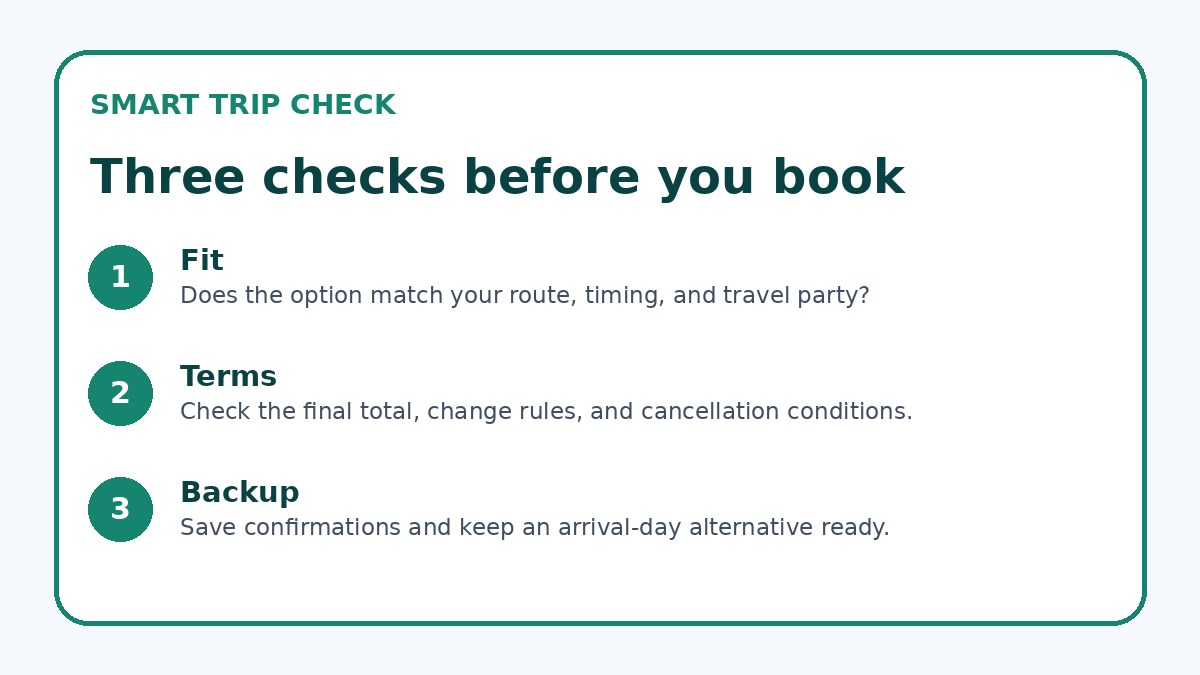
- Map exact station and stop addresses in Florence and Milan and calculate door-to-door travel time including transfers.
- Verify luggage allowances, extra handling rules, and whether seat reservations are required on the provider’s booking page.
- Compare total trip time and number of transfers rather than only comparing in-vehicle durations.
- Confirm refund and change policies for tickets you consider so you can adapt if plans shift.
- Prepare a backup departure within a 1–3 hour window and note taxi companies and typical first-mile options.
- Save offline maps, screenshots of tickets, and terminal photos to your phone in case of poor connectivity.
Disruption backup: a simple, solo-friendly contingency plan
Create a compact backup plan before you travel. Identify an alternative departure within a one- to three-hour window—another train or coach—or a nearby station you could reach by taxi. For solo travelers, prioritize backups that avoid complex multi-step transfers or isolated stops. Keep contact details for local taxi firms and a simple fare estimate for a last-mile lift. If your primary option is a high-speed service, note a slower regional alternative that uses the same terminals; that makes switching carriers simpler and reduces the risk of ending up in a different part of the city.
Also keep basic supplies accessible: a charged phone with offline maps, a small emergency cash amount, and photocopies or screenshots of tickets and station addresses. If a disruption forces an overnight stay, know a few safe neighborhoods near each terminal and how to get there by public transport or taxi. Finally, check the provider’s official booking page for live advisories or disruption policies just before departure—don’t rely on second-hand sources.
Rail & Intercity Transport questions travelers ask
Is it safer for a solo traveler to take a train or a coach from Florence to Milan?
Safety depends more on arrival and departure points, time of day, and personal comfort than on vehicle type. Trains generally arrive at central stations with more frequent onward transport and staff presence, which many solo travelers find convenient. Coaches may be fine during daytime but can stop at peripheral locations that require additional last-mile planning. Assess the stop addresses and how you’ll reach your final destination; choose the option that minimizes late-night transfers and long walks with luggage.
How should I choose between a direct option and one with a transfer?
Compare total door-to-door time, number of transfers, and how heavy or cumbersome your luggage is. A direct service reduces the risk of missed connections and lightens transfer stress; however, a connecting itinerary might drop you closer to your accommodation or offer a cheaper or more convenient departure time. If you select a route with a transfer, build at least a 30–60 minute buffer depending on station size and whether you need to move between different railway terminals.
What should I verify on the provider’s booking page before final payment?
Check exact station or stop names and addresses, luggage allowances and any size or weight limits, seat reservation requirements, and the carrier’s change and refund policy. Confirm departure and arrival times, platform or bay information if listed, and any on-board accessibility details you need. If you have connecting segments, ensure the timetable allows reasonable transfer time. For live availability and schedules you can compare across providers, Trip.com can be used as a quick reference, but always confirm the final details on the official carrier page.
Final decision note
Choosing the most practical Florence to Milan transport for a solo traveler means thinking end-to-end: where the trip starts and finishes, how many times you handle luggage, how flexible you need to be, and what your backup is if something goes wrong. Prioritize options that minimize transfers and leave you with straightforward last-mile choices, and always verify exact stop addresses and ticket terms on the provider’s booking page before you pay. With a clear door-to-door comparison and a simple disruption plan, you’ll reduce stress and make the journey itself a useful part of your travel day.
Continue planning
Check current options and final conditions
Use the provider page to confirm live availability, the final total, cancellation terms, and every condition that matters to your trip.
This evergreen planning guide was created with AI-assisted drafting and a structured quality review. It does not display live prices, schedules, availability, visa guidance, or provider rankings. Verify current details before booking. Some links are affiliate links; we may earn a commission at no additional cost to you.