Practical answer first: for most couples who value spontaneity, travel day backup, and easy seat changes, a moderately flexible ticket or a fully changeable fare is the simplest choice. If you are traveling on a fixed schedule, have tight connections, or want the lowest possible upfront cost and can commit to a specific departure, a non-changeable fixed ticket may work. Couples should weigh the likelihood of late starts, lingering breakfasts, or luggage issues against the premium and rules attached to flexible fares. This guide explains how to compare flexibility, what tradeoffs matter most for two people traveling together, and which booking details to verify on the provider’s final page before you confirm.
See current options before you compare the details
Availability and final conditions change. Open Trip.com now or keep reading for the practical comparison.
How ticket flexibility affects couples' comfort
Flexibility influences how comfortably a couple can travel together when plans shift. If one partner wants to linger for coffee or a museum, flexible tickets let the other person join a later service without buying a second full fare. For couples who want the psychological ease of being able to adapt, flexibility reduces the chance that one person has to wait alone at the station or scramble for a new ticket. It also helps when delays, slow packing, or last-minute itinerary changes occur; the fewer penalties and restrictions, the more you can treat the day as a shared experience rather than two solo timelines.
There are emotional and logistical benefits beyond refundability or change fees. Seat assignment rules and the ability to exchange both tickets as a pair matter when you want to sit together, especially at peak times or on popular departure windows. Couples traveling with luggage or a stroller may prefer the security of reserved seating that can be modified, while those traveling light and sticking to off-peak departures might accept stricter tickets to save money. Think about whether you value guaranteed adjacency and stress-free changes more than a lower upfront fare.
Common flexibility options and what they mean
Ticket flexibility on the Osaka to Kyoto route typically appears in a few forms: fully refundable fares, changeable fares (with or without fees), and non-changeable/nonrefundable tickets. Fully refundable fares let you cancel and get money back within the provider’s allowed window. Changeable fares allow you to alter the date or time for a fee or fare difference; sometimes the penalty is a modest flat fee, other times it’s a percentage. Non-changeable fares are cheapest but carry the greatest risk: if your plans shift, you may need to buy new tickets at current rates.
Beyond the headline label, read the fine print for seat reservation rules, same-day exchange policies, and whether penalties apply per ticket or per booking. For couples, a fee structure that charges per ticket doubles the cost of changes, whereas a bundled booking that allows one-time swaps might be cheaper if both must change. Also check whether transfers between different service types (for example, a limited express versus a local service) are allowed under the same fare class, because that affects how easily you can rebook together on an alternate train.
| Approach | Best for | Tradeoff to check |
|---|---|---|
| Fully refundable fare | Couples who prioritize flexibility and minimal stress | Higher upfront cost and sometimes stricter reservation processes |
| Changeable fare with fees | Couples wanting a balance between cost and adaptability | Moderate fees and possible fare difference charges on rebooking |
| Non-changeable budget fare | Couples confident about exact travel timing and seeking lower cost | Little to no recourse if plans change; potential for extra purchases |
| Mixed strategy (one flexible, one fixed) | Couples hedging risk when one traveler is less certain | Complexity in seating and uneven financial exposure between partners |
Ready to check the option that fits your plan?
Use your exact dates and traveler details so the provider page can show the current total and conditions.
Tradeoffs: cost, convenience, and worst-case scenarios
Choosing between a flexible and a fixed fare requires thinking in probabilities and worst-case outcomes. If your schedule is rigid and both of you are confident you’ll arrive at the station on time, a fixed ticket minimizes upfront cost and often simplifies booking. However, if one of you routinely runs late or you plan activities with variable lengths, the risk of missing a fixed departure can lead to higher total expense and stress. Couples should balance the lower initial price against the potential cost of last-minute replacements, waiting at stations, or paying rebooking penalties.
Another key tradeoff is administrative overhead. Flexible fares mean more freedom but sometimes require extra steps to change or cancel: phone calls, provider websites, or station office visits. If you prefer a low-maintenance trip, choose the ticket type with change procedures you find straightforward. Also consider travel insurance and whether it covers change fees; in some cases, a mix of a cheaper fixed fare plus comprehensive travel insurance can be smarter than a higher flexible fare, depending on your risk tolerance and the exact policy terms.
Before you book
- Decide together how important seat adjacency is and whether you need guaranteed reserved seats for the whole trip.
- Compare change and cancellation fees per ticket and per booking reference before committing to any fare.
- Run two 'what if' scenarios (one partner delayed, one partner cancels) and total the likely costs for each ticket type.
- Confirm on the seller’s final booking page whether changes can be made online or require a station visit or phone call.
- Check whether the chosen fare allows switching between service types (express vs local) without buying new tickets.
- Save or screenshot the booking terms and any customer-service confirmation about change or refund policies.
How to compare options and finalize a couple-friendly booking
Compare options side-by-side: look at the change fee, whether fare differences apply, seat reservation flexibility, and refund windows. For each fare, imagine two scenarios — one partner delays and both partners must travel later, and one partner cancels entirely — and calculate the cost and hassle in each case. Don’t forget to check whether change penalties apply per person or per booking reference; that difference can double the cost for couples. If you use different booking platforms, confirm that seat reservations and exchange policies are honored across channels or only on the original seller’s page.
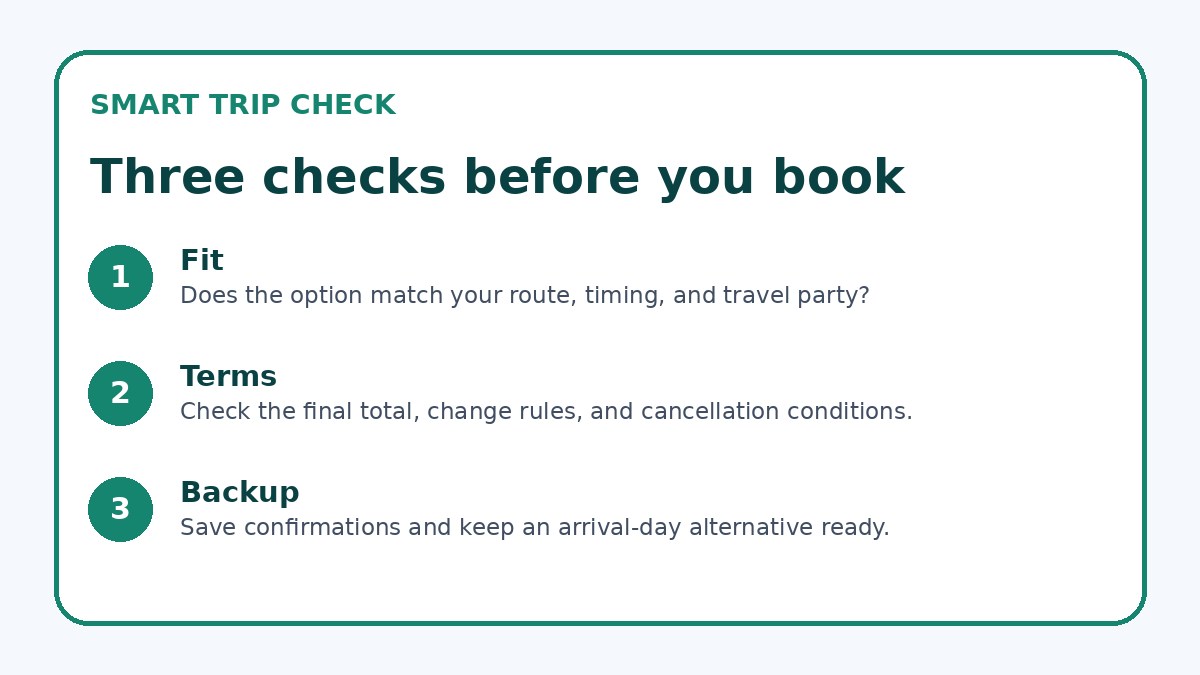
When ready to book, verify three things on the provider’s final page: exact change and cancellation rules, whether seats are guaranteed together at the time of booking, and any timing windows when changes are permitted without penalty. If the provider’s site is unclear, contact customer service and save the response. Trip.com can be used to compare current availability and general terms, but always rely on the official carrier or ticket seller for final booking conditions and to complete the purchase.
Frequently asked questions
If one partner is delayed, can the other take a different train without penalty?
That depends on the fare rules. Some flexible tickets allow each passenger to change independently, while many fixed tickets require the original traveler to be present or penalize each ticket separately. Always read whether changes are allowed per passenger or per booking reference, and verify if a partial rebooking is permitted. If in doubt, contact the ticket seller before travel; if you need day-of flexibility, prioritize fares that explicitly permit independent changes to avoid unexpected charges.
Can couples reserve seats together when buying different ticket types?
Often you can reserve adjacent seats regardless of fare type, but seat assignment policies vary by provider. Some sellers permit seat selection only with certain fare classes or require reservation fees. If one ticket is non-changeable and the other flexible, the system might still let you book adjacent seats initially but could restrict moving both seats together later. To ensure adjacency, book early, confirm seat numbers on the final booking page, and keep both bookings under the same reservation if the provider supports that option.
Is travel insurance a better alternative to buying a flexible ticket for couples?
Insurance can cover many risks such as medical emergencies or certain trip interruptions, but it may not reimburse routine change fees or missed-departure costs caused by lateness. Compare policy terms carefully: look for coverage that includes trip changes and missed departures specifically, and check exclusions and claim procedures. For couples, insurance plus a lower-cost ticket might be economical if the policy covers likely issues; however, if you want immediate on-the-spot changes without claims, a flexible fare will be more convenient than waiting for an insurance reimbursement.
Final planning note
For couples traveling between Osaka and Kyoto, the right ticket choice depends on how much uncertainty you expect and how much you value staying together without hassle. Flexible fares reduce the emotional and logistical friction of last-minute changes, help keep couples seated together, and simplify day-of adjustments, but they cost more up front and sometimes come with their own procedures. Fixed fares can save money for tightly scheduled travelers but carry the risk of doubling change costs for two people. Review change and cancel rules per ticket, confirm seat adjacency, and run simple cost scenarios before you book. Verify final terms on the provider’s booking page and consider Trip.com as one place to compare current availability and conditions before you complete your purchase.
Continue planning
Check current options and final conditions
Use the provider page to confirm live availability, the final total, cancellation terms, and every condition that matters to your trip.
This evergreen planning guide was created with AI-assisted drafting and a structured quality review. It does not display live prices, schedules, availability, visa guidance, or provider rankings. Verify current details before booking. Some links are affiliate links; we may earn a commission at no additional cost to you.