Practical answer first: when booking a Busan car rental as a couple, prioritize (1) whether both partners are listed as permitted drivers, (2) the collision damage waiver (CDW) terms and deductible amount, (3) liability limits that cover third-party injury and property, and (4) any exclusions for young or foreign drivers. Read the insurer’s definition of “driver” and the fine print on cross-border or ferry use. Before you click confirm, check the rental company’s booking page for required documents, driver-age limits, and how to purchase or decline supplemental coverages. This gives you the protection you need without surprises during pickup or after an incident. Below you’ll find how to read common policy phrases, tradeoffs to weigh for couples, and a simple checklist to use at booking and pickup.
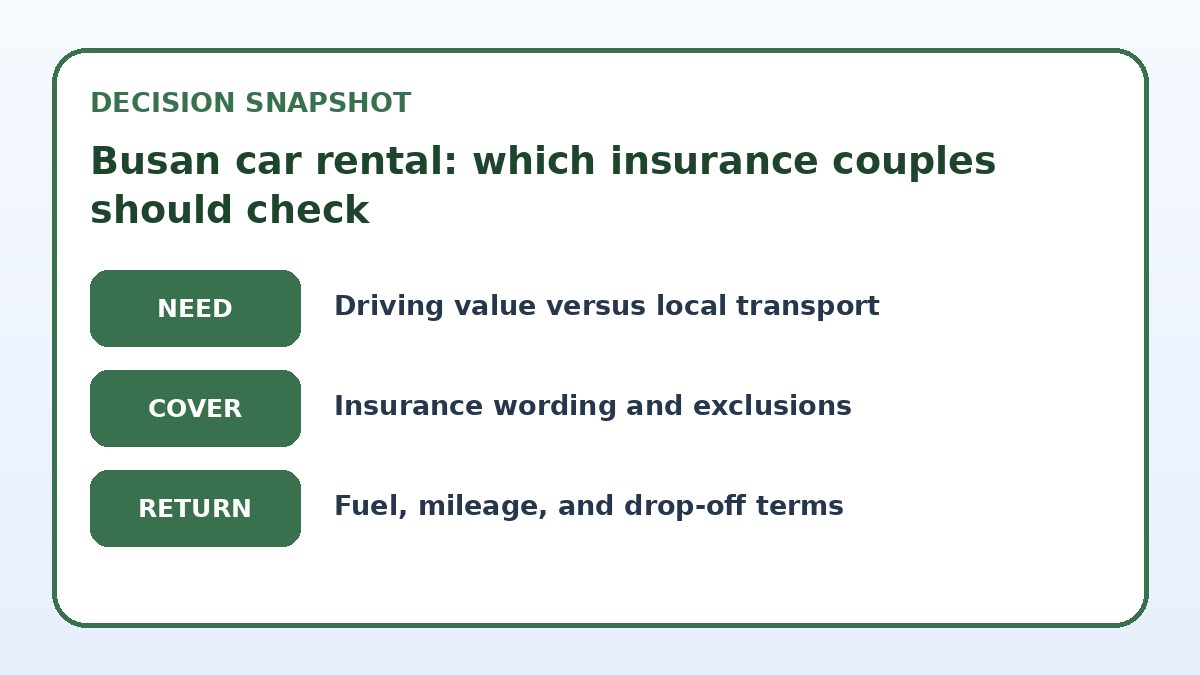
See current options before you compare the details
Availability and final conditions change. Open Trip.com now or keep reading for the practical comparison.
Understanding common insurance terms in plain language
Insurance documents use short phrases that matter. “Collision Damage Waiver (CDW)” or “Loss Damage Waiver (LDW)” usually means the rental company waives some or all financial responsibility for damage to the vehicle, but most policies still list a deductible or “excess” that you must pay first. “Third-party liability” covers injury or property damage you cause to others; it does not pay for your car. “Supplemental Liability Insurance (SLI)” raises that third-party ceiling beyond the basic policy, while “Personal Accident Insurance” covers medical costs for vehicle occupants. Each term determines who pays what after an incident, so focus on the deductible, caps, and conditions spelled out for each item.
Rental contracts also include exclusions and rider clauses that change coverage. Common exclusions for couples include unlisted drivers, driving under the influence, off-road use, or using the car on ferries or certain islands unless the policy explicitly allows it. Definitions matter: a “permitted driver” could require being named on the contract; “immediate family” may not be treated the same as a spouse. When a clause looks vague, ask for a written clarification on the booking page or at pickup — verbal reassurances are useful but harder to resolve in a claim.
What couples should compare before booking
Start with who will drive most of the time. If both partners will share driving duties, ensure the rental price or policy explicitly includes multiple permitted drivers and check whether there is an additional fee per driver. Next, compare deductibles on CDW/LDW: a low deductible raises the base cost but reduces out-of-pocket risk if you hit a parked car or incur scraping damage. Also compare liability limits: South Korean minimums may be modest, and supplemental liability can prevent a local accident from becoming a personal financial burden.
Don’t ignore age and license details. Many Korean rentals treat drivers under a certain age or with short-held foreign licenses as higher risk, and policies might exclude them or require extra cover. If one partner is a foreign license holder or recently converted a license, verify the insurer’s definition of a valid license. Finally, look at theft coverage wording — does it exclude items left in the car? For couples traveling with bags, a theft exclusion could shift responsibility to you after a break-in.
| Approach | Best for | Tradeoff to check |
|---|---|---|
| Decline extra coverage and use personal/credit-card insurance | Couples confident in their card’s rental coverage and willing to file post-trip claims | May save upfront but can leave you responsible at pickup and require time-consuming claims later |
| Buy rental company CDW with high excess | Budget-conscious couples who accept some out-of-pocket risk | Lower daily cost but potentially large immediate payment after any damage |
| Buy rental company CDW with low or zero excess | Couples wanting straightforward, low-stress claims handling | Higher daily rental rate in exchange for minimal post-incident costs |
| Purchase supplemental liability and theft protection | Couples driving in dense urban areas or carrying valuable items | Adds cost but reduces personal financial exposure for third-party claims and theft |
Ready to check the option that fits your plan?
Use your exact dates and traveler details so the provider page can show the current total and conditions.
Tradeoffs: cost versus peace of mind for couples
Lower daily rates often come with higher deductibles and narrower coverage wording. Choosing a no-frills CDW with a large excess might save money but exposes both partners to unexpected out-of-pocket costs after a minor incident. Conversely, opting for the lowest or zero deductible usually increases the daily rate but means you’ll pay less at the scene if you cause or sustain damage. Couples should discuss how comfortable they are splitting an unpredictable bill and whether that money is better spent preemptively on higher coverage.
Another tradeoff involves overseas credit card insurance vs. rental-supplied coverage. Some credit cards include rental damage protection but require you to decline the rental company’s CDW and to pay initial costs and file a claim later — a process that can be time-consuming and stressful while traveling together. Using the rental company’s policy often simplifies claims handling locally. If you plan to rely on third-party credit card coverage, confirm its wording, geographic limits, and whether it covers additional drivers and theft in South Korea.
Before you book
- Confirm both partners are named as permitted drivers on the rental contract before leaving the counter.
- Photograph the vehicle, mileage, and any pre-existing damage on both the exterior and interior at pickup and return.
- Read the CDW/LDW clause to identify the deductible amount, what damages are excluded, and whether theft is covered.
- Verify third-party liability limits and whether supplemental liability insurance is available at booking or only at pickup.
- Ask for written confirmation of any verbal exceptions (extra driver, reduced deductible) and save a copy of the signed contract.
- Check whether your credit card’s rental coverage applies in South Korea and whether it requires declining the rental company’s CDW to be valid.
How to verify policy details at booking and at pickup
On the booking page, read each coverage description line-by-line and look for links to full policy documents. Verify who is defined as a “driver,” whether spouses or partners are automatically included, and whether there are age or license restrictions. If coverage terms use shorthand like “CDW included” without specifying the excess, click through to the policy PDF or request the contract text. If the booking platform lists Trip.com as an availability check option, you can use it to compare current rental conditions, but always confirm the insurer’s own wording on the provider’s final booking page before committing.
At pickup, ask for a copy of the rental agreement and read the insurance section aloud together. Confirm the deductible amount, whether both partners are listed as permitted drivers, and which contact to call for roadside assistance and claims. Photograph the vehicle thoroughly and keep dated photos and the inspection form. If an agent gives a verbal exception (for example, allowing an additional driver for free), ask for it to be added to the written contract. These steps reduce ambiguity if you need to make a claim later.
Frequently asked questions
Do we both have to be listed as drivers on the Busan rental contract?
Not always, but it’s common for rental companies to require each driver to be listed and to charge an extra fee for additional drivers. Some contracts include a spouse or domestic partner automatically, but many do not, so don’t assume inclusion. If both of you plan to drive, ask at booking whether the policy names multiple permitted drivers and whether the insurer’s damage and liability coverages still apply when an additional driver is at the wheel. If an extra fee is waived verbally, request it in writing on the rental agreement.
Can our domestic credit card’s insurance replace the rental company’s CDW?
Possibly, but you must check several specifics. Credit card insurer wording varies: many require you to decline the rental company’s CDW to use card coverage, and they may only cover damage up to certain limits or exclude theft in some countries. Confirm that the card’s policy covers rentals in South Korea, includes additional drivers, and specifies whether it reimburses the full deductible or requires you to pay first and claim later. Always review the card’s fine print and keep phone numbers and claim forms accessible while traveling.
What should we do immediately if we have an accident or the car is vandalized in Busan?
First, ensure everyone’s safety and contact local emergency services if needed. Document the scene: take photos of vehicle damage, the surroundings, license plates, and any other vehicles involved. Exchange contact and insurance details with other parties and collect witness names if possible. Notify the rental company per the contract’s instructions and ask for a written incident report from the police if they attend. Keep copies of all reports and receipts; whether you rely on the rental company’s insurance or a third-party card, complete the provider’s claim processes promptly and keep both partners aligned on who will handle paperwork.
Final planning note
For couples renting a car in Busan, the key to a low-stress trip is reading the insurance wording before you finalize the booking and agreeing together on acceptable risk levels. Decide whether to minimize upfront costs and accept a higher deductible, or pay more for a low-excess policy that simplifies claims and reduces day-of-accident stress. Verify permitted-driver language, deductible amounts, liability limits, and theft exclusions on the provider’s final booking page — and get any verbal concessions written into the contract at pickup. With those checks done, you can focus on driving the coastline, exploring neighborhoods, and enjoying Busan without last-minute insurance surprises.
Continue planning
Check current options and final conditions
Use the provider page to confirm live availability, the final total, cancellation terms, and every condition that matters to your trip.
This evergreen planning guide was created with AI-assisted drafting and a structured quality review. It does not display live prices, schedules, availability, visa guidance, or provider rankings. Verify current details before booking. Some links are affiliate links; we may earn a commission at no additional cost to you.