If you need to reach Hong Kong International Airport after a business trip, start by matching your priorities: predictability, speed, luggage handling, cost control and whether you’ll need a receipt for expense reports. The simplest quick decision is: choose the route that minimizes risk for your most important constraint — for tight schedules pick transport with the fewest handoffs, for expense-account travel prefer services that provide formal invoices, and for late-night departures select options that run reliably overnight. Below I spell out the tradeoffs of the main transfer approaches used by business travelers, what to check on the provider page before booking, and how to fold this choice into hotel selection and meeting schedules so you leave Hong Kong calm and on time.
See current options before you compare the details
Availability and final conditions change. Open Trip.com now or keep reading for the practical comparison.
Decide by priority: time, cost, or convenience
Start by ranking what matters for this trip’s return: Will you be pressed for time after a late meeting? Do you need a VAT-style invoice or corporate receipt? Is carrying multiple pieces of luggage a dealbreaker? Business travelers often misjudge transfer choices because they treat cost as the primary factor. Instead, write down your top two priorities and eliminate transfer modes that can’t reliably satisfy them. That decision dramatically narrows the options and helps you focus on practical checks before booking.
For example, if predictability is top priority you’ll favor options with reserved seats or a prebooked vehicle to avoid queuing. If cost control is primary, public rail and scheduled shuttles can lower spend but may require extra walking, connections, or fixed departure times. If convenience and door-to-door service are essential, a hotel-arranged transfer or private car will be heavier on paperwork and booking steps but saves time on arrival and luggage handling.
Compare the common transfer approaches
Airport rail (MTR/Airport Express), hotel shuttles, metered taxis, rideshares, and prebooked private cars are the core choices in Hong Kong. Rail services work well when your hotel is near a station and you’re traveling light, but they involve transfers if you’re in the New Territories or Kowloon hills. Taxis start from the curb and handle luggage easily, though traffic variability can affect timing. Prebooked private transfers give clearer pickup times and invoice options but require advance confirmation and a reliable cancellation policy.
When comparing, look beyond base fares to practical items: pickup logistics, where exactly the driver will meet you, how much help with bags is included, and what documentation the provider supplies for corporate expense reports. Check whether the service website allows you to choose vehicle size and to add a meet-and-greet or flight monitoring so drivers adjust pickup for delays. Where schedules might change, prefer services that explicitly state how they handle late pickups or flight disruptions.
| Approach | Best for | Tradeoff to check |
|---|---|---|
| Airport rail (MTR / Airport Express) | Travelers near stations with light luggage and fixed schedules | Lower variability in transit time but requires walking or transfers to reach rail stations |
| Hotel shuttle or concierge-arranged car | Those wanting convenience, luggage help, and central pickup | May have limited schedules and less direct control than a prebooked private car |
| Metered taxi or on-demand rideshare | Flexible departures and immediate curbside pickup | Subject to traffic variability and may complicate expense receipts |
| Prebooked private transfer | High predictability, invoice-ready service, and tight timelines | Requires advanced booking and higher upfront commitment |
Ready to check the option that fits your plan?
Use your exact dates and traveler details so the provider page can show the current total and conditions.
Booking checks and what to verify
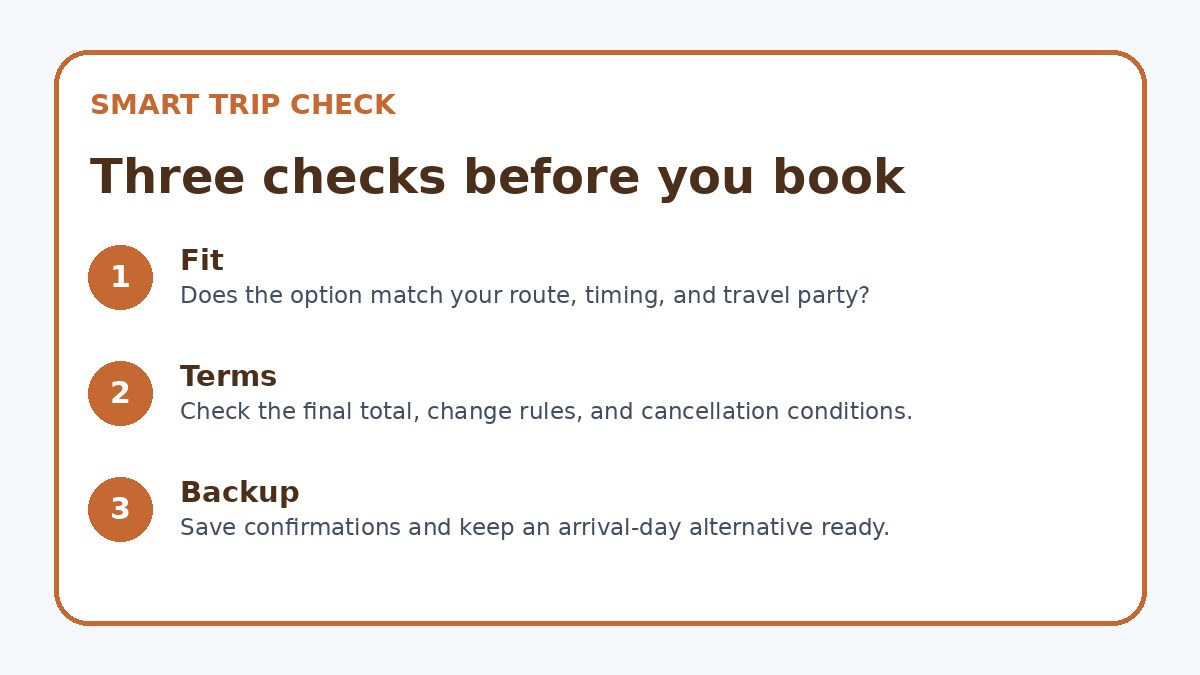
Before you finalize any transfer, verify the provider’s cancellation policy, how they handle flight delays, and the exact meeting point at your hotel or office. Confirm whether the price shown is total or if taxes, tolls or airport surcharges appear at checkout. If you require a company invoice, read the booking form or FAQs to confirm what details the vendor will include. If a rideshare or street taxi is an option, understand whether digital receipts meet your corporate finance rules.
If using the rail or a hotel shuttle, confirm the timetable nearest your departure window and whether seat reservations are needed for peak times. For private car bookings, check driver contact options and whether the booking system monitors your flight and offers free waiting time. For any provider, always note an emergency contact number for your supplier and a backup transfer plan, such as a taxi rank or nearest MTR station, in case your original booking fails.
Before you book
- Confirm which transfer priority matters most (speed, invoice, cost, luggage help) and write it down on your itinerary.
- Check provider cancellation policy, flight-delay handling, and any waiting-time fees before you book.
- Verify the exact pickup point and the driver’s contact method on the booking confirmation.
- Ensure the service can issue an itemized invoice or acceptable receipt for corporate expense claims.
- Plan a backup route (nearest MTR station or taxi rank) and note it in your calendar with travel time buffers.
- Save booking confirmations and screenshots to your phone and email them to your assistant or expense system.
Integrate transfer planning into the rest of your trip
Factor the return transfer into meeting scheduling, packing and hotel selection. If you’ve booked early-morning calls, choose accommodation close to the route you’ll use to get to the airport to avoid peak-hour unpredictability. Pack a small day bag with essentials and travel documents so you can leave your larger luggage at the hotel if that speeds your transit. Confirm check-out options at your hotel — some properties will hold luggage or offer express check-out to streamline departures.
Also, leave buffer time for security and immigration at the airport, and remember that transit time to the airport can vary with traffic, weather events, and city festivals. Share the chosen pickup plan with colleagues or assistants and include the booking reference and pickup contact. If you use corporate travel tools or Trip.com to compare options, save screenshots of confirmations and invoices for expense submissions and to simplify any dispute resolution later.
Frequently asked questions
How early should business travelers leave Hong Kong for their international flight?
Aim to leave enough buffer for both ground transit and standard airport processing. Consider the complexity of your transfer: if you rely on rail, add time to reach the station; if using road transport, add extra margin for rush-hour traffic or weather delays. Also factor in time for check-out, last-minute hotel tasks, and luggage drop-off. Rather than a fixed rule, base your departure on the airport distance and the transfer method chosen, then add a conservative buffer to cover unexpected holdups.
What documentation should I get from a transfer provider for corporate reimbursement?
Request an itemized invoice that lists the provider name, service dates and times, pickup and drop-off locations, vehicle type, and the total fare. Ensure the invoice includes a clear company or vendor address and a booking reference you can tie to your expense report. If you plan to use a rideshare, check whether the digital receipt contains these details and whether your finance office accepts it. When in doubt, ask the supplier before booking if their documentation meets your employer’s reimbursement requirements.
Is booking a private transfer worth it for short business trips?
That depends on your priorities: private transfers reduce uncertainty and usually offer meet-and-greet service, which can be time-saving after a tight schedule or overnight meeting. For brief trips where efficiency and a guaranteed pickup matter more than cost, the administrative simplicity and predictability can justify the expense. If your trip schedule is flexible and you’re traveling light, public rail or a taxi might be adequate. Compare the tradeoff between marginal time saved and additional booking steps or cost.
Final planning note
Choosing the right Hong Kong airport transfer for a business return is about matching the transfer mode to your priorities and confirming a few practical details. Pick the option that minimizes risk for your most important constraint — whether that’s arrival time, invoice requirements, or luggage handling — and verify pickup points, cancellation rules and invoice formats on the provider’s booking page. Keep a simple backup plan, communicate booking details to anyone who needs them, and factor the transfer into meeting and checkout times. When in doubt, compare current availability and confirmations on provider sites or a travel platform such as Trip.com, and save all receipts for corporate reconciliation.
Continue planning
Check current options and final conditions
Use the provider page to confirm live availability, the final total, cancellation terms, and every condition that matters to your trip.
This evergreen planning guide was created with AI-assisted drafting and a structured quality review. It does not display live prices, schedules, availability, visa guidance, or provider rankings. Verify current details before booking. Some links are affiliate links; we may earn a commission at no additional cost to you.