The practical answer: for most families traveling Tokyo to Kyoto the easiest door-to-door option is rail for reliability and city-center convenience, but coaches and mixed-mode plans can save money or simplify luggage needs. Start by weighing terminal fit, luggage friction, and timing flexibility: which departure point is closest to your accommodation, how much carrying you and your children can handle between platforms or bus stops, and whether your schedule tolerates delays. Pack with transfers in mind — in-train storage beats repeated lifts if you have small children — and build a disruption backup (later train, nearby hotel, or coach alternative) before you leave the hotel. Below you’ll find decision checkpoints, comparisons of four planning approaches, and a compact checklist to use the morning of travel. The guidance focuses on door-to-door practicality so you can choose the transport mix that keeps the family calm and on the move.
How to pick between rail, coach, or mixing modes
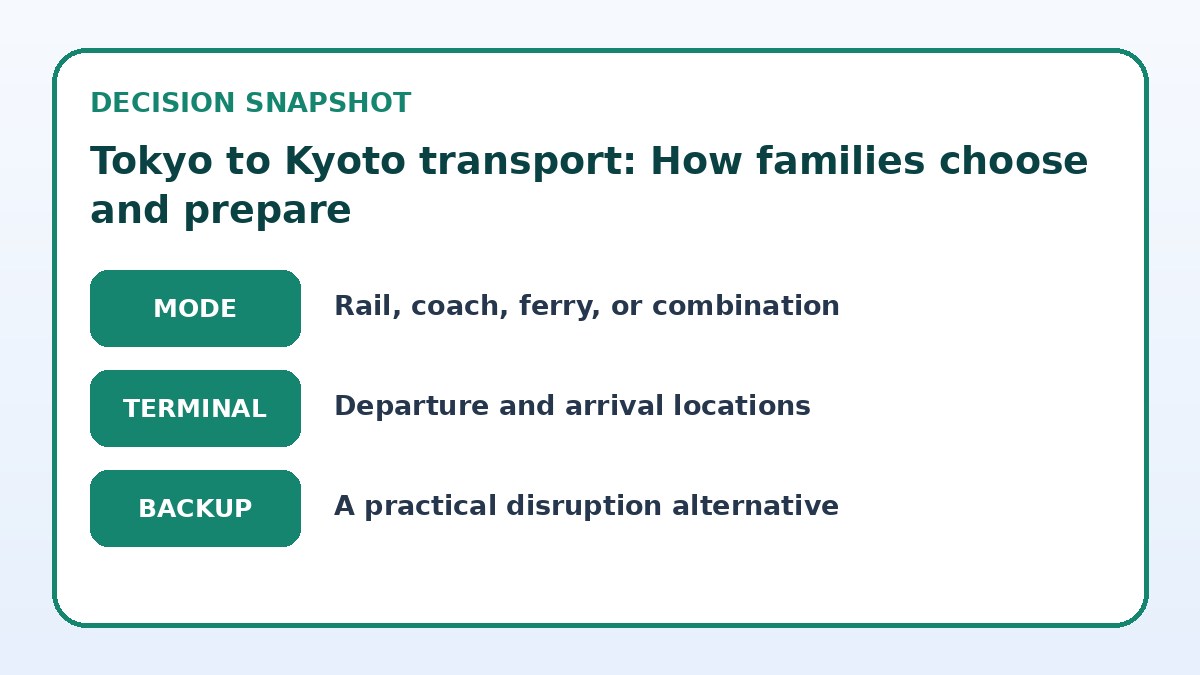
Begin by mapping door-to-door time rather than just in-vehicle duration. Rail from central Tokyo to central Kyoto typically drops you into city stations, which reduces last-mile transfers to hotels. Coaches often leave from major bus terminals; if your family is staying near one, a coach can be simple. However, if getting to the bus terminal requires multiple transfers or an early taxi ride, much of the perceived savings vanish. A mixed-mode plan—taxi to a nearby station, then express rail, or coach to a suburban stop followed by a short taxi—can balance comfort and cost.
Next, consider luggage and child logistics. Trains with reserved seating and dedicated luggage spaces reduce the hassle of lifting suitcases on and off vehicles and make diaper or snack changes easier. Coaches usually have underfloor storage that eliminates the need to carry heavy bags between platforms but may mean walking across a large terminal to board. For families with strollers, check whether the train or coach offers level boarding or whether you’ll need to fold and carry the stroller through gates. Choose the option that minimizes repeated lifting and long walks while keeping departure times that suit nap and meal schedules.
Choose the end-to-end journey plan
| Journey approach | Best for | Friction to check |
|---|---|---|
| Reserve rail seats to minimize on-board juggling | Families who prefer predictable seating and easy luggage placement | Less schedule flexibility and potential fees or restrictions when changing plans |
| Unreserved rail or frequent departures | Families needing timing flexibility to match naps and meals | Risk of separated seats and inconsistent luggage space during busy periods |
| Coach or bus with underfloor luggage storage | Families prioritizing minimal carrying between terminals and straightforward boarding | Terminals may be further from accommodation and coach schedules can be less frequent |
| Mixed-mode plan (taxi + train or coach + short taxi) | Families balancing door-to-door convenience with cost control | Requires coordinating more segments and can introduce extra points of failure |
Check live intercity options
Look beyond the ride itself and compare terminals, transfers, luggage, and arrival fit.
Terminal fit and transfer friction: what to check
Assess the arrival and departure terminals in relation to where you’ll be staying. A station or bus terminal that’s a short taxi ride from your accommodation can be worth a slightly longer journey time. Look at platform layouts: does the route use mainline terminals with elevators and clear signage, or smaller suburban platforms with stairs? For families, elevator access, wide gates for strollers, and short platform-to-exit distances matter more than the nominal journey time. If you expect to change trains, count how many transfers are required and whether they involve crossing between different stations or buildings.
Ask practical questions before booking: how many stairs will you encounter? Are there luggage storage racks or space beside seats? Are stations likely to be crowded at your departure time? These are provider details you should verify on the operator’s final booking page or station maps, not in a general guide. If a trip requires a late-night taxi to reach a connecting service, factor that into your plan and cost estimate. Minimizing transfer friction often reduces stress more than shaving minutes off the scheduled travel time.
Timing flexibility and the family rhythm
Families travel on rhythms: naps, meals, and toilet stops dictate feasible departure windows. Choose services with timing flexibility—trains with multiple departures per hour, or coach networks with spare seats—instead of relying on a single departure. If your preferred departure coincides with your child’s nap, consider a slightly later option that keeps the child rested and the household calmer. Also build in a comfortable pre-departure routine: arriving at the terminal with time to use facilities, buy snacks, and let children stretch helps prevent on-board meltdowns.
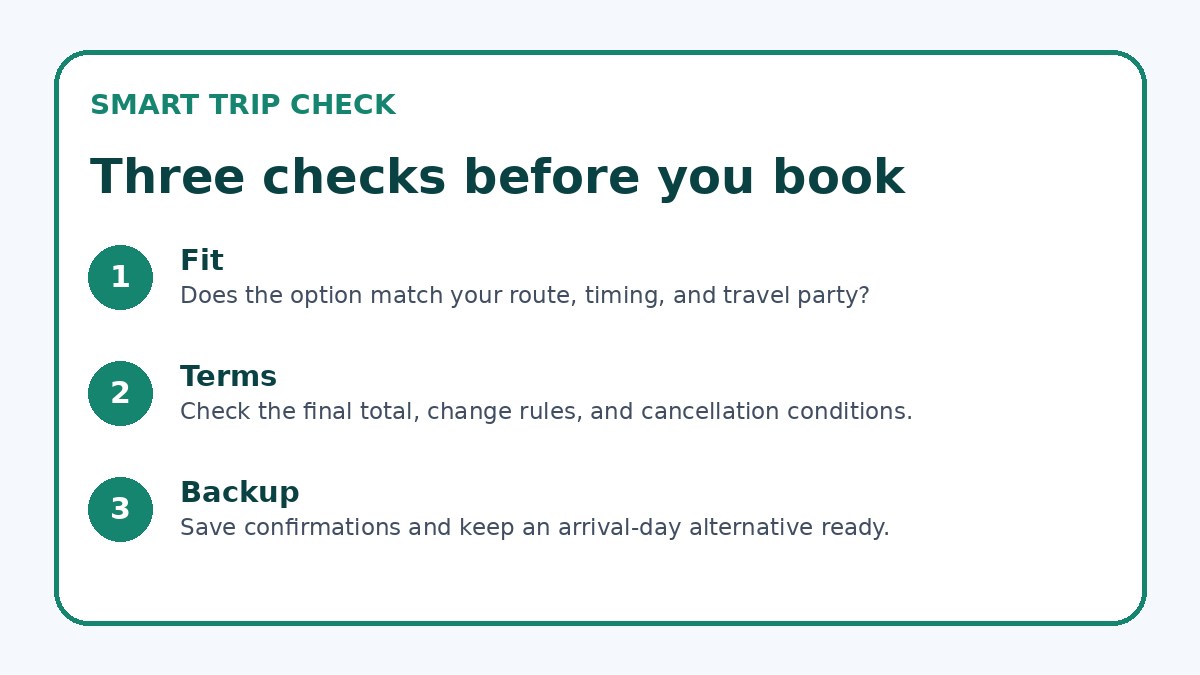
If you reserve seats, check refund and change policies on the operator’s final booking page so you can swap to a later service if plans shift. For unreserved options, plan to travel off-peak where possible to secure adjacent seats. Allow extra time for toilet visits and snack breaks at stations—short stops add up with children. Whenever possible, choose services that give you clear windows for boarding and disembarkation rather than a single tight transfer that could be missed by a minor delay.
Compare the practical alternatives
Use the final page to confirm what is actually offered on your dates and save a workable fallback.
Intercity travel checklist
- Map door-to-door transit time from your lodging to the departure terminal and from the arrival terminal to your Kyoto accommodation.
- Verify elevator, stroller access, and luggage facilities on the operator’s booking page or station map before you finalize the ticket.
- Reserve seats if you need guaranteed adjacent seating; note the operator’s change and refund rules in case your schedule shifts.
- Prepare a travel-day bag with snacks, spare clothes, medications, charging cable, diapers/wipes, and basic first-aid supplies.
- Save contact details and screenshots of your booking, the operator’s help line, and one alternate service (train or coach) for the same route.
- Build a disruption backup: note one later departure, one cross-mode option, and a nearby place to rest if travel becomes overnight.
Building a simple disruption backup
A disruption plan should be small, clear, and actionable. Identify one later train or coach you can reasonably reach if your first choice is missed. Know the name of the next suitable station, the phone number or app to change bookings, and a nearby hotel or public facility if you need an immediate rest stop. Do not rely on memory—store routes and contacts in your phone and print a quick backup note for the person traveling with kids who may not have mobile signal at a busy terminal.
Consider three backup levels: a short delay solution (next scheduled departure on the same line), a cross-mode option (switch to coach or taxi if rail is suspended), and an overnight plan (nearby family-friendly lodging or a station with 24-hour facilities). Before you travel, check the operator’s terms for changes and refunds and confirm current availability on the operator’s booking page; Trip.com is an optional place to compare availability but always verify on the provider’s official site before finalizing.
Rail & Intercity Transport questions travelers ask
Is taking the train from Tokyo to Kyoto the best option for families with young children?
Trains often offer the best balance of city-center arrival, predictable travel times, and onboard space for families, but “best” depends on your specific needs. If your accommodation is close to a major rail station and you value short last-mile transfers, trains reduce the stress of multiple taxis or long walks. Reserved seats help keep children together and make luggage handling simpler. However, if you have bulky strollers or many suitcases and your lodging is near a bus terminal, a coach with underfloor luggage storage might be more convenient. Verify seat layouts, luggage rules, and station access on the operator’s final booking page.
How early should a family arrive at the station or terminal in Tokyo before departure?
Plan enough time to manage toilets, snack purchases, security checks, and moving children and luggage without rushing. For reserved trains, arriving 30–45 minutes early is usually sufficient to orient yourselves, locate elevators, and find your platform, but allow up to 60 minutes if you expect crowds, need to fold a stroller, or prefer a relaxed routine. For coaches with large terminals, add extra time for baggage check-in and finding the correct boarding area. Confirm recommended arrival windows on the provider’s booking page and adjust for peak travel periods or station construction.
What should we pack in our travel-day bag for a Tokyo to Kyoto trip with kids?
Pack a small, easily accessible bag with immediate essentials: water bottles, snacks, a change of clothes, diapers or sanitary supplies, wet wipes, a basic first-aid kit, and any medications your children need. Include entertainment items like a tablet with offline media and headphones, a small toy, and a lightweight blanket for naps. A compact portable charger and printed or screenshots of booking confirmations and backup plans are important. Keep this bag with you rather than stowed with checked luggage so you can reach items during transfers or unexpected delays.
Final decision note
Families planning Tokyo to Kyoto transport should prioritize door-to-door practicality over the raw in-vehicle travel time. Choose the option that minimizes transfers and heavy carrying while fitting your family’s daily rhythm: reserved rail seats for predictable seating, unreserved trains for timing flexibility, coaches for easier luggage handling, or a mixed-mode plan when geography demands. Verify station access, luggage rules, and change policies on the operator’s final booking page before you commit. Use the checklist and disruption backups to reduce decision fatigue on the travel day, and you’ll arrive in Kyoto with more energy to enjoy the city.
Continue planning
Check current options and final conditions
Use the provider page to confirm live availability, the final total, cancellation terms, and every condition that matters to your trip.
This evergreen planning guide was created with AI-assisted drafting and a structured quality review. It does not display live prices, schedules, availability, visa guidance, or provider rankings. Verify current details before booking. Some links are affiliate links; we may earn a commission at no additional cost to you.