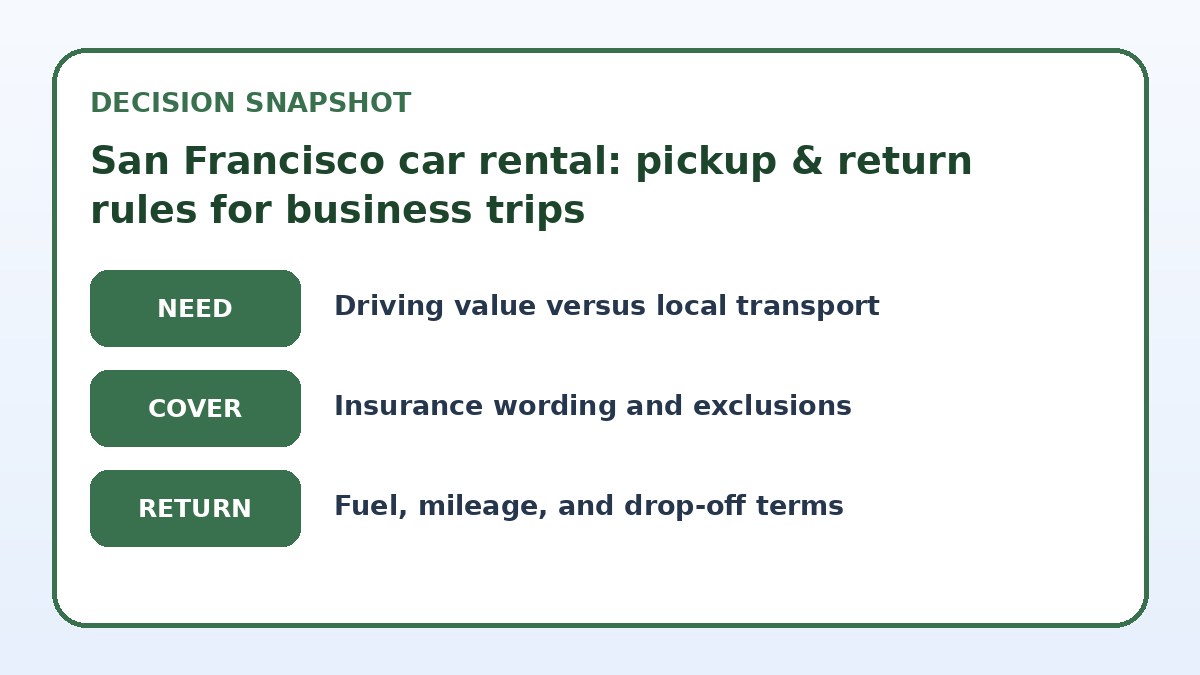
Decide first: will driving improve your San Francisco business trip or add more friction? For many short, downtown-focused trips it won’t—parking, peak-hour congestion, and tight pickup/return windows can cost time and stress. But if your schedule includes Bay Area meetings outside the Financial District, visiting multiple campuses, or reaching suburbs with poor transit links, a car can be worth it. This article gives a clear yes/no framing up front and then explains the tradeoffs: route value (what drives you’ll actually do), insurance language to watch for, pickup and return friction you may face at SFO and city locations, and practical non-driving fallbacks. Read through the pickup/return checklist and the comparison of four mobility strategies to pick the approach that matches your itinerary and risk tolerance.
Route value: when a San Francisco car rental makes or breaks your schedule
Start by mapping your meetings and client sites on a single map layer so you can see clustering and travel legs. A car becomes valuable when appointments span the Peninsula, East Bay (Oakland, Berkeley), and South Bay (San Jose, Mountain View) in a single day or over consecutive days with tight windows. Also factor in early-morning or late-night travel when public transit is limited. If all your engagements are in downtown San Francisco, SoMa, or the Embarcadero, high-frequency Muni, BART, and rideshares usually beat driving once you add parking search time and potential meter or garage costs.
Consider the return leg: if you must catch a late flight from SFO or OAK, an evening car saves time, but returns at airport lots can be busy and require shuttle time. For cross-bay trips during rush hours, estimate door-to-door drive times and compare them to transit alternatives using real-time apps. Where optional client visits are on the margins of your itinerary, build in slack—unexpected traffic or parking searches are the most common trip breakers for business travelers relying on cars.
Decide whether driving earns its place
| Mobility strategy | Best for | Cost or friction to check |
|---|---|---|
| Rental car (self-drive) | Multi-site Bay Area schedules and late-night airport legs | Parking, fuel, tolls, pickup/return queues, and insurance wording to manage |
| Rideshare and taxis | Short downtown hops and flexible, on-demand one-way trips | Variable wait times, surge pricing, and limited control for multi-stop days |
| Public transit plus micromobility | Dense-city schedules with predictable stops and fixed meeting locations | Longer door-to-door times and limited late-night options for peripheral sites |
| Pre-booked car service or chauffeur | High-importance meetings demanding guaranteed pickup times and minimal hassle | Higher cost and potential cancellation or rescheduling terms to check |
Check live rental choices only after the route test
Use the exact driver, dates, pickup point, and return plan to compare current conditions.
Insurance wording: what to verify so you don’t get surprised
Rental agreements use precise language for protection: loss/damage waivers, collision damage waiver (CDW), theft protection, supplemental liability, and third-party loss. Don’t assume your corporate policy or personal credit card fully covers every scenario—coverage limits, exclusions for certain vehicle classes, and requirements about authorized drivers are common. Read the contract to confirm whether the rental’s coverage is an optional product that replaces your responsibility or merely reduces it; if phrasing is unclear, contact the provider to get the exact clause in writing before you confirm.
When comparing options, ask three specific questions on the final booking page: what incidents are excluded (e.g., off-road use, tire/windshield damage), who is an authorized driver, and how are deductibles handled? Keep documentation: if you accept a damage waiver at pickup, get a receipt and the waiver’s written terms. Trip.com can be used to compare availability and basic policy outlines, but for definitive insurance wording verify each supplier’s full rental agreement and any corporate-rental addenda before you drive off.
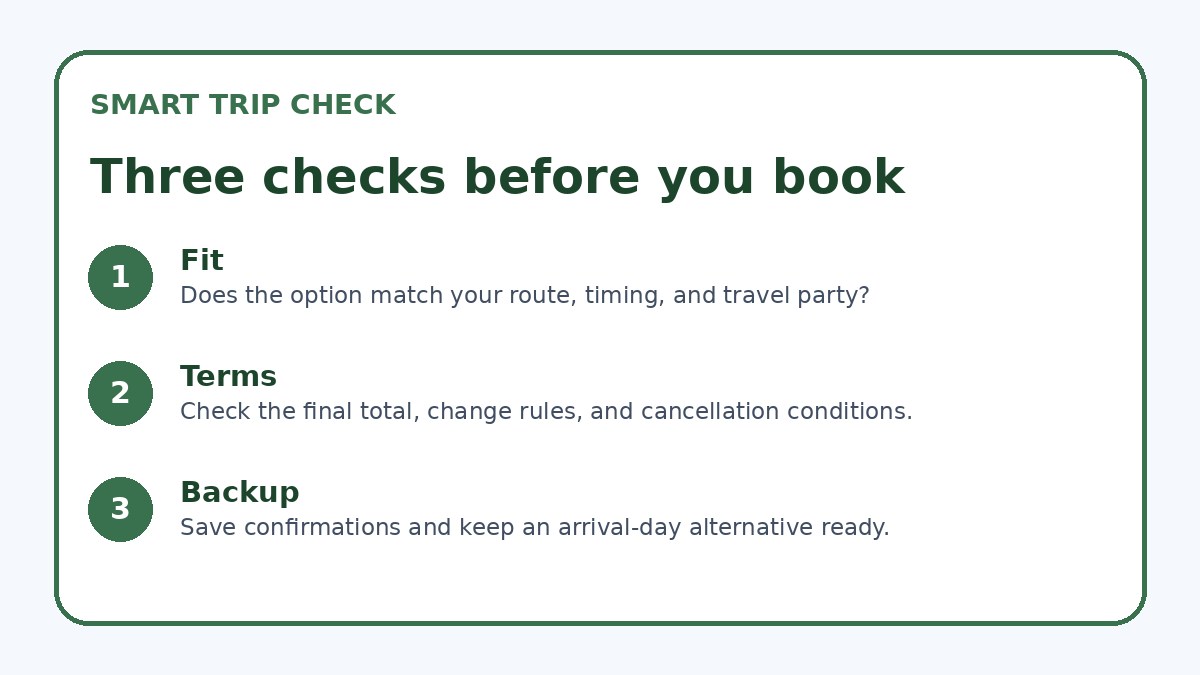
Compare the full rental conditions
Confirm insurance wording, exclusions, deposit, fuel, mileage, and return terms on the final page.
Pickup and return friction: logistics that cost real time
Airport pickups often promise convenience but can add time. At SFO and OAK, off-airport lots use shuttle buses; on-airport counters may be separated from curbside loading, and peak arrivals create queues. City center pickups sometimes place vehicles in remote lots or require shuttle coordination—verify whether your confirmation gives a lot name, a specific counter, or a direct keybox code. For returns, confirm hours and whether after-hours drop boxes are available; strict return windows, inspection waits, and shuttle intervals can turn a short trip into a significant delay.
Other friction points: fuel rules (full-to-full vs. prepaid), toll handling, and charges for late returns or extra cleaning. Check whether the chosen location assesses an additional fee for one-way returns between airports and city lots. At pickup, document any pre-existing damage with photos and ask staff to note it on your contract. Before you finalize a booking, review the provider’s stated pickup instructions, return procedure, and any required shuttle timings on the booking page so you can schedule around them.
Car rental terms to verify
- Map all meeting addresses and mark them as transit-friendly, drives-best, or mixed to assess true car value.
- Confirm pickup location details on the booking page (lot name, shuttle info, counter hours) before you leave for the airport.
- Read the full rental agreement section on insurance and exclusions and save a screenshot or PDF of the terms.
- Photograph vehicle condition from all sides at pickup and ensure staff initials or notes pre-existing damage on the contract.
- Note the fuel policy, toll handling, late-return penalties, and any one-way drop fees listed on the final booking page.
- Test a fallback route using real-time transit and a sample rideshare run to estimate true door-to-door times.
Non-driving fallback: practical alternatives for tight business itineraries
If you opt not to rent, build a layered mobility plan. For core downtown travel, rely on BART for airport-downtown links and Muni/BART for intra-city movements; shorten walk times with scooters or bikes for last-mile hops. For client sites beyond core transit, allocate a rideshare budget and time blocks for pickups—pre-book or use corporate ride programs where available. For heavy door-to-door days, consider booking a local car service for specific legs to guarantee time and reduce transfer friction, but verify cancellation and wait-time policies.
Test the fallback the evening before a major meeting day: run the route with real-time transit data or a short rideshare to confirm typical durations. Keep a plan B contact for drivers or a backup pickup spot if your primary option has unexpected delays. If several attendees share one itinerary, consolidating rideshare or hiring a single car can be more efficient than everyone individually renting cars and hunting parking in busy neighborhoods.
Car Rental & Road Trip questions travelers ask
How much time should I allow for pickup and return at San Francisco airports?
Allow extra time versus a simple curbside pickup. At airport locations, factor in shuttle waits if the rental lot is off-airport, check-in queues at counters, and potential inspection time at return. A conservative approach is to add 30–60 minutes beyond drive time for pickup or return during peak hours. Exact shuttle intervals, counter hours, and after-hours drop procedures vary by location—verify these details on the provider’s final booking or location information page so you can schedule transfers confidently.
Will my corporate insurance or credit card cover a San Francisco car rental?
Coverage depends on policy specifics and the rental agreement language. Corporate policies often have limits or require pre-authorization; credit cards typically offer secondary coverage that may exclude certain vehicle classes or damage types. Look for exclusions such as off-road damage, windshield and tire coverage, and authorized driver lists. Before declining the rental company’s waivers, obtain a written confirmation from your corporate policy or card issuer describing covered incidents and deductibles, and compare that to the rental agreement on the booking page.
What’s the easiest non-driving plan for a downtown San Francisco meeting-heavy trip?
Combine BART for airport-to-downtown transfers, Muni for intra-city travel, and rideshares or scooters for last-mile legs beyond transit stops. For tightly scheduled days, pre-book rides for specific legs or use a corporate ride account to prioritize reliability. If several colleagues share locations, coordinate a single rideshare or arrange a short-term car service for key runs. Always check real-time transit apps the evening before and factor in buffer time for potential delays during peak commuting hours.
Final decision note
For business travelers, the right San Francisco car rental decision begins with itinerary clarity. If your days radiate across the Bay Area or require late-night airport runs, a rental can save time—provided you verify insurance terms, pickup logistics, and return procedures on the provider’s booking page. If your schedule is downtown-centered, public transit combined with rideshares usually reduces friction. Use the checklist and mobility comparison to match the option to your priorities: speed, cost predictability, or guaranteed pickup times. Before you finalize any booking, verify the exact pickup location, insurance exclusions, fuel and toll handling, and after-hours return process on the supplier’s final page; Trip.com can help compare availability, but rely on the rental agreement for contract terms.
Continue planning
Check current options and final conditions
Use the provider page to confirm live availability, the final total, cancellation terms, and every condition that matters to your trip.
This evergreen planning guide was created with AI-assisted drafting and a structured quality review. It does not display live prices, schedules, availability, visa guidance, or provider rankings. Verify current details before booking. Some links are affiliate links; we may earn a commission at no additional cost to you.