Practical answer first: before you search live fares, pick exact travel dates, count every piece and kilogram of luggage, decide whether you need a guaranteed hold or can split bags across segments, and choose whether a single-ticket itinerary matters for misconnect protection. For travelers with extra luggage on Bangkok to Phuket flights, the core tradeoff is route flexibility versus predictable baggage allowance. Direct options reduce handling and re-check risks but may cost more or carry tighter free allowances. Connecting itineraries can offer lower base fares or more generous checked-bag allowances when booked as a single ticket, yet they introduce transfer risk and possible re-ticketing fees.
This article guides you through the routing, baggage and connection risks, schedule fit, and fare-condition verifications you must make before pressing buy. It also helps you prepare exact traveler details and dates so you can compare apples to apples across carriers or booking platforms. If you want a quick place to compare current availability, you can check a major aggregator like Trip.com, but always verify baggage and change/refund rules on the airline’s final booking page.

See live routes for your exact travel day
Compare direct and connecting choices with the same baggage and traveler details.
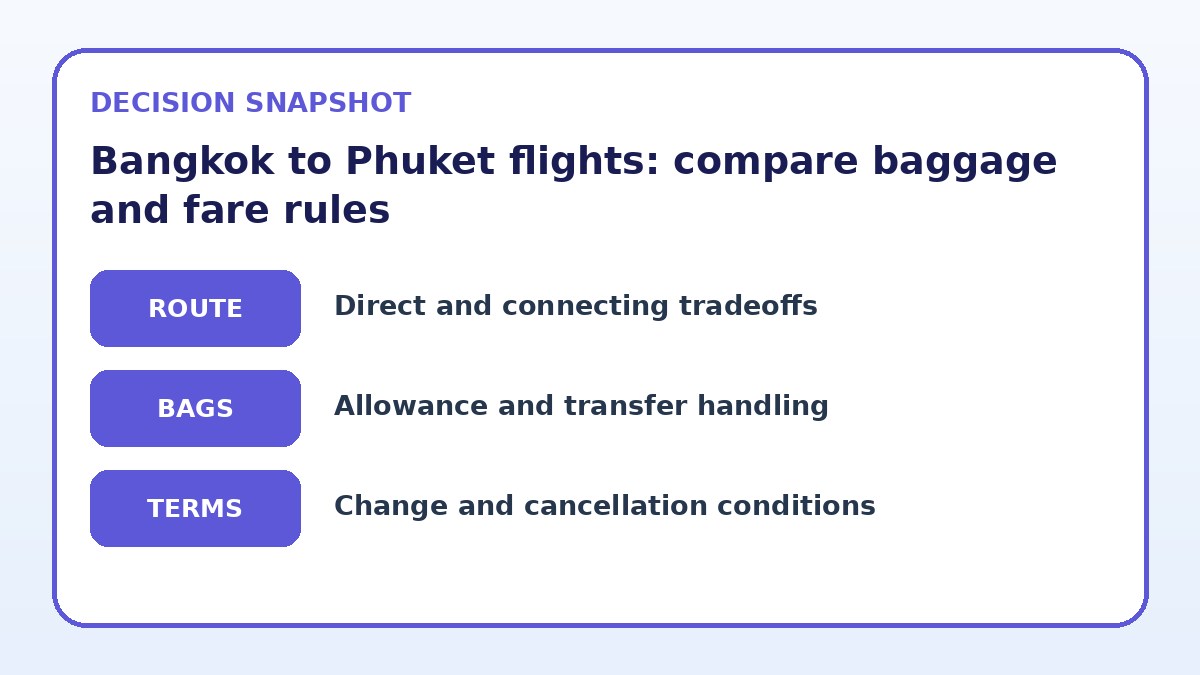
Routing and the fare-versus-convenience tradeoff
Start by deciding how much you value direct routing. For Bangkok to Phuket flights, a one-leg itinerary cuts handling and the chance of needing to collect and re-check luggage during a transfer. That convenience is especially important with oversized or fragile items. However, direct services sometimes come with stricter included baggage allowances depending on the carrier and fare class, so you may still need to pay for extra checked weight or pieces even when flying nonstop.
Compare that with connecting options: they can offer more flexible fare structures or different carriers that include larger allowances in higher fare bundles. If you book the entire journey on a single ticket, most carriers accept through-checked luggage and will re-route it for you, which reduces passenger handling. But if the itinerary requires changing between separate tickets or different ticketing agencies, plan for collecting and re-checking bags and the time and cost that adds.
Baggage and connection risk: what to verify
Before you book, read the exact baggage rules tied to the fare class on the airline’s final booking page. Verify whether the allowance is defined by piece count or weight, whether carry-on size limits exist, and whether oversized or heavy items incur a predetermined fee. If your luggage is near typical cutoffs, confirm how the carrier measures (linear dimensions vs. weight) and whether airport staff or curbside agents commonly enforce limits on that route.
If your itinerary includes a connection, check whether the ticket is on one booking reference. A single-ticket booking usually allows through-checking; separate tickets often do not. Ask the airline what happens to luggage on irregular operations: will they hold bags for missed connections, or do you need to rebook and reclaim items yourself? These answers appear on carrier pages or in contract of carriage documents; write down the relevant passages or screenshots before finalizing.
Compare flight-selection strategies
| Flight strategy | Best for | Risk to check |
|---|---|---|
| Direct nonstop flights | Minimizing handling and transfer risk for bulky or fragile luggage | May have tighter included allowances depending on fare class and sometimes higher base fares |
| Single-ticket connections | Through-checked baggage and protection on missed connections when handled by one carrier | Longer travel time and potential for tighter schedules if connection windows are short |
| Low-cost carriers with add-on baggage | Lower base fares with predictable per-piece add-ons you can pre-purchase | Add-on costs can add up and rules often enforce strict size/weight limits and fees at the airport |
| Full-service carriers with higher included allowances | Simpler budgeting when checked baggage is included in fare bundles | Fare bundles that include baggage may appear more expensive upfront; compare total cost, not base fare alone |
Recheck the complete itinerary
Confirm airports, connection handling, baggage, and change conditions before deciding.
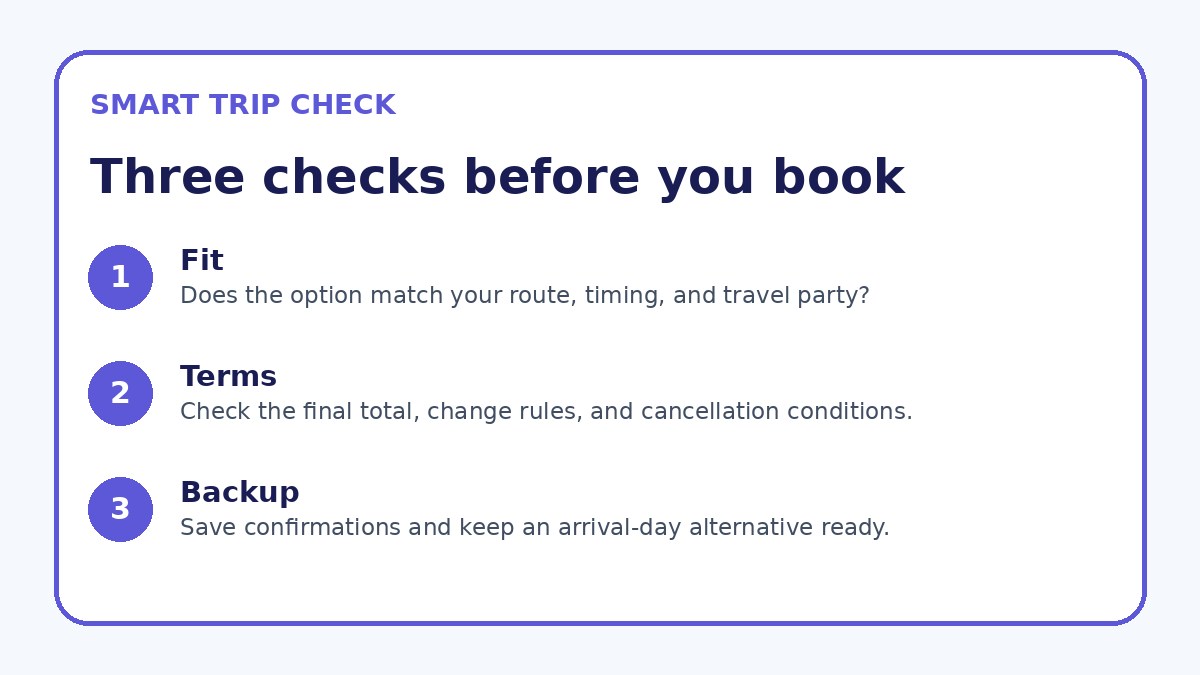
Schedule fit: arrival times, transfer windows and buffer planning
Choose flights with realistic transfer buffers when you travel with extra luggage. Baggage handling, security checks, and longer boarding processes for oversized items can extend transfer time. If you must change terminals or re-check luggage, leave ample margin beyond the minimum connection time the airline lists. Also consider the time of day: early-morning and late-night flights may have reduced ground handling staff, which can delay baggage processing.
Balance schedule convenience against contingency needs. If missed connections would cause overnight stays or additional transport of heavy bags, prefer later outgoing flights or pay for options that protect you on missed connections (see fare conditions). Make sure you can reach airline customer service quickly at your transfer point — find the carrier’s local desk phone or support line and save it with the booking reference.
Flight details to verify
- Confirm exact travel dates, passenger full names as on ID, and whether infants or additional travelers require separate baggage allowances.
- List each bag’s dimensions and weight; decide which pieces can travel as checked, carry-on, or require oversize handling.
- Search fares comparing direct and connecting options, making sure to eyeball the fare class and the airline’s baggage allowance on the carrier’s booking page.
- If the itinerary has connections, verify it’s a single PNR for through-checking; if not, plan time and cost to collect and re-check luggage.
- Screenshot or copy the airline’s baggage rules, change/cancellation terms, and any add-on baggage purchase page before completing payment.
- Save contact numbers for airline airport desks and customer service, and leave contingency time in your schedule for slower baggage handling.
Fare conditions and what to check on booking pages
Fare rules determine whether you can add baggage, change travel dates, or get protection for missed connections. On the airline’s final booking page, look for explicit lines about included checked baggage, maximum weight per piece, fees for extra pieces, and whether the carrier permits add-on baggage at booking versus only at the airport. Also check change and cancellation rules: refundable versus non-refundable, change fees, and whether a fare difference applies.
When comparing offers, open the full fare conditions or contract of carriage and copy the exact language about baggage liability and re-routing. If the seller is a third-party site, verify the same rules on the airline’s site before completing payment. If you plan to add baggage later, confirm when and how you can purchase it — online before departure is usually cheaper and reduces the risk of airport surprises.
Flight Guide questions travelers ask
Should I book a direct flight from Bangkok to Phuket if I have heavy or oversized luggage?
A direct flight reduces the number of times your luggage is handled and eliminates the need to re-check items between separate tickets, which lowers the chance of damage or loss. However, direct services may still limit weight per piece or charge for oversized items. Before booking, read the carrier’s baggage policy on the final booking page to confirm the maximum weight and fees for oversize items. If a direct option’s permitted weight is too low, compare single-ticket connecting itineraries that include a higher allowance in their fare bundle.
Can I rely on a single booking to protect me if I miss a connection with checked bags?
When your itinerary is issued on one booking reference (a single PNR), most carriers will accept through-checked baggage and have procedures for re-routing you and your bags after missed connections. But protections and actions vary by airline and fare conditions. Check the carrier’s contract of carriage and the fare rules on the booking page to see how they handle missed connections and baggage re-routing. If it’s critical, consider purchasing higher-flexibility fares or add-on protection explicitly documented by the airline.
What should I verify about baggage add-ons before buying a cheaper base fare?
Identify whether baggage is sold by piece or by weight, whether online pre-purchase reduces fees compared with airport purchases, and whether the add-on applies to one direction or both. Confirm who enforces size and weight at check-in and whether the airline allows mixing piece and weight allowances on different segments. Finally, ensure the booking platform’s baggage add-on generates a visible reference on your itinerary or ticket; when using third-party sellers, re-check the airline’s site to confirm the add-on appears under your reservation.
Final decision note
When traveling Bangkok to Phuket with extra luggage, the right pre-booking choices make your trip smoother and cheaper in the long run. Start with exact dates and a complete luggage inventory, then compare direct versus connecting options while focusing on whether your ticket is a single PNR and what baggage the fare actually includes. Verify baggage weight and piece rules, add-on procedures, and the carrier’s handling of missed connections on the airline’s booking page before you pay. Preparing these details and screenshots—plus adding realistic buffer time—reduces surprises at the airport and gives you confidence that your bags will arrive with you.
Continue planning
Check current options and final conditions
Use the provider page to confirm live availability, the final total, cancellation terms, and every condition that matters to your trip.
This evergreen planning guide was created with AI-assisted drafting and a structured quality review. It does not display live prices, schedules, availability, visa guidance, or provider rankings. Verify current details before booking. Some links are affiliate links; we may earn a commission at no additional cost to you.