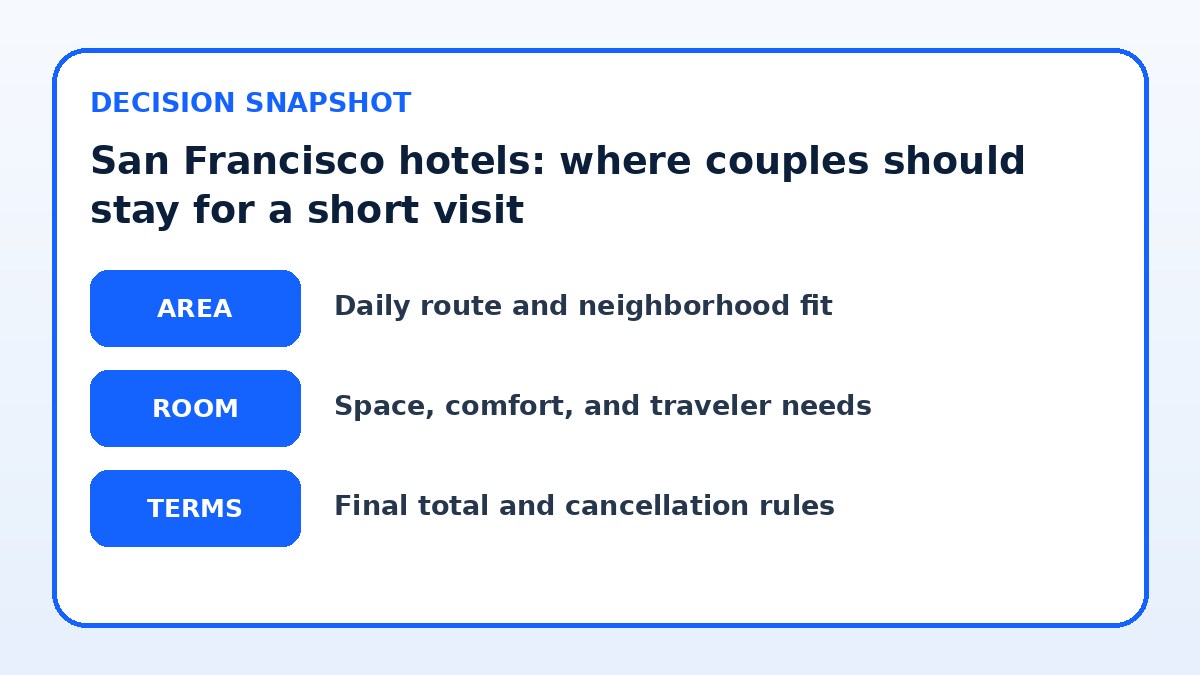
Practical answer first: for most couples on a short visit, pick a centrally located neighborhood—Union Square, Embarcadero/FiDi, Fisherman’s Wharf, or Hayes Valley—based on how you’ll spend your daylight hours and how much walking or transit you’re comfortable with. If your priority is sightseeing with minimal back-and-forth, Union Square or Embarcadero saves walking and transit complexity. If you want more local cafés, quieter evenings, and a shorter journey to Golden Gate Park, favor Hayes Valley. Fisherman’s Wharf is convenient for bay attractions but busier and more tourist-focused. Below you’ll find tradeoffs by neighborhood, how daily-route friction affects your time, practical room and party needs for couples, and the final booking terms to check before you lock a hotel reservation.

Check live stays in the areas that fit
Use your dates and party size to compare current rooms after you narrow the neighborhood fit.
Neighborhood fit: pick by daily rhythm, not just sights
Start by noting how you want to spend daylight: museum and park mornings, waterfront strolls, or compact city-walking days. Union Square sits near major transit hubs and the cable car, making it efficient if you plan to hop between Chinatown, North Beach, and the Embarcadero. Embarcadero/FiDi works if you prefer scenic morning waterfront walks and want to be near piers or ferry options. Hayes Valley is better for leisurely coffee, boutique browsing, and a quieter evening, while Fisherman’s Wharf places you next to bay attractions and boat launches.
Consider evening preferences: do you want lively nightlife a short walk away, or quiet residential streets after dinner? Union Square and Fisherman’s Wharf are livelier at night with many visitors out late; Hayes Valley and parts of the Embarcadero are comparatively calm after restaurants close. For a short stay, minimizing travel time between where you sleep and where you spend most of the day usually wins—prioritize the neighborhood that aligns with your daily rhythm rather than an abstract idea of the city.
Choose an area-selection strategy
| Area approach | Best for | Tradeoff to check |
|---|---|---|
| Choose Union Square | Couples wanting minimal transfers and easy access to major attractions | Busy, tourist-heavy evenings and less of a residential neighborhood feel |
| Choose Embarcadero/Financial District | Couples prioritizing scenic waterfront mornings and direct access to piers | Further from some neighborhoods and can be quieter at night |
| Choose Hayes Valley | Couples seeking quieter evenings, local dining, and boutique shopping | Requires short rides to many major tourist sights |
| Choose Fisherman’s Wharf | Couples focused on bay attractions, boat departures, and lively daytime energy | High daytime crowds and more tourist-oriented dining options |
Daily-route friction: how travel time eats your short trip
On a two- or three-night trip, even 15–30 extra minutes each way can cost a significant portion of your day. Map your likely daily loop—hotel to morning activity, midday meal or museum, afternoon attraction, evening dinner—and estimate transfers. Union Square reduces transfers for many classic San Francisco loops because several transit lines and cable cars converge there. Embarcadero reduces waterfront-to-pier walking but can add time if you want to reach neighborhoods like the Mission or Haight without transfers. Hayes Valley adds short rides to some sights but reduces walking fatigue.
Factor in arrival and departure logistics: proximity to BART or SFO shuttle points simplifies airport transfers, while being close to Muni lines or major rideshare pickup spots speeds up ad-hoc plans. If you have limited daylight, aim to keep most of your planned stops within a 20–30 minute total travel loop from your hotel; that keeps travel friction low and leaves more time to actually explore and relax.
Now compare like with like
Keep the same dates, guests, room needs, and cancellation preferences while you compare the final choices.
Room and party needs: small differences that matter for couples
Decide on the room features that affect comfort: bed size, noise insulation, a small sitting area, and a workable bathroom. For couples, a king bed and blackout curtains help with comfort after long days. If you plan on working remotely for a bit, check that the room offers a stable workspace and reliable Wi‑Fi. If celebrating an occasion, look for rooms with a view or a small upgrade option; ask the hotel’s booking page about room location, extra amenities, or late check-out policies before you commit.
Consider party logistics: if you’ll bring one suitcase each and plan mostly daytime outings, a standard double or queen room is usually fine. If one of you needs mobility accommodations or you prefer more space to dine in-room, prioritize a larger room type or a hotel with suites. Verify bed configuration, the hotel’s policy on rollaway or extra beds, and whether connecting rooms are available if you prefer more space or separate sleeping areas.

Hotel booking check before payment
- Map your planned daytime loop and list the two neighborhoods you’ll be visiting most to narrow ideal hotel locations.
- Confirm bed type, room layout, and noise insulation on the hotel’s booking page or with a direct message before reserving.
- Compare cancellation and change policies across the rooms you short-list and save screenshots of the hotel’s stated terms.
- Check proximity to transit stops or rideshare pickup locations using a transit map to estimate actual door-to-door travel time.
- Ask the hotel about housekeeping frequency, breakfast inclusion, and any renovation notices that could affect your stay.
- If airport transfer matters, verify shuttle or BART access and whether the hotel lists specific transfer partners on its booking page.
Final booking terms: what to verify on the hotel page
Before you book, check the hotel’s final booking page for cancellation and change policies, whether taxes and fees are included in the quoted rate, and exactly which room features are guaranteed. Confirm arrival check-in and departure check-out times, whether early check-in or late check-out is possible (and any fees), and whether parking is offered if you’ll have a car. If these items matter to you, make a note to contact the hotel directly to get confirmation in writing or in a booking receipt.
Also verify services that commonly change: whether breakfast is included or available for purchase, the hotel’s current cleaning and housekeeping procedure, and whether there are any scheduled renovations that could affect your stay. If you plan to use public transit or ferries, cross-check nearby stops on a transit map; if you’ll use Trip.com or another aggregator, use it to compare availability and booking terms but verify the final details on the hotel’s official booking page before finalizing.
Hotel Guide questions travelers ask
Which San Francisco neighborhood offers the best balance for a two-night couples' stay?
For many couples with only two nights, Union Square offers the best balance because it compresses travel time to multiple classic attractions and transit options. Staying there reduces the number of transfers and puts shops, restaurants, and cable car lines within walking distance. If you prefer waterfront mornings or plan to take a bay cruise, Embarcadero is worth considering. If quiet evenings and local dining matter more than immediate sight access, Hayes Valley can be a better fit despite short extra travel times.
How should couples weigh saving money against location convenience in San Francisco?
On a short trip, convenience often outweighs modest savings because travel time is the scarcest resource. A cheaper hotel far from key sights can cost you an hour or more each day in transit, which is time you can’t get back. When comparing options, calculate door-to-door travel time and how many hours of sightseeing the difference in location would eliminate. If savings are substantial and you’re comfortable with longer daily routes, factor that in—but for two to three nights, prioritize location unless the price gap is large.
What practical questions should couples ask the hotel before finalizing a reservation?
Ask about bed configuration and whether the room type you booked guarantees a king or queen bed, request confirmation of check-in and check-out times and any fees for early arrival or late departure, and inquire about housekeeping frequency and breakfast options. If mobility, noise, or special occasions matter, ask about room location, noise insulation, and whether they can note the reservation for a quiet room or a small celebration. Always verify cancellation or change terms on the final booking page and request a written confirmation if you ask for special arrangements.
Final decision note
Short stays are won or lost by location and the details that affect daily friction. For most couples, choosing a neighborhood that matches how you’ll spend daylight—Union Square for transit convenience, Embarcadero for waterfront mornings, Hayes Valley for quieter evenings, or Fisherman’s Wharf for bay-focused activities—simplifies decision-making. Once you shortlist an area, compare room layouts, bed type, and cancellation policies, and confirm the hotel’s practical terms on its booking page. Do that and you’ll convert limited time into a relaxed, efficient visit instead of a schedule full of transit and backtracking.
Continue planning
Check current options and final conditions
Use the provider page to confirm live availability, the final total, cancellation terms, and every condition that matters to your trip.
This evergreen planning guide was created with AI-assisted drafting and a structured quality review. It does not display live prices, schedules, availability, visa guidance, or provider rankings. Verify current details before booking. Some links are affiliate links; we may earn a commission at no additional cost to you.