If you’re traveling from Busan to Jeju with extra luggage, the practical decision is less about which departure looks fastest and more about which fare and policy protect your baggage and wallet. Short domestic sectors often have many carriers and fare types that look similar but vary widely in how they treat checked bags, fees for oversized or sports equipment, and the penalties or credit you’ll get if you must change plans. Start by deciding whether you need an included checked piece, flexibility to change dates, or both; each need shifts you toward a different fare class or booking strategy. Below I explain the routing choices you’ll face, the specific baggage and connection risks to watch for, how to judge schedule fit given luggage handling, and which fare conditions to verify on the airline’s final booking page before you commit.

See live routes for your exact travel day
Compare direct and connecting choices with the same baggage and traveler details.
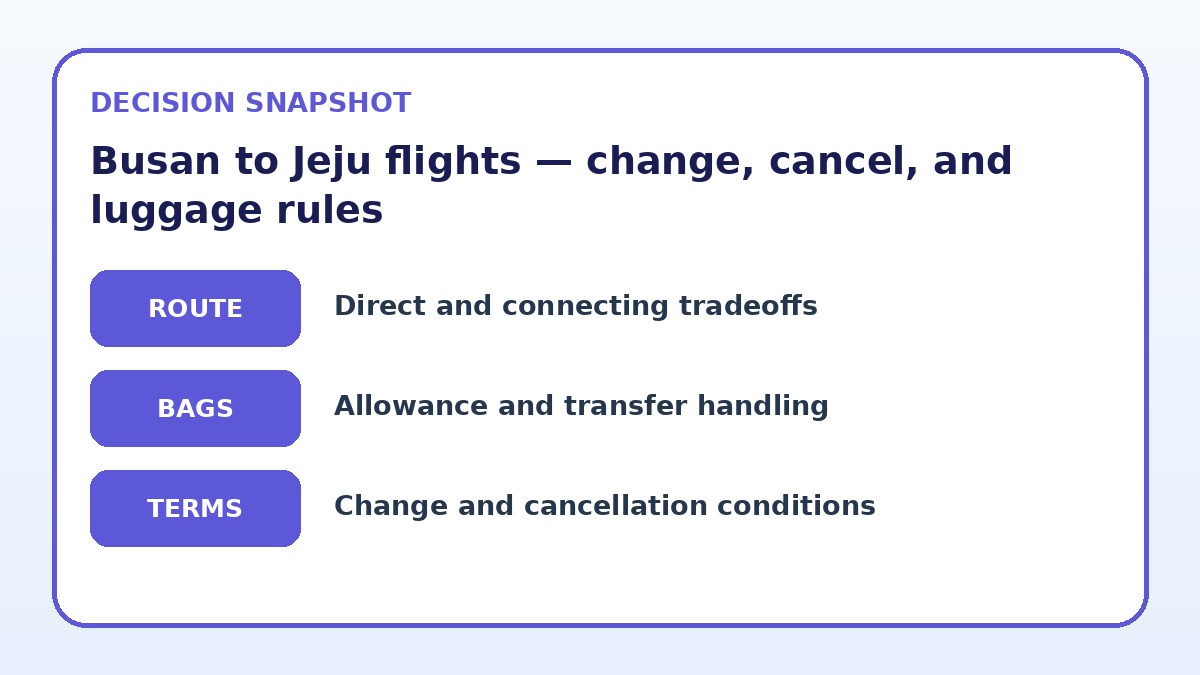
Routing choices and why they matter for baggage
For Busan to Jeju travel most passengers look for direct flights because they minimize handling and reduce the risk of a lost or delayed checked bag. If direct services are available, they are usually the simplest for extra-luggage travelers: fewer transfers mean fewer times your bag is moved and fewer points where a missed connection can strand your luggage. If no direct option suits your schedule, connecting itineraries can still work, but you must verify whether your baggage will be checked through to the final destination or require recheck at the connection airport.
When comparing routes, always check the transfer process: will you change terminals? Is there an overnight connection that requires baggage pickup for customs or security? Even within domestic travel, some carriers operate from different terminals or partner poorly with others, meaning a connecting itinerary may require you to retrieve and recheck bags. On your final booking page, confirm whether the carrier will check your luggage to Jeju automatically and what happens if a connection is missed.
Baggage allowances, special items, and excess fees
The headline allowance—how many kilograms or pieces are included—matters, but the fine print can be decisive. Airlines can differ between piece-based and weight-based systems, and rules for oversized items, sports equipment, or musical instruments often fall outside standard allowances. For travelers with extra luggage, choose the booking option that explicitly lists the number, weight, and dimension limits for checked items; note whether items above those limits require advance reservation or carry a surcharge that is booked in advance versus payable only at the airport.
Also check how the airline defines ‘oversize’ and ‘overweight’ and whether fees escalate per kilogram or per piece. If you plan to bring bulky items, ask whether advance purchase of an excess-baggage allowance or a special-article booking is accepted online; some carriers cap on-board or hold space for large items and require those to be registered in advance. On the provider’s final booking page verify the exact fee schedule, any item-specific booking steps, and whether refunds or credits apply if you later reduce baggage.
Compare flight-selection strategies
| Flight strategy | Best for | Risk to check |
|---|---|---|
| Book a flexible fare that includes baggage | Travelers who want minimal rebooking risk and predictable baggage coverage | Higher upfront fare but fewer surprises for baggage fees and change costs |
| Buy a low-cost fare and add baggage separately | If you are price-sensitive and confident your plans won’t change | Lower base price but potential high airport fees and limited change options |
| Use a basic fare and purchase travel insurance for flexibility | Those who prioritize low fares but want some protection against cancellations | Insurance may not cover airline baggage fees or very short-notice changes |
| Book a refundable ticket without extra baggage included | Travelers who value change/cancel freedom and can prepay baggage only if needed | Refundability cost can exceed the price of flexible but nonrefundable fares with baggage |
Recheck the complete itinerary
Confirm airports, connection handling, baggage, and change conditions before deciding.
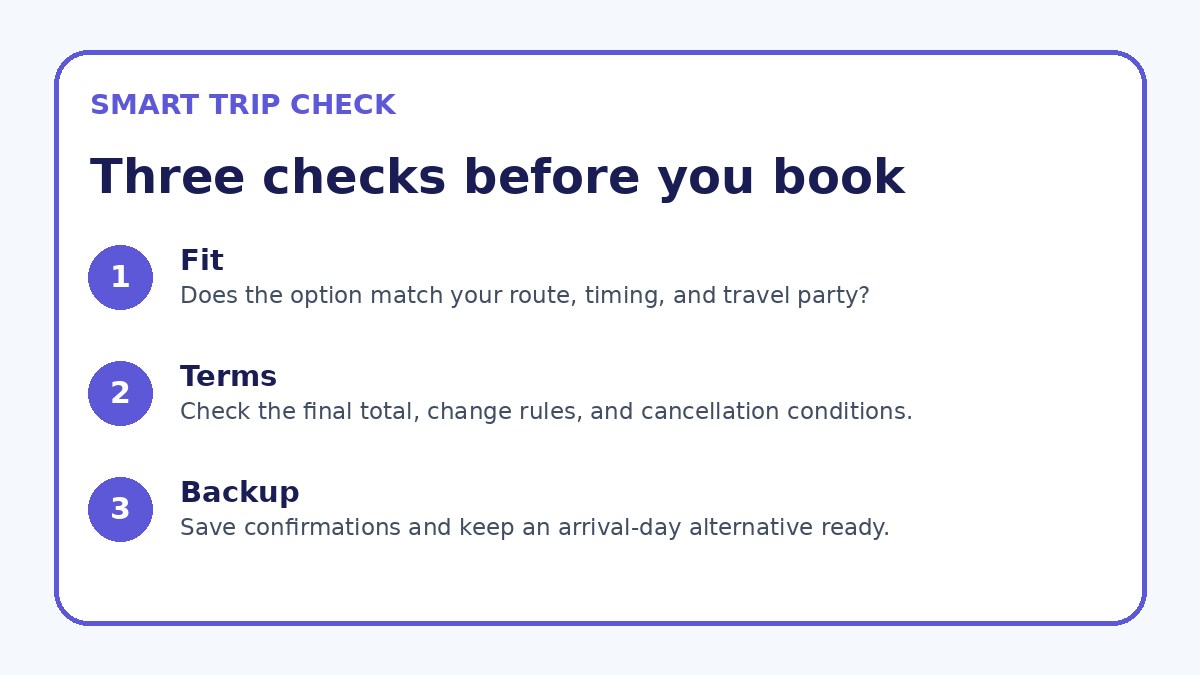
Schedule fit and connection risk when carrying more luggage
Extra luggage usually slows you down at check-in and at arrival. If you need to check heavy or multiple bags, allow extra time at the airport for bag drop and security. Choose flights with comfortable connection windows when itineraries require a transfer; a 30-minute connection might be standard for a light-travel passenger but risky when you must wait longer for baggage processing or move between terminals. When you compare schedules, factor in realistic processing times rather than theoretical minimums.
If an itinerary includes narrow connection windows, investigate the airline’s missed-connection policy and whether they will protect checked baggage. Some carriers will not accept responsibility if schedule changes or delays cause you to miss a separately ticketed onward flight. Where both legs are on the same ticket with a single carrier or properly partnered carriers, your checked bags are more likely to be protected and rebooked automatically, but you must confirm this protection on the booking page and keep contact details handy if re-accommodation is required.
Flight details to verify
- Write down exact travel dates, passenger full names, contact phone and email before comparing live fares.
- Measure and weigh each checked item; note dimensions and item type (sports gear, instrument) to match carrier rules.
- On the airline’s final booking page confirm baggage allowance, special-item procedures, and any advance registration requirements.
- Compare change and cancellation wording: check timing windows, fees, and whether unused taxes are refundable or held as credit.
- If connecting on separate tickets, verify whether bags must be reclaimed and rechecked and plan extra time between flights.
- Save or screenshot the fare rules and baggage policy page immediately after booking so you can reference exact terms later.
Fare conditions, changes and cancellation rules to verify
Fares differ not only by price but by flexibility. Basic or deeply discounted fares commonly restrict changes and refunds and may not include any checked baggage. Mid- and higher-tier fares often bundle baggage and include more forgiving change conditions, or they at least allow paid upgrades. Before completing a booking, read the fare rules on the airline’s final purchase page: look for permitted changes, the cost to change or cancel, whether credit or refund is offered, and how long you have to make a change without penalty.
When provider-specific facts could change, verify the exact wording for change windows (how long before departure you can change), whether change fees apply per passenger or per booking, and the refund policy for unused taxes and fees. If you need both baggage and flexibility, calculate the total cost of a flexible fare versus a cheaper fare plus purchased baggage and separate change protections. Consider buying travel insurance only after confirming whether your fare already offers sufficient protection for changes or cancellations.
Flight Guide questions travelers ask
Will a checked bag be protected on a connecting Busan to Jeju itinerary?
It depends on whether both legs are on the same ticket and whether the carriers have an interline or codeshare arrangement. If you book through a single carrier or through partnered airlines on one itinerary, the carrier will usually check your bag through to the final destination and handle re-accommodation if a connection is missed. If you book separate tickets with different carriers, you may need to collect and recheck your baggage at the connection point. Always confirm on the final booking page whether checked baggage will be through-checked and what the carrier’s missed-connection policy covers.
Should I prepay extra baggage online or pay at the airport?
Prepaying baggage online is generally safer and often cheaper than paying at the airport, and it reduces check-in time. Prepaid options also guarantee space allocation for oversized or special items when required. However, only the airline’s final booking or manage-booking page shows the exact fees and whether the item needs prior registration. If your plans might change, compare the cost of prepaying baggage with flexible fare options and whether airline rules allow refunds or credits for unused baggage purchases.
How do I balance a low fare with the risk of changes when I travel with bulky luggage?
Start by calculating the worst-case cost: add the low fare to the maximum expected baggage fees and potential change fees. Compare that sum to a higher fare that includes baggage and more lenient change terms. Consider the likelihood you will need to change dates: if it is high, the predictable higher fare may be cheaper in practice. Also check whether travel insurance covers the specific change scenarios you care about; insurance rarely covers airline baggage surcharges, so confirm what is and isn’t protected before relying on it.
Final decision note
For travelers with extra luggage on Busan to Jeju flights, the right booking is the one that aligns baggage needs with acceptable change risk. Direct routing reduces handling and the chance of lost bags, but when schedule or price forces a connection you must verify whether baggage is checked through. Always measure and weigh items, confirm special-item rules, and read the fare’s change and cancellation wording on the carrier’s final booking page. Prepare exact dates and passenger details before checking live options, compare the true total cost of baggage plus change flexibility, and keep records of the fare rules after booking so you can act quickly if plans shift.
Continue planning
Check current options and final conditions
Use the provider page to confirm live availability, the final total, cancellation terms, and every condition that matters to your trip.
This evergreen planning guide was created with AI-assisted drafting and a structured quality review. It does not display live prices, schedules, availability, visa guidance, or provider rankings. Verify current details before booking. Some links are affiliate links; we may earn a commission at no additional cost to you.