If your trip centers on central Fukuoka and you plan mostly temple visits, museums and restaurant dives, public transport normally wins for simplicity. But if you want coastal jaunts, rural onsen, or a flexible day trip to Yanagawa or Itoshima, renting can shorten transfers and unlock quieter spots. This guide gives a practical answer up front: for most solo travelers staying inside Fukuoka City, skip a car. Rent only if your itinerary includes multiple day trips outside the rail network or if you value complete schedule freedom and will comfortably handle Japan’s driving environment. Below you’ll find clear tradeoffs—route value, insurance wording to check, pickup and return friction, and a ready non-driving fallback plan—so you can decide with confidence before you hit a booking page.
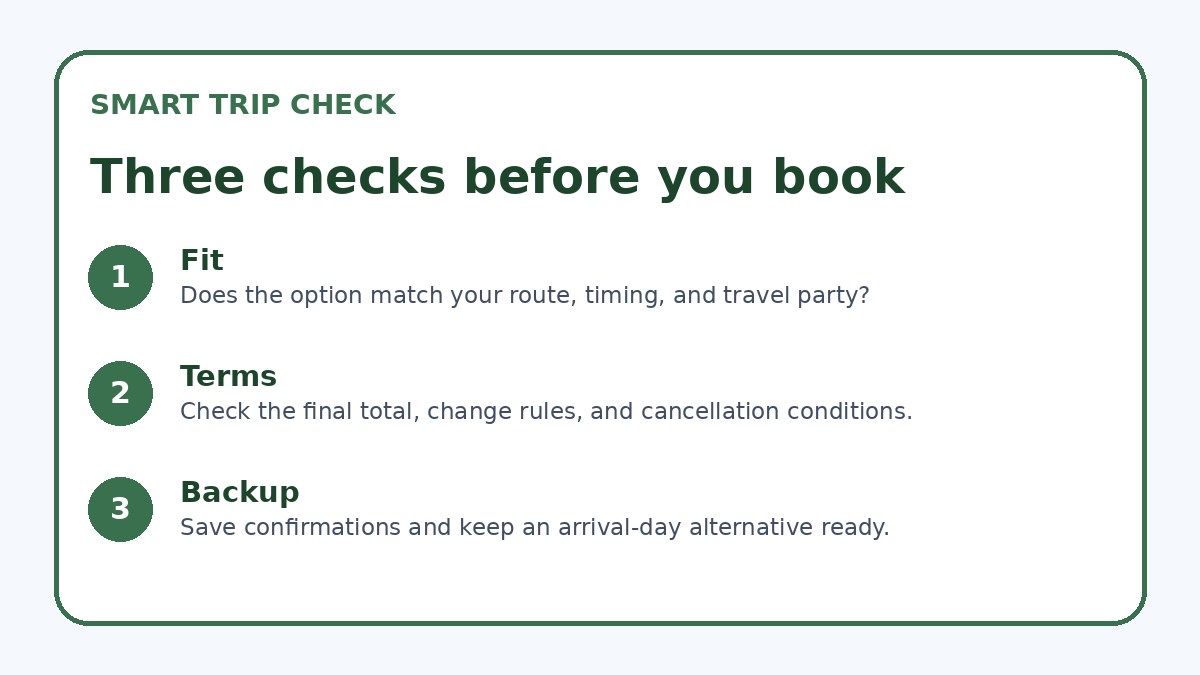
Route value: when driving truly helps your Fukuoka plan
Decide by mapping the actual routes you want to take, not by vague ideas. A single trip to Itoshima’s coastline, an early-morning onsen outside town, or multiple village stops along the Genkai Sea make a car worthwhile. These routes often involve limited or infrequent public transit, long transfer times, and limited last-mile options. If your days are a handful of centrally located museums, markets, nightlife districts and nearby castles, the subway and tram network will usually be faster and far less stressful than parking and urban traffic.
Consider timing and frequency: driving shines when you need to start before the first trains or return after late-night services end, or when your itinerary requires door-to-door hopping between rural sights. But remember the trade: slower average speed through city traffic, parking search times, and occasional narrow local roads where driving in Japan requires focus. Balance the raw time savings against the cognitive load of navigating unfamiliar roads and parking regulations.
Decide whether driving earns its place
| Mobility strategy | Best for | Cost or friction to check |
|---|---|---|
| Public transit only (subway, JR, tram, buses) | Solo visitors staying and sightseeing within Fukuoka City who value low planning overhead and predictable costs. | Less flexibility for rural day trips, limited early/late-night options, and may require more walking or transfers. |
| Short-term rental for specific day trips | Travelers needing a car for one or two rural excursions while using transit in the city. | Requires careful timing for pickup/return and may add complexity for tolls and insurance for short hires. |
| Long-term rental for entire trip | Solo travelers planning many off-network destinations or an itinerary spanning several prefectures. | Higher administrative burden, parking hassles, and ongoing fuel/toll costs; often unnecessary inside the city. |
| Mixed approach: transit plus guided tours/private transfers | Those who want rural access without driving responsibilities or navigating local roads alone. | Less spontaneous than driving and can cost more per trip, but removes insurance and parking headaches. |
Check live rental choices only after the route test
Use the exact driver, dates, pickup point, and return plan to compare current conditions.
Insurance wording: what to verify before you sign
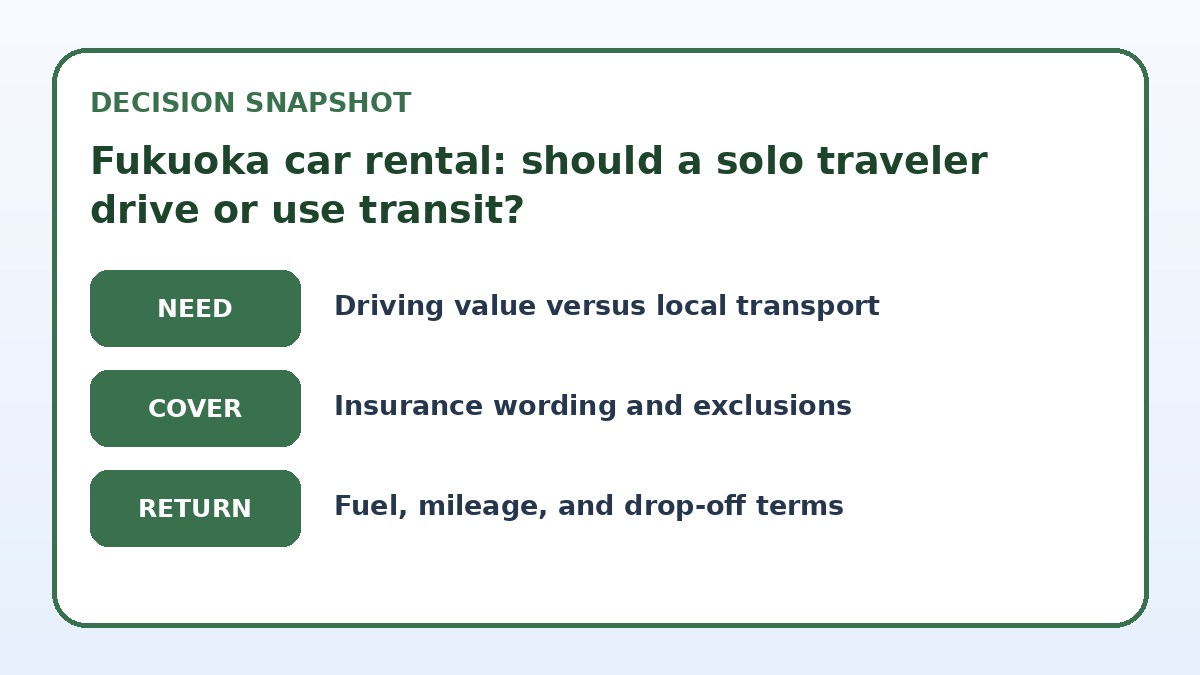
Insurance pages use compact terms that hide crucial limits. Before booking, check liability limits, whether the collision damage waiver (CDW) is included or optional, and what deductibles apply. Confirm whether personal injury, passenger coverage and roadside assistance are part of the package or require separate policies. If the offer mentions third-party coverage or excess reduction, read the final booking terms to learn how claims are processed and whether a credit-card rental protection policy or separate travel insurance is recommended.
Also verify restrictions often buried in the fine print: cross-prefecture travel limits, nighttime driving exclusions, mileage caps, and whether tolls, parking fines or damage to tyres and undercarriage are covered. If you plan to drive onto small island roads or mountain passes, check that the provider allows those routes. Make a screenshot or save the insurer’s policy page so you can reference exact wording at pickup—rental counters sometimes display differing interpretations of coverage.
Compare the full rental conditions
Confirm insurance wording, exclusions, deposit, fuel, mileage, and return terms on the final page.
Pickup and return friction: practical time costs to expect
Pickup and return can eat more time than actual driving. Airport counters may be busy, require ID checks, and have lines for optional insurance upsells. Off-airport outlets can require a shuttle transfer. Confirm office opening hours, the time window for returns, and whether after-hours drop-off is allowed (and whether it costs extra). If you’re collecting at Fukuoka Airport or Hakata, compare the walk from terminal to counter and whether you must wait for a vehicle shuttle. All of these factors turn a short drive into a half-day administrative task if you’re not prepared.
Think about fuel rules, toll cards and parking payment systems you’ll need to use. Some rentals give an ETC (electronic toll) card; others won’t. Returning a car with a near-empty tank can incur refuelling fees, and incorrect toll handling may lead to invoices after you return home. Ask the provider what documentation you’ll receive at return and how disputes over damage or fuel are handled. These operational frictions influence whether the car is a time-saver or a hassle for a solo traveler.
Car rental terms to verify
- Map every day’s start and end points; compare door-to-door time using public transit schedules versus estimated driving time.
- Read the rental agreement’s insurance and damage sections; save or screenshot the precise coverage wording before booking.
- Confirm pickup and return hours, one-way drop rules, and whether after-hours drop-off is allowed for your chosen location.
- Check if an ETC card or toll handling is included and how tolls are charged or reimbursed by the rental provider.
- Identify nearest train stations and late-night taxi options for each overnight because transit may not run when you need it.
- If unsure, book a single-day rental for a planned rural excursion and keep transit-only plans for other days.
Non-driving fallback: clear transit alternatives and backup plans
If you decide not to rent, plan one strong fallback route per day. For example, identify the closest subway or JR station to each destination, note the latest evening train back, and pin two bus lines that serve the area. Make a shortlist of taxi apps or local taxi ranks for late returns and a map of likely parking or drop-off points in case you later change your mind. Buying an IC card (stored-value transit card) simplifies transfers and saves time at ticket machines.
Use a hybrid approach when it fits: rely on public transit in the city and book a guided day trip or a private car for a single rural excursion. That avoids the continuous costs and responsibilities of long-term rental while giving you the access a car provides for a day. If you intend to book one-day rentals, align pickup locations and times to match transit arrivals and ensure the rental counter has flexible return policies you’ve verified on the booking page.
Car Rental & Road Trip questions travelers ask
Is driving in Fukuoka difficult for foreign solo travelers?
Many visitors drive in Japan without issue, but difficulty depends on experience and comfort with local rules. Road signage around Fukuoka is generally clear, with English in major areas, yet you’ll face narrower local roads, left-side driving, and different lane markings. Parking rules can be strict and paid parking is common in city centers; know whether your rental includes assistance for parking fines. If you’re unfamiliar with left-side driving or narrow rural lanes, consider public transit or a guided transfer for rural legs and reserve driving only for routes you’re confident handling.
What should I verify about insurance when booking a Fukuoka car rental?
Check the rental’s collision damage waiver (CDW) terms, deductible amount, and whether third-party liability is included. Verify whether roadside assistance is automatic, if tyre, undercarriage and glass damage are excluded, and whether the policy allows cross-prefecture travel. Confirm who handles tolls and fines, and read the claim process timeline. Keep a copy of the policy and the rental agreement accessible at pickup; if any insurance element is unclear, get written confirmation from the provider before accepting the vehicle.
Can I mix transit and driving without losing money or time?
Yes—mixing is often the most efficient approach. Use transit for urban days and reserve a short-term rental or private transfer for rural side trips. To avoid wasted time, align rental pickup with your transit arrival and pick a pickup location with minimal transfer time (for example, close to a major station or the airport). Compare the administrative overhead of each rental (pickup, return, fuel rules) to the time saved driving to ensure the hybrid choice actually improves your schedule.
Final decision note
For most solo travelers whose itinerary stays inside Fukuoka City, public transport provides a lower-stress, lower-commitment option than a car. Rent a vehicle only when your route list includes multiple rural or off-network destinations where trains and buses add long transfers or constrain timing. Before you book any Fukuoka car rental, read the final booking terms for insurance limits, deductible amounts, cross-prefecture rules, pickup/return hours and toll handling. If doubts remain, book a single-day rental for one key excursion and rely on transit otherwise—this hybrid approach often delivers the best balance of freedom and simplicity.
Continue planning
Check current options and final conditions
Use the provider page to confirm live availability, the final total, cancellation terms, and every condition that matters to your trip.
This evergreen planning guide was created with AI-assisted drafting and a structured quality review. It does not display live prices, schedules, availability, visa guidance, or provider rankings. Verify current details before booking. Some links are affiliate links; we may earn a commission at no additional cost to you.