Decide your stay area first, then choose the room features you actually need. For a solo traveler in Munich that means picking one of a few neighborhoods by what you’ll do each day — city-center for quick museum and train access, Glockenbach or Gärtnerplatz for nightlife and cafes, Schwabing for parks and long daytime strolls, or Haidhausen for quieter local life with good transit. Once the area is chosen, shorten your shortlist by checking walk-time to your main destinations and the hotel’s room size, soundproofing, and storage for a single traveler. This approach reduces daily friction: a slightly smaller room in the perfect spot often saves hours of transit, while a larger room farther out might be worth it when you value quiet or workspace. Later in the article you’ll find criteria to compare listings, the tradeoffs for each neighborhood, and practical booking terms to verify before you finalize a reservation.
Check live stays in the areas that fit
Use your dates and party size to compare current rooms after you narrow the neighborhood fit.
Neighborhood fit: pick the area that matches your agenda
Start by mapping what you’ll do each day and where those places sit across Munich. If you’re mainly arriving or departing by train or planning day trips, staying near Hauptbahnhof or Marienplatz reduces luggage handling and shortens transit connections. If evenings in bars, galleries, or live music matter more, Glockenbachviertel and Gärtnerplatz put you close to cafés and nightlife that remain easy to walk back from. Schwabing suits travelers who want leafy avenues, museums like the Pinakotheken cluster, and a quieter daytime rhythm, while Haidhausen (near Rosenheimer Platz) balances a residential feel with straightforward tram or S-Bahn links into the center.
When choosing, be honest about energy levels and mobility: a centrally located small room may feel cramped but pays back in saved transit time; a larger room out toward Neuhausen or the west can be peaceful but requires longer daily commutes. Consider the specific streets near your prospective hotel — proximity to a U-Bahn or S-Bahn entrance, a tram stop with frequent service, or a well-lit walking route can swing a decision. Use a map to draw walk-time circles for your top three activities and focus on overlap: the neighborhood within most circles is usually your best base.
Choose an area-selection strategy
| Area approach | Best for | Tradeoff to check |
|---|---|---|
| Central (Marienplatz/Hauptbahnhof) choice | Travelers who prioritize short transfers to trains, museums, and a compact walking radius. | Smaller rooms and more tourist noise; higher foot traffic and less neighborhood intimacy. |
| Glockenbach/Gärtnerplatz nightlife base | Those who plan evening activities, bars, and easy walking home at night. | Potential for nighttime noise and fewer large hotel options with full amenities. |
| Schwabing park and culture option | Solo travelers seeking quieter days, cafés, and museum clusters with a relaxed pace. | Longer transfers to some sights and possibly more dependence on U-Bahn connections. |
| Haidhausen residential stay | Visitors wanting local café life, calmer streets, and solid tram or S-Bahn links. | Fewer late-night services and a slightly longer trip to the central tourist sites. |
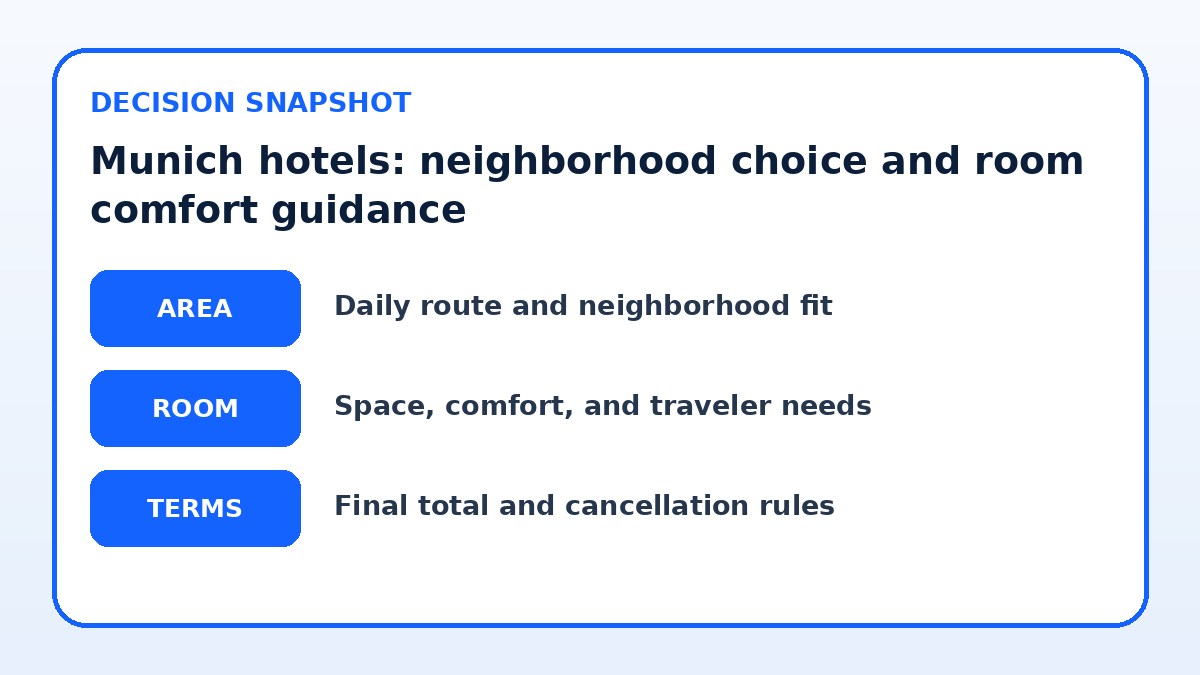
Daily-route friction: evaluate how your hotel affects each day
Think beyond distance: transfer count, frequency of public transit, and the effort of carrying luggage influence your daily experience. A hotel a 20-minute walk from Marienplatz might be faster door-to-door than one five minutes from a less frequent tram if that tram runs only every 15–20 minutes. For early starts or late returns, check that nearby trains or trams run at the times you need, and that the walking route is well lit and direct. If you have mobility constraints, verify elevator availability at stations and hotel entryways, and prefer locations with fewer changes between transport modes.
Also factor in time of day: mid-afternoon exploring, morning museum runs, and late-night returns each have different demands. If you plan several museums in a single day, staying near the Kunstareal (the museum district) is more convenient than oscillating between a central hotel and a distant neighborhood. Conversely, if you want one base but many day trips, proximity to S-Bahn lines that serve regional routes is more useful than nightlife access. Make a simple spreadsheet of likely daily trips and estimated door-to-door times to compare options objectively.
Now compare like with like
Keep the same dates, guests, room needs, and cancellation preferences while you compare the final choices.
Room and party needs: what matters most for a solo traveler
List the room features that will make your solo stay comfortable: bed size, workspace, luggage storage, soundproofing, and bathroom privacy. If you plan to work or read for hours, a well-lit desk and a quiet room are more important than an extra square meter of floor space. If your trip centers on nightlife, prioritize good locks, secure luggage options, and blackout curtains over built-in desks. Small hotels and boutique properties often trade public space for larger private rooms; compare pictures carefully and read recent descriptions to confirm what’s actually included.
Don’t overlook hotel services that substitute for larger rooms: a reliable breakfast, late check-in, luggage hold, and laundry options can make a compact room far more livable. Solo travelers may value contactless check-in and clear late-arrival instructions; confirm these on the hotel’s booking page. If you’re carrying expensive gear, ask about in-room safes or reception-secured storage. Finally, consider the building type—modern hotels often have elevators and thicker walls, while historic buildings may offer charm but noisier corridors and steeper stairs.

Hotel booking check before payment
- Map your main daily destinations and draw 15–30 minute walk or transit circles; prioritize neighborhoods with the most overlap.
- Confirm nearest U-Bahn/S-Bahn/tram stops and check typical service frequency for your planned hours.
- Compare room photos for actual desk space, wardrobe size, and soundproofing indicators like double glazing.
- Open the hotel’s full booking terms and verify cancellation, prepayment, check-in hours, and breakfast details.
- Ask the property about luggage hold, late check-in procedures, and in-room safes if you carry valuables.
- Read recent guest notes about noise, elevator access, and exact building entry arrangements before booking.
Final booking terms: what to verify before you reserve
Before committing, verify cancellation and change policies, check-in and check-out times, and whether the rate includes breakfast or local taxes. Don’t rely on summary labels; open the full terms on the hotel’s booking page and confirm whether non-refundable rates are flexible for your schedule. If you need airport or train transfers arranged, check whether the hotel offers them and what exact steps you must follow to request the service. For anything that could affect your trip—late arrival, early departure, extra luggage—read the fine print and note any mandatory fees or prepayment conditions.
Also confirm operational details that change frequently: whether breakfast hours match your planned mornings, whether on-site facilities like gyms or business centers are open, and whether the property has a 24-hour reception if you will arrive late. If public transport strikes or city events are a concern during your dates, plan alternative routes and ask the hotel about local recommendations. Use Trip.com or similar platforms to compare current availability, but verify final conditions on the hotel’s own booking page before you finalize the reservation.
Hotel Guide questions travelers ask
If I’m here for three days, should I stay centrally or in a quieter neighborhood?
For a short three-day trip, staying centrally usually reduces transit time and lets you see more without rushing between neighborhoods. Central hotels put major museums, main squares, and transport hubs within easy reach, which is handy when your itinerary is tight. However, if you prioritize sleep, long café mornings, or remote work, a quieter neighborhood with good U-Bahn connections can be a better trade. Evaluate how many early starts and late returns you’ll have; if most activities are in the center, central accommodation typically pays back the extra hustle.
How can I judge if a room is quiet enough before booking?
Look for mentions of soundproofing in the room description, photos showing double-glazed windows, and the property’s location relative to busy streets. Search guest comments for repeated notes about nightlife or traffic noise. If noise is critical, contact the hotel to request a high-floor or courtyard-facing room and ask whether rooms face main streets. Also check whether the property specifies quiet hours; historic buildings can be charming but have thinner walls. If available, choose a room type labeled ‘quiet’ or note the request when you book.
What booking terms should a solo traveler prioritize in Munich?
Main priorities are flexible cancellation for unexpected changes, clear check-in instructions (especially for late arrivals), and luggage-hold policies. Also check whether breakfast hours fit your schedule and whether taxes or tourist levies are included. If you plan to work, confirm reliable Wi‑Fi and whether the hotel has a business-friendly room option. Finally, verify identification requirements and whether the hotel needs advance notice for any special access needs so there are no surprises on arrival.
Final decision note
For solo travelers in Munich the most practical path is: pick the neighborhood that matches your daily agenda, then refine by room features that affect sleep, work, and luggage handling. Central neighborhoods shave off transit time for short trips; Glockenbach and Gärtnerplatz reward night owls; Schwabing offers green space and cultured days, and Haidhausen provides a quieter local feel. Once you shortlist an area, compare door-to-door times for your typical day, check photos and descriptions for workspace and noise control, and read the hotel’s full terms on the provider page before booking. Use these steps to make a confident shortlist, and verify final details on the hotel’s booking page or on Trip.com if you want to compare current availability.
Continue planning
Check current options and final conditions
Use the provider page to confirm live availability, the final total, cancellation terms, and every condition that matters to your trip.
This evergreen planning guide was created with AI-assisted drafting and a structured quality review. It does not display live prices, schedules, availability, visa guidance, or provider rankings. Verify current details before booking. Some links are affiliate links; we may earn a commission at no additional cost to you.