Practical answer up front: for most solo travelers visiting central Kyoto, public transport and walking are usually easier, cheaper, and less stressful than renting a car. Driving becomes worth considering if you plan multiple day trips outside the city—mountain shrines, rural temples, Sakai-style countryside—or if your itinerary includes early-morning or late-evening stops that public transit won’t serve. Before you book a Kyoto car rental, weigh route value (what you want to see), pickup and return friction (airport vs city center), and insurance wording (liability, CDW, roadside assistance). This article walks through those tradeoffs, shows four mobility strategies to compare, explains what to verify on booking pages, and gives a concrete non-driving fallback so a single missed connection won’t ruin your trip.
Route value: when a car adds meaningful access
Decide by mapping destinations, not feelings. Kyoto’s core—Gion, Higashiyama, Kiyomizu-dera, Arashiyama—has dense pedestrian and public-transit coverage. A car does not speed movement inside those neighborhoods and often adds parking time and cost. A solo traveler can see a long list of iconic spots with efficient rail, private shuttle buses, and short taxi hops, so the marginal benefit of a car for central sightseeing is low.
Driving shines when your plan prioritizes outlying places with poor public-transit frequency. Examples that typically justify a Kyoto car rental include small rural temples, mountain routes with multiple dispersed stops, or day trips that stitch several low-frequency sites together. If your mapped day would otherwise require multiple transfers, long waits, or early starts, a car can turn an impractical day into a comfortable one—provided you check road access, seasonal closures, and parking capacity at each stop before booking.
Decide whether driving earns its place
| Mobility strategy | Best for | Cost or friction to check |
|---|---|---|
| Public transit and walking | Solo travelers focused on central Kyoto and tighter budgets | Less flexibility for early/late or remote-site travel; requires some walking and transfer planning. |
| Car rental for day trips only | Solo travelers wanting targeted access to rural or dispersed sites | Requires coordinating pickup/return and paying per-day rental plus parking; insurance clarity needed. |
| Multi-day car rental | Itineraries with many remote stops or an overnight countryside loop | Higher pickup/return friction, solo fatigue driving, and more exposure to contract restrictions. |
| Blended approach (transit + occasional taxi/short rental) | Travelers who want transit convenience with occasional extended reach | May be slightly more expensive per excursion and requires rebooking flexibility and good advance planning. |
Check live rental choices only after the route test
Use the exact driver, dates, pickup point, and return plan to compare current conditions.
Insurance and contract wording solo travelers must check
Insurance terms vary by country and company; the headline items to verify are liability coverage levels, collision damage waiver (CDW) limits, and whether roadside assistance is included. For solo travelers, confirm who is an authorized driver (some contracts restrict rental to the named driver only), what documentation is required to process a claim, and whether any third-party insurance you hold (credit card or travel policy) is accepted as primary or secondary.
Also watch the small-print exclusions that commonly affect lone drivers: restrictions on mountain roads, off-road use, winter tire or chain requirements, and penalties for driving outside Japan’s designated areas. If the booking page or contract uses terms you don’t understand, ask the rental company to email a clear explanation before you commit. When in doubt, take photos of the vehicle at pickup and record the fuel level and odometer; those simple steps reduce disputes and keep solo travelers in control.
Compare the full rental conditions
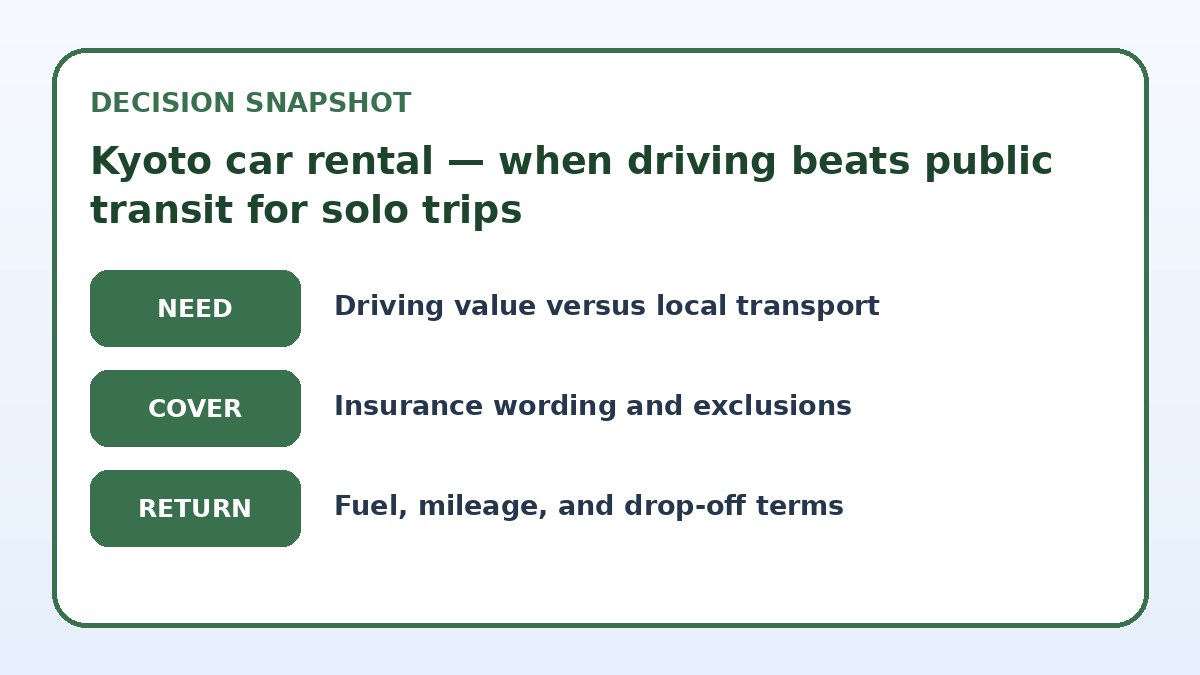
Confirm insurance wording, exclusions, deposit, fuel, mileage, and return terms on the final page.
Pickup, return friction, and daily convenience
Where you collect and drop off the car matters as much as the rate. Airport pickups often save time if you’re arriving with luggage and plan immediate out-of-city driving; but airport desks can have longer queues and shuttle transfers to vehicles. City-center pickups avoid long drives into Kyoto but sometimes limit vehicle choice and may close earlier—confirm desk hours, drop-off procedures, and whether after-hours returns are allowed without extra fees.
Think through daily convenience: narrow streets, one-way routes, and busy neighborhoods make central parking awkward. Solo drivers face all navigation and fatigue alone, so prioritize rentals with easy pick-up instructions, 24/7 roadside assistance, and a pick-up location that matches your arrival. If public transport handles most of your days, consider a same-day or one-day rental from a nearby location for specific day trips rather than a multi-day hire that increases complexity.
Car rental terms to verify
- Map every planned stop and mark nearest train or bus station to measure actual walking versus driving time.
- Photograph rental contract pages, vehicle condition, and odometer at pickup to document pre-existing damage.
- Confirm permitted drivers, CDW terms, liability limits, and roadside assistance coverage on the final rental booking page.
- Verify pickup and return office hours, after-hours procedures, and any shuttle transfers before choosing airport or city pickup.
- Identify alternative transit options for each remote stop (train line names, nearest stations, and bus routes) and save offline maps.
- Reserve parking in advance where possible or call destinations to confirm on-site parking and any vehicle size restrictions.
A credible non-driving fallback every solo traveler should have
Even if you choose to rent, prepare a non-driving plan in case weather, fatigue, or unexpected traffic makes driving unwise. That fallback should list train and bus lines that reach your key sites, nearby taxi contact options, and a mapped alternative day plan that clusters sites by transit direction. Keep a downloadable offline map and the names of destinations in Japanese script to show drivers or station staff when needed.
Also ensure you can cancel or shorten a rental if you decide not to drive: check cancellation windows, refund policies, and whether you can rearrange pickup without heavy penalties. For true peace of mind, identify one or two flexible local tour operators or day-trip buses that accept single travelers on short notice; these can replace a rented car for remote excursions while keeping your schedule intact.
Car Rental & Road Trip questions travelers ask
Do I need an international driving permit to rent and drive in Kyoto?
Requirements depend on your country of license and the rental company: some nationalities must present an International Driving Permit (IDP) plus their home license, others need a certified translation or local license. Always check the rental company’s listed driver eligibility and the documentation they request on the booking page before you travel. Carry the original home license, the IDP or translation if required, your passport, and any rental confirmation paperwork; without the correct documents, the company may refuse rental at pickup.
How should I judge whether parking will be available at a specific temple or rural site?
Parking availability varies by site and season; don’t assume every temple has adequate parking. Look for official site pages or contact the shrine/temple directly to ask about on-site parking, capacity, vehicle size limits, and fees. If a site lists only a small lot or none, identify nearby public lots or a drop-off point and confirm taxi access. For remote stops, plan a backup nearby attraction served by transit in case parking is full or access is restricted.
What clauses in the rental contract matter most to solo travelers?
Focus on clauses about authorized drivers, cross-border travel, CDW and liability limits, roadside assistance, and exclusions (mountain roads, weather closures, or off-road use). Also check fuel policy, after-hours return fees, and late-return penalties. If you rely on a credit card for secondary insurance, confirm whether the rental company accepts it and whether any hold will be placed on your card. When terms aren’t clear, request a written clarification from the company before pickup to avoid surprises.
Final decision note
The simple decision framework for Kyoto car rental is this: if your days are based in central Kyoto, favor public transit, walking, and occasional taxis. Choose a car when your itinerary contains multiple dispersed rural stops, tight early/late schedules, or routes with poor bus or train coverage. Before booking, map your route value, verify all insurance and driver rules on the supplier’s final booking page, and plan pickup/return logistics to avoid airport or after-hours friction. Keep a prepared non-driving fallback—train/bus options, taxi contacts, and a short alternative itinerary—so a single change of plans doesn’t derail your trip. With those checks, solo travelers can pick the mobility strategy that matches the kinds of places they want to see, rather than committing to a car by default.
Continue planning
Check current options and final conditions
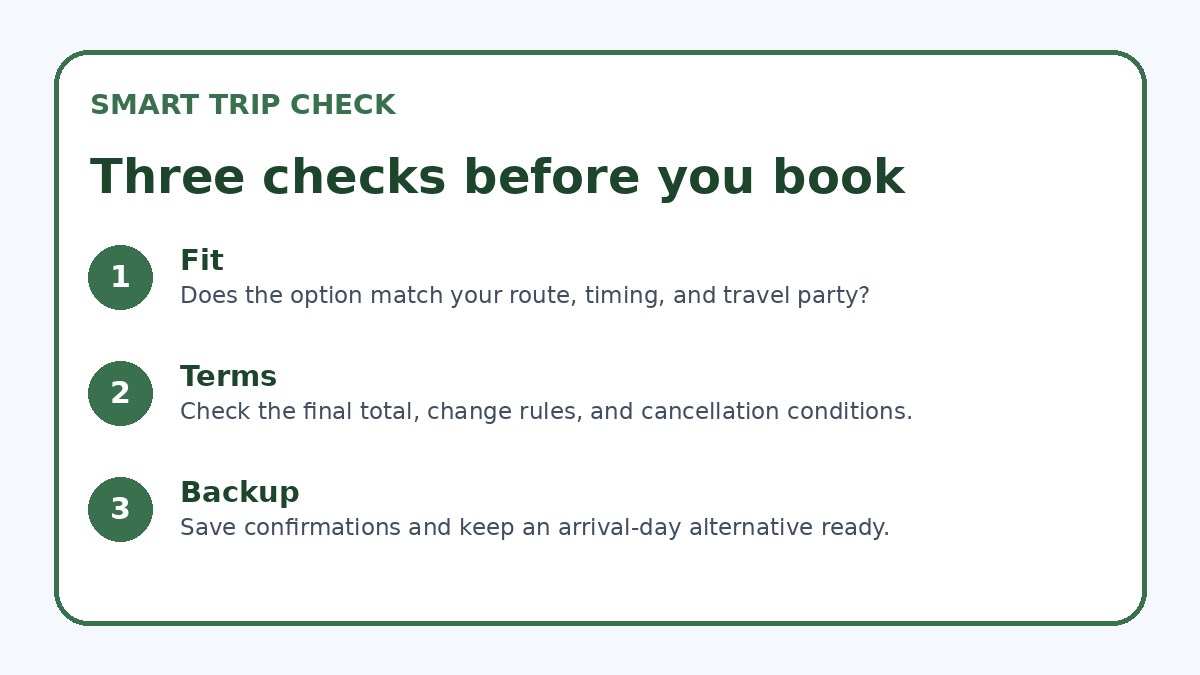
Use the provider page to confirm live availability, the final total, cancellation terms, and every condition that matters to your trip.
This evergreen planning guide was created with AI-assisted drafting and a structured quality review. It does not display live prices, schedules, availability, visa guidance, or provider rankings. Verify current details before booking. Some links are affiliate links; we may earn a commission at no additional cost to you.