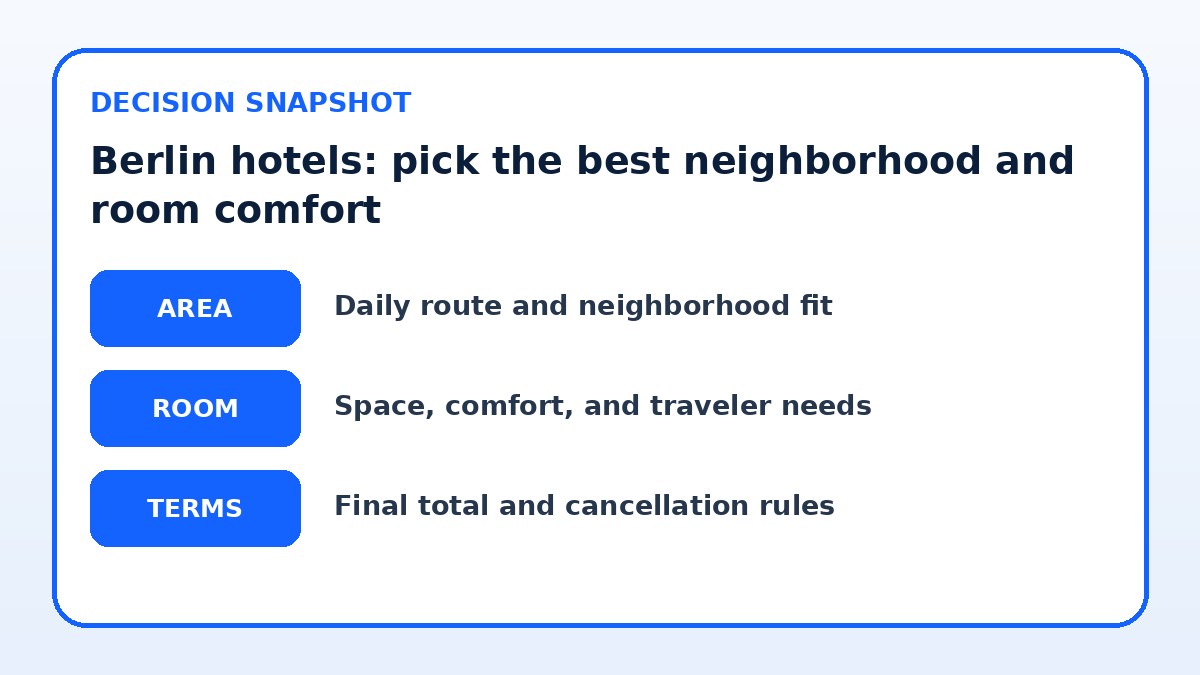
Pick the neighborhood first: choose Mitte or Kreuzberg if you want short walks to museums, nightlife and transport; choose Prenzlauer Berg or Charlottenburg if you prefer quieter streets, longer mornings and calmer evenings. For a typical solo trip, prioritize one of those two area types, then select a room that fits your daily rhythm — a compact, well-located single is great if you plan long days out; a larger room with a seating area and blackout curtains makes sense if you’ll be spending evenings working, resting, or recharging in the hotel. This article gives a fast recommendation up front, then walks you through daily-route friction, room and party needs, and the booking terms you must verify before you commit.
Check live stays in the areas that fit
Use your dates and party size to compare current rooms after you narrow the neighborhood fit.
Neighborhood fit: central convenience vs calmer residential
Decide whether you want short distances to Berlin's main attractions or a quieter local feel. Mitte, Alexanderplatz and parts of Kreuzberg put museums, major tram and U-Bahn lines, and evening options within easy walking distance. Staying here reduces daily commute time and leaves more hours for exploring. The downside is street noise, busier eateries and sometimes higher nightly demand for rooms.
If you prefer calmer streets and a more residential rhythm, look toward Prenzlauer Berg, Charlottenburg or parts of Friedrichshain farther from the Spree. You trade longer first-mile trips to major sights for leafy cafés, lower nighttime noise and often a different choice of small grocery stores and local bakeries. For solo travelers who value sleep and a relaxed evening, these neighborhoods can be a better base, but expect slightly more planning for museum days or late-night transport.
Choose an area-selection strategy
| Area approach | Best for | Tradeoff to check |
|---|---|---|
| Stay central (Mitte/Kreuzberg) | Maximizing sightseeing time and short walks to museums, nightlife and transit hubs | More street noise and higher foot traffic; possibly smaller rooms and busier dining at night |
| Stay residential (Prenzlauer Berg/Charlottenburg) | Quieter evenings, better bakery culture and more relaxed streets for solo walking | Longer transit to major sights; requires planning for evening returns |
| Choose a transit-hub location (near Hauptbahnhof or Zoologischer Garten) | Easy long-distance travel connections and straightforward arrival/departure logistics | Areas are functional rather than atmospheric and may be busy at peak travel times |
| Prioritize in-room comfort over location (larger rooms in quieter blocks) | Remote work, rest days, or privacy after late nights | More commuting time to main sights; may feel removed from central evening activity |
Daily-route friction: how location affects your day
Map the practical movements of your trip before you pick a neighborhood: mornings to museums, afternoons to neighborhoods, evenings to performances or nightlife. If most your activities cluster in Mitte and Museum Island, staying in that area cuts walking and transit time; you can nap between blocks or head out again quickly. Conversely, if you want to hop between distant neighborhoods—like a morning in Charlottenburg and an evening in Kreuzberg—staying centrally can reduce back-and-forth time.
Also factor night travel: Bahn and U-Bahn run differently overnight than during the day. If you foresee late returns, staying near well-lit main streets and frequent-night service stations eases solo arrival. Check the exact station names, walking routes, and whether a tram stop or U-Bahn exit requires stairs or long ramps. Don’t assume “close to transport” on a listing means the route is convenient for your particular daily plan—verify on local transit maps.
Now compare like with like
Keep the same dates, guests, room needs, and cancellation preferences while you compare the final choices.
Room and party needs: single travelers aren’t all the same
Solo travelers have varied needs: some need just a bed and a safe place to store a backpack, others need a work table, reliable Wi‑Fi and a minibar or kitchenette for longer stays. Pick the room type after you decide your top priorities. If you plan long days out and only sleep in the hotel, a compact single or standard double near transit will save money and time. If you work remotely or value in-room downtime, prioritize a larger room with a separate seating area, good blackout options and soundproofing.
Safety and social preferences also matter. Look for properties with 24-hour reception or secure keycard access if arriving late, and check whether the property has lockers or in-room safes for valuables. If you hope to meet other travelers, consider small boutique hotels or vetted hostels with private rooms that advertise communal spaces. Whatever you choose, read the booking page for exact bed dimensions, noise notes, and whether the room faces a courtyard or main street—these details materially affect comfort.
Hotel booking check before payment
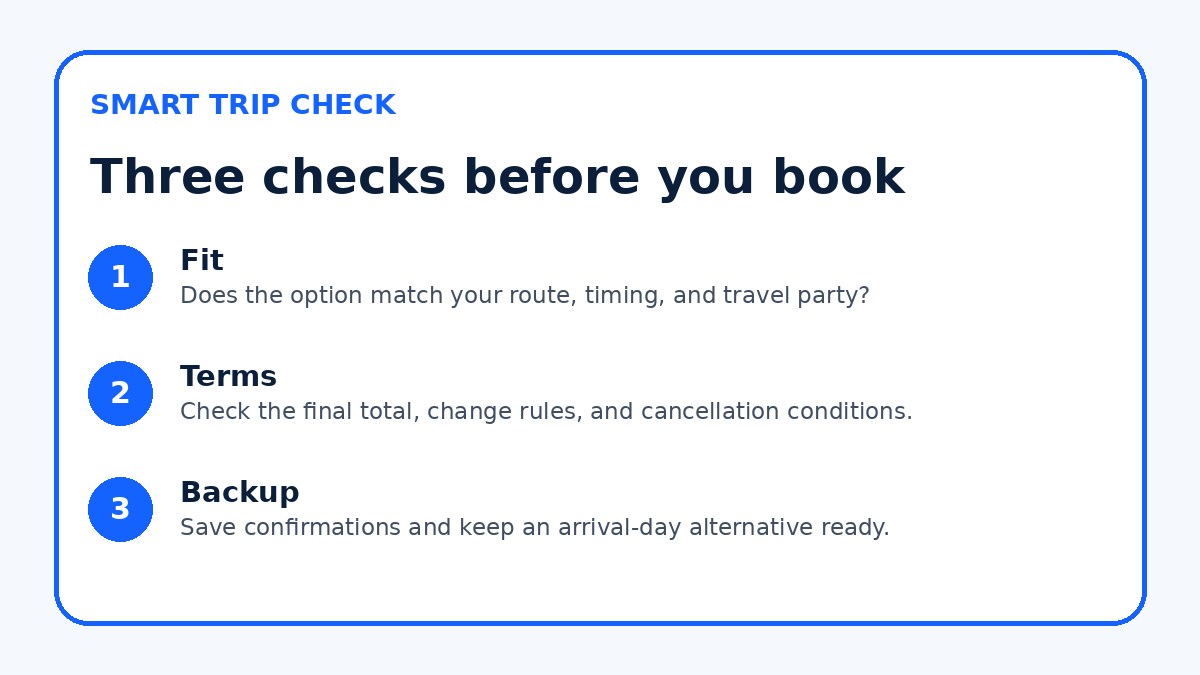
- Pick one neighborhood type first—central or residential—based on your typical daily schedule and noise tolerance.
- List your three daily priorities (museums, nightlife, work time) and test them against walking and transit times on a map.
- Confirm elevator access, stairs, and exact room floor when you have heavy luggage or mobility needs.
- Read the cancellation, prepayment and ID policy on the hotel’s final booking page; screenshot or save the confirmation.
- Verify nearest transit stops by name, check evening/night service, and plan at least one door-to-door route for late returns.
- If you need meeting or coworking space, confirm Wi‑Fi speed, desk availability and whether a day room is possible for focused work.
Booking terms and what to verify before finalizing
Before you book, verify cancellation policy, prepayment requirements, and the exact check-in/check-out window. Policies differ by room type and rate; a flexible rate often costs more but removes stress if plans change. Also confirm ID rules, whether the property asks for a deposit on arrival, and any local registration requirements. If you plan an early arrival or late departure, check luggage storage options; some hotels hold bags for free, others charge.
Confirm transport access on the provider’s final booking page: the listed “distance to station” may be measured in walking minutes without considering stairs, luggage-friendly ramps or late-night safety. Check whether the property has an elevator if you need an upper-floor room, and whether there are additional fees for cleaning or city levies. If you want to compare live inventory, you can optionally check a comparison site such as Trip.com—but always validate the final terms on the hotel’s own or official booking partner’s pages.
Hotel Guide questions travelers ask
Which Berlin neighborhood is safest for solo travelers who arrive late at night?
Safety depends on street lighting, how busy the area is late at night, and the specific block rather than the whole neighborhood. Choose a hotel near main streets with late public-transport options, look for 24-hour reception or secure entry, and read recent guest notes about night noise and safety. Verify the hotel’s exact address and the walking route from the nearest late-night station on a map before booking—don’t rely on general neighborhood labels alone.
Should I prioritize a lower price or a better location when traveling alone in Berlin?
Think about where you’ll spend your days. If you plan long, full sightseeing days and late returns, prioritize location to save commuting time and reduce the need for taxis. If your itinerary includes long rests, work sessions, or you’re on a tighter budget, a cheaper room in a quieter, slightly further neighborhood can be fine. Balance this by checking transport options and whether the savings are worth the extra daily travel time.
How can I check if a listed room is truly quiet and suitable for remote work?
Look for specific mentions of soundproofing, courtyard-facing rooms, and blackout curtains on the listing. Check guest reviews that mention noise levels and whether the property advertises business-friendly amenities (desk, reliable Wi‑Fi). If noise is critical, contact the property to request a quiet room and ask about typical evening noise or construction. Finally, verify the exact desk dimensions and Wi‑Fi policy on the provider’s booking page before you finalize.
Final decision note
For solo travelers in Berlin the practical approach is simple: choose a neighborhood type first, then match the room to how you’ll actually use it. Central neighborhoods minimize walking and allow quick returns between activities, while residential areas give quieter evenings and a slower pace. Once you’ve picked the area, focus on concrete room details—bed size, elevator access, noise orientation and in-room workspace—and verify cancellation, prepayment, and exact check-in rules on the hotel’s final booking page. With that checklist finished you’ll be able to shortlist one or two areas and open live inventory confidently, comparing exact terms and photos before you book.
Continue planning
Check current options and final conditions
Use the provider page to confirm live availability, the final total, cancellation terms, and every condition that matters to your trip.
This evergreen planning guide was created with AI-assisted drafting and a structured quality review. It does not display live prices, schedules, availability, visa guidance, or provider rankings. Verify current details before booking. Some links are affiliate links; we may earn a commission at no additional cost to you.