If you’re traveling from Seoul to Gyeongju with bulky suitcases, photography gear, or sport equipment, the practical choice is the option that minimizes transfers and heavy lifting while matching your schedule. For most travelers that means picking the service or combination that offers easy terminal access, guaranteed space for large items, and a simple last-mile plan to your accommodation. This article helps you compare rail, express coach, private car, and mixed door-to-door approaches by highlighting luggage friction, transfer complexity, timing flexibility, and disruption backups. I’ll explain what to check on operator booking pages, how to plan the final transfer in Gyeongju, and how to decide when paying a bit more for convenience is worth it. Use this to make a decision that keeps your trip on time and your bags under your control.

Terminal fit: where you start and finish matters
Begin by mapping the exact terminals in Seoul and drop-off points in Gyeongju. Seoul’s major rail and coach terminals typically have elevators, staffed luggage storage, and platform access, which matters if you are handling oversize or multiple bags. If your departure terminal requires long walks between check-in and platform, those corridors become a practical cost—think about how many suitcase lifts you can realistically manage, whether you’ll need a porter, and if station trolleys are available. Compare how each mode places you relative to your Seoul accommodation or hotel check-out.
On the Gyeongju side, some stations or bus terminals are a short taxi ride from historic neighborhoods and many hotels. A solution that drops you at a terminal with easy taxi ranks or short shuttle options usually beats the cheapest option that stops farther away. If you’re staying at a guesthouse down narrow lanes, verify that local roads accept taxis with large trunks. Wherever provider-specific facts could change, check the operator’s booking page for terminal addresses, luggage facilities, and any recommended last-mile transfer partners.
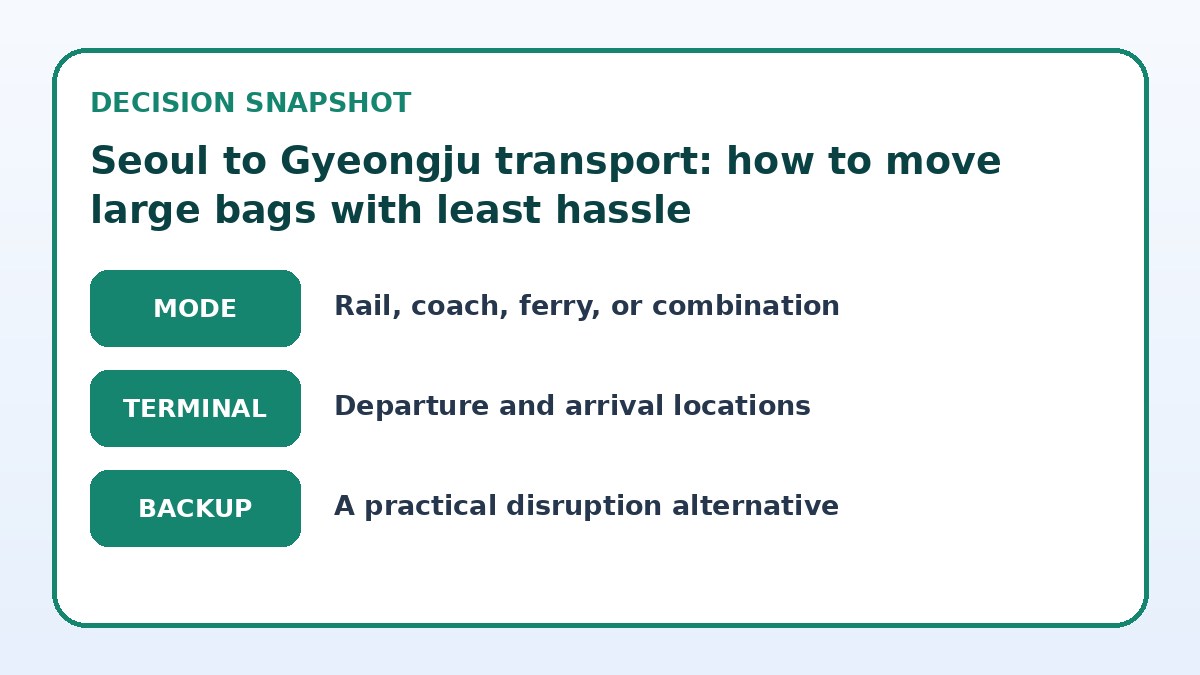
Choose the end-to-end journey plan
| Journey approach | Best for | Friction to check |
|---|---|---|
| Rail (direct or with one connector) | Travelers valuing comfort and stability with moderate luggage handling | May require platform transfers and confirming luggage space; check station elevator access and seat reservations. |
| Express coach (door-to-terminal) | Those who want fewer personal lifts and simpler boarding with large suitcases | Drop-off may be farther from final address; verify stop locations and how luggage is handled at each stop. |
| Private car or taxi (door-to-door) | Travelers prioritizing minimal handling and direct transfers to accommodation | Higher cost and vulnerable to road traffic; confirm vehicle trunk size and pick-up/drop-off logistics. |
| Mixed (train/coach + booked transfer) | Travelers seeking a balance of cost and convenience while limiting manual luggage moves | Requires careful timing and a reliable last-mile provider; plan buffer time between legs. |
Check live intercity options
Look beyond the ride itself and compare terminals, transfers, luggage, and arrival fit.
Luggage and transfer friction: how much handling will you do?
Count connections and physical lifts when deciding: each transfer increases the chance of delays, lost items, or fatigue. Trains often allow larger suitcases in vestibule areas or special racks, but policies can vary; coaches load baggage into underfloor bays and only one baggage handler typically moves items, which lessens your personal effort. A private car virtually eliminates intermediate handling, but you must be comfortable with road travel time and possibly narrow streets at your final stop. Consider whether you can manage stairs, curbside loading, and carrying heavy bags across platforms.
If your gear includes fragile or bulky items—tripods, skis, or large boxes—look for services that offer dedicated luggage compartments or the option to dispatch freight-style shipments. When using mixed modes, time your connections to avoid tight transfer windows: leaving 45–90 minutes between arrival and the next pickup reduces stress from minor delays. Always verify luggage size limits and any extra handling options on the provider’s final booking page before finalizing plans.
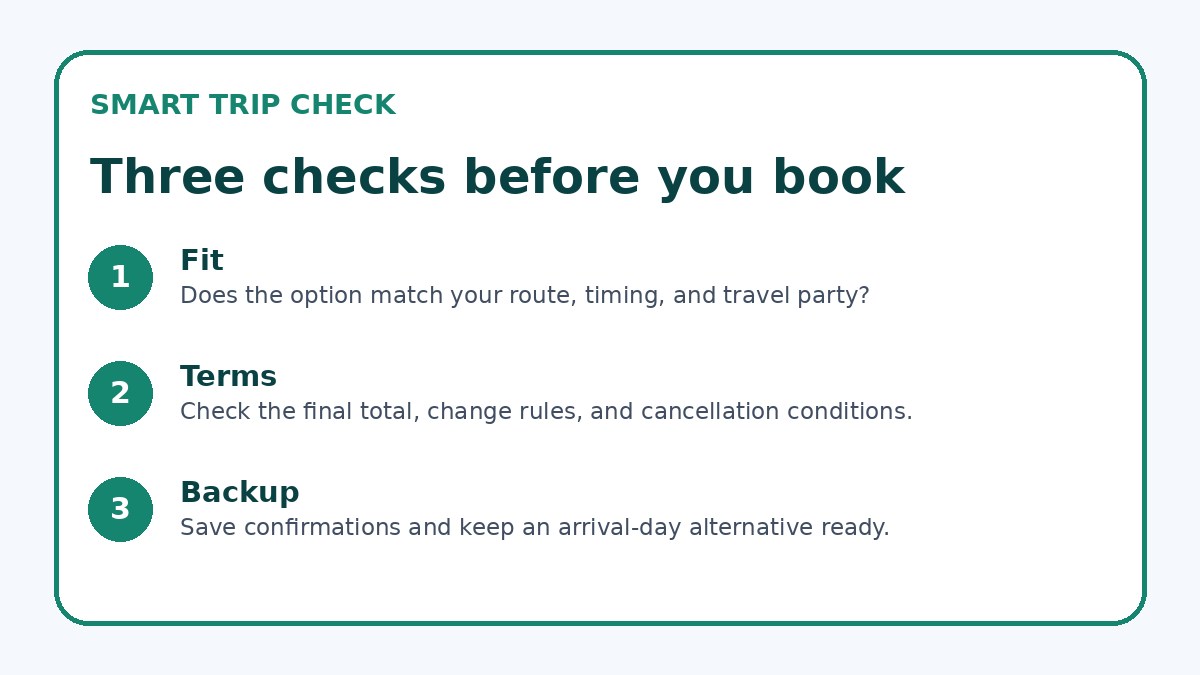
Timing flexibility: schedules, frequency, and peak travel times
Assess how often services run and how that interacts with your flight or check-out time. Frequent trains and buses reduce the need to rush, but less frequent departures make a private car more attractive despite higher cost. Peak travel periods—weekends, holidays, and festival dates—tighten availability and can make station areas busier, which increases transfer friction for oversized bags. Choose options that allow a buffer for delays and give you the freedom to reschedule without complex rebooking penalties.
If you must arrive or depart at a specific hour—early morning or late evening—confirm that terminals are staffed and trolleys or baggage assistance are available at those times. For services with reserved seats or vehicle types, check cancellation and change policies on the operator’s site. Trip.com can be useful to compare current availability and conditions, but always confirm the final details on the provider’s official booking page since operational details can change.
Compare the practical alternatives
Use the final page to confirm what is actually offered on your dates and save a workable fallback.
Intercity travel checklist
- Before booking, note both Seoul departure terminal and Gyeongju arrival terminal addresses and confirm elevator and trolley availability.
- Check luggage size and quantity rules on the operator’s official booking page and ask about reserved spaces for oversized items.
- Plan a single, pre-booked last-mile transfer (taxi or hotel shuttle) to avoid multiple handoffs in Gyeongju.
- Allow at least 45–90 minutes buffer between connections when mixing modes to absorb minor delays.
- Save contact numbers and terminal maps offline, and screenshot booking confirmations for all legs and transfers.
- Confirm backup options—alternate departure times, another carrier, or a pre-booked taxi—in case your booked service is disrupted.
Disruption backup: plan a simple, measurable fallback
Pick a realistic backup that won’t increase luggage handling if your primary plan is disrupted. Good backups are another service with the same terminal access, a pre-arranged taxi with a large trunk, or a local luggage transfer courier that will collect at the station and deliver to your hotel. Avoid backups that rely on multiple short hops; each additional handoff amplifies risk. Make sure the fallback is bookable from your phone and that you know exactly where to meet the driver or courier if schedules slip.
Before you travel, download maps of Seoul and Gyeongju terminals and save the addresses, plus two phone contact options for your accommodation. If you plan to rely on a taxi as a fallback, note the common taxi types and whether you’ll need a larger-vehicle request. If you choose a luggage-forwarding service, verify pickup windows and delivery timing on the provider’s booking page and give yourself margin time for deliveries that might arrive after your check-in deadline.
Rail & Intercity Transport questions travelers ask
Is it better to take the train or coach from Seoul to Gyeongju if I have oversized luggage?
For oversized luggage, coach services often reduce how much you personally lift because baggage is handled by staff into underfloor compartments; however, coaches may stop at bus terminals that are less convenient for your final address. Trains can offer more stable, roomy onboard storage and easier access between carriages, but policies on oversized items vary by operator. To decide, compare how many transfers each option requires, whether terminal layouts include elevators and ramps, and whether either service requires advance notice for large equipment. Verify specific luggage rules on the provider’s booking page before deciding.
Can I send luggage separately so I can travel light on the Seoul to Gyeongju leg?
Yes, luggage-forwarding services exist that pick up bags and deliver them to your hotel or a terminal; this can remove transfer friction and protect fragile items. But these services have pickup windows and delivery timelines that must match your schedule, and they sometimes require a physical handover at a staffed counter. If you plan to use this option, confirm pickup and delivery timeframes, insurance terms, and where to meet the courier in both Seoul and Gyeongju on the courier’s booking page. Keep essentials with you in case of delivery delays.
What should I verify on booking pages to avoid surprises with luggage policies?
Look for explicit size and weight limits, the number of allowed pieces, and whether oversized or unusual items (golf clubs, tripods, boxes) need pre-notification. Check whether baggage is carried by staff or left in shared compartments, and whether there are extra handling fees. Also confirm terminal addresses, boarding and drop-off procedures, and customer service contact details for day-of travel. If anything is unclear, contact the operator directly before you book; Trip.com can be a helpful reference to compare availability, but always confirm critical luggage details with the provider.
Final decision note
For travelers with extra luggage, the winning choice is the option that minimizes transfers and personal handling while matching your schedule and budget. Private cars win on door-to-door convenience but cost more and may be impacted by road traffic. Coaches reduce your own lifting but can place you farther from your final address, while rail combines comfort with dependable onboard space if you confirm luggage allowances and station access in advance. A mixed plan with a single pre-booked last-mile transfer often balances cost and practicality. Before you book, verify luggage rules, terminal addresses, and backup options on operator pages so your bags arrive as smoothly as you do.
Continue planning
Check current options and final conditions
Use the provider page to confirm live availability, the final total, cancellation terms, and every condition that matters to your trip.
This evergreen planning guide was created with AI-assisted drafting and a structured quality review. It does not display live prices, schedules, availability, visa guidance, or provider rankings. Verify current details before booking. Some links are affiliate links; we may earn a commission at no additional cost to you.