Practical answer up front: for most couples who value schedule freedom and low-transfer friction, choose the combination of cross-border rail or coach with refundable or changeable fares—unless your schedule is fixed and you prefer the fastest single-mode option even with stricter ticket rules. The real decision hinges on how you balance flexibility, door-to-door convenience, luggage needs, and the pain points of crossing an international border. Start by comparing whether a single through-ticket exists, how easy transfers are between terminals, and what penalties apply for date or name changes. If avoiding stress at the border and keeping plans adjustable matters more than shaving minutes off travel time, prioritize tickets with easy changes and clear refund rules.
Choosing modes: rail, coach, ferry, or a combo
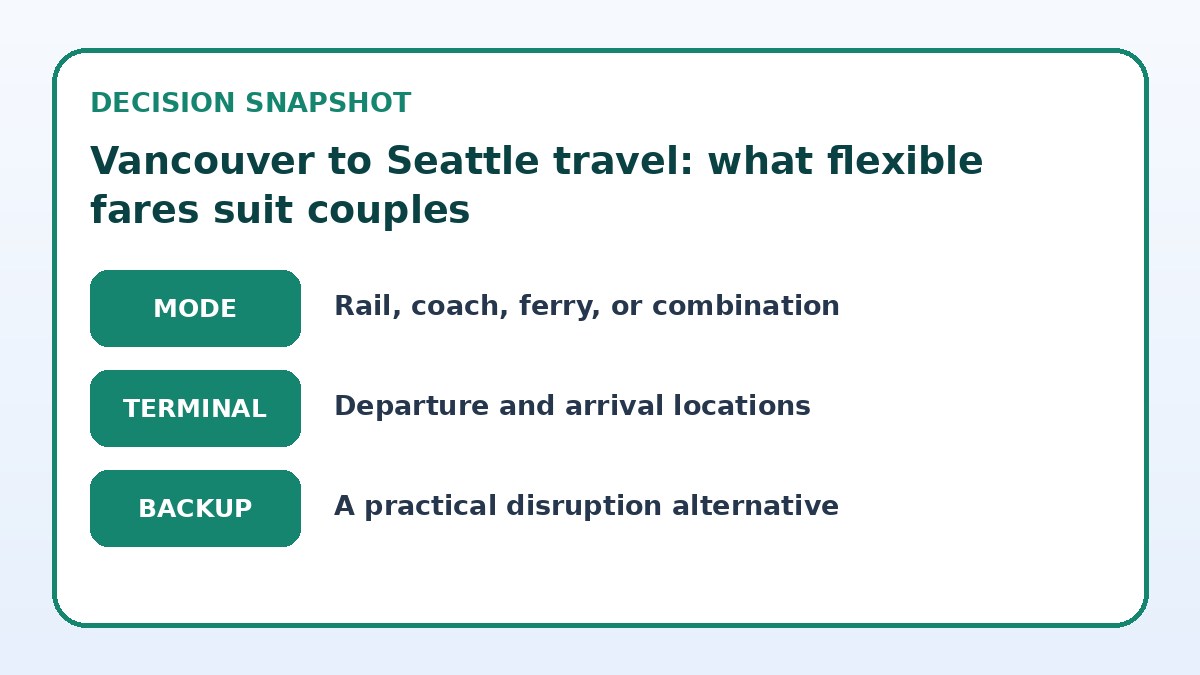
Start by listing the feasible modes between Vancouver and Seattle and then compare them by how they fit your couple’s travel style. Rail often offers a calmer cabin and table seating good for conversation; coaches can be simpler to book with frequent departures; ferries add scenery but may require extra transfers to reach terminals. For couples, think about whether you prefer one door-to-door ticket or don’t mind switching providers mid-route—each change adds friction with luggage and border checks.
When comparing modes, factor in how comfortable you are with transfers and the total journey, not only ride time. A seemingly fast option that dumps you far from your final neighbourhood can be less practical than a slower service that arrives nearer your accommodation. Also weigh onboard space for two: if you need to work, rest, or store bags together, pick the mode with the most usable cabin layout and explicit luggage allowances.
Choose the end-to-end journey plan
| Journey approach | Best for | Friction to check |
|---|---|---|
| Single-mode direct (fastest single ticket) | Couples on a strict schedule who prioritize travel time over flexibility. | Usually less flexible on changes or refunds and may require longer local transfers at either end. |
| Flexible fares on rail or coach | Couples who want easy same-day changes and minimal rebooking stress. | Often costs more up front and still requires checking baggage and terminal transfer rules. |
| Mixed-mode combo (ferry + rail/coach) | Couples valuing scenery and a relaxed journey with room to adjust plans en route. | More transfers increase luggage friction and the number of separate ticket rules to monitor. |
| Low-cost nonrefundable single-operator option | Couples with rigid, confirmed schedules who want the lowest upfront fare and no change. | Minimal flexibility for delays or plan changes; rebooking often requires paying full fare differences. |
Check live intercity options
Look beyond the ride itself and compare terminals, transfers, luggage, and arrival fit.
Terminal fit and luggage/transfer friction
Examine where each mode arrives and departs: downtown train or coach stations versus ferry terminals or airport-like centres. For couples, short, level transfers beat a scenic but distant terminal—especially if one partner has mobility needs or you’re handling two suitcases and a daypack. If a transfer involves public transport, check frequency and how easy it is to board with luggage and two people; an extra 15–30 minutes of walking or waiting multiplies in annoyance.
Luggage rules vary and can influence the ticket flexibility tradeoff. Some low-cost fares limit bags or require carry-on only; flexible fares tend to include more generous allowances. Check the provider’s final booking page for exact baggage size, fees, and where luggage is stored on-board. If you’ll start or end at a place without easy storage, choose options with simpler transfers so you can keep your belongings with you and reduce the chance of lost time or stress.
Timing flexibility: fares, same-day changes, and couples’ plans
Timing flexibility is about matching the ticket rules to how fixed your schedule is. Couples traveling for a wedding, appointment, or time-sensitive booking might need hard departure times; others on city-breaks will benefit more from flexible or open-date tickets. Look explicitly for same-day change policies and how those changes are processed—online, by phone, or only at a ticket counter. If a fare requires calling a central office for every change, that can cost you precious hours.
A pragmatic test is to ask yourselves: how would you handle a one- or two-hour delay? If you’re okay adjusting site visits and dinner reservations, a cheaper semirigid ticket may work. If delays would derail other bookings, prioritize flexible fares that permit switching to another service on the same operator without hefty fees. Always confirm the provider’s final booking page for the precise steps and any fare difference charges before you buy, because rules can vary widely even within the same company.
Compare the practical alternatives
Use the final page to confirm what is actually offered on your dates and save a workable fallback.
Intercity travel checklist
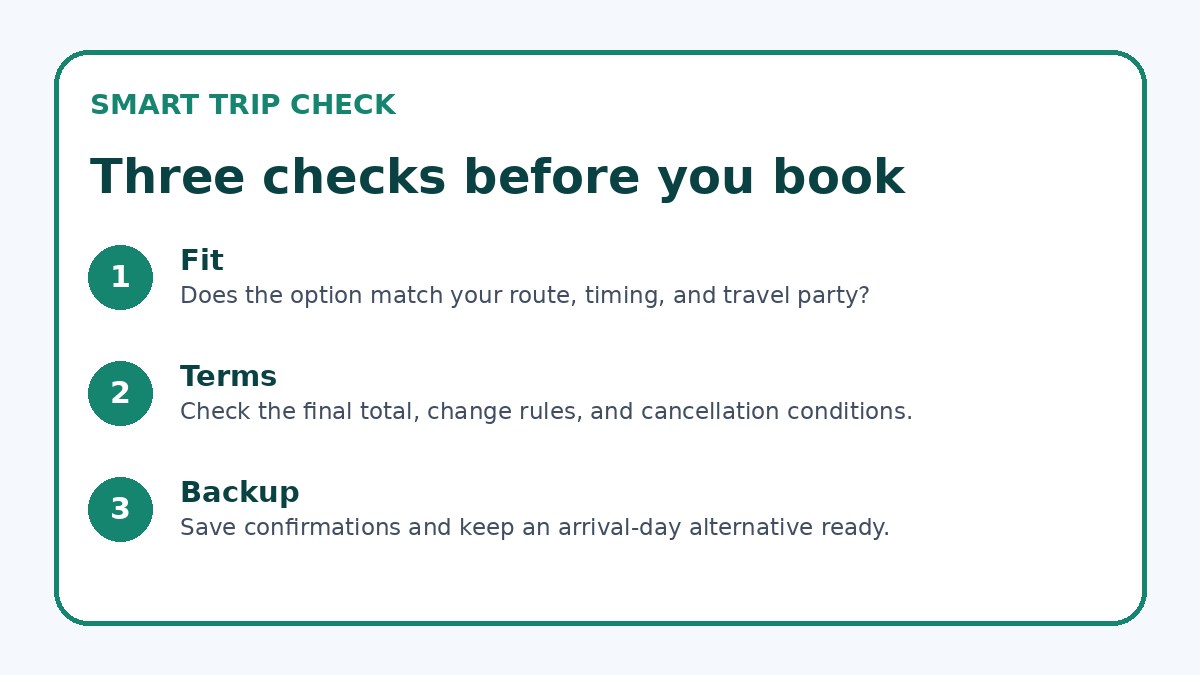
- Compare change and refund conditions on the provider’s final booking page before selecting a fare.
- Confirm terminal arrival points and measure transfer time to your accommodation or next connection.
- Verify baggage allowances for each leg and whether two checked bags are included or cost extra.
- Decide which partner will handle rebooking and keep contact numbers for customer service handy.
- Plan and save at least two realistic alternate departures in case of delay or cancellation.
- Carry digital and paper copies of identity documents required for cross-border travel and bookings.
Disruption backup: what couples should prepare
Disruptions—border delays, mechanical issues, or local traffic—are when ticket flexibility matters most. Couples should pick a primary route and a backup plan that minimizes added stress if things go wrong. A resilient plan means knowing alternate departure times, nearby terminals, and options for local transfer (ride-hail, regional rail, or later coach). Keep digital copies of all tickets and a photo of each traveler’s ID to speed rebooking at counters if needed.
Also decide which partner handles problem-solving so decisions stay efficient under pressure. Identify how refunds or reissue credits are processed and whether you’ll need in-person assistance to change certain fare types. If you plan to use a multi-leg combo, verify each leg’s change policy before booking—one nonflexible segment can lock both partners into an inconvenient itinerary. Trip.com can be used to compare current availability, but always verify change and refund terms on the provider’s final booking page.
Rail & Intercity Transport questions travelers ask
How do we choose between a flexible fare and a nonrefundable cheaper ticket for this route?
Think in terms of risk versus convenience. If your plans can shift—late meetings, uncertain check-in times, or sightseeing that might overrun—buy a fare that allows date and time changes with low fees. If your schedule is locked (wedding, event, meeting) and you can’t afford to miss a specific departure, a nonrefundable cheaper ticket may make sense. Always check the provider’s final booking page for exact change fees, same-day transfer rules, and whether name changes are allowed before deciding.
What should couples verify about transfers and luggage when booking a combo journey?
Check exactly where each leg starts and ends and whether those terminals are close enough for an easy walk with luggage. Verify baggage allowances on every separate ticket: some carriers include checked bags only on flexible fares while others charge per piece. If the combo requires switching operators, confirm whether you need to collect baggage and recheck it. Also review local transfer options—train, shuttle, or ride-hail—and estimated minimum connection times to avoid tight connections.
If our primary service is disrupted at the border, what practical steps should couples take to rebook quickly?
First, keep each other calm and designate one person to handle calls or online rebooking to avoid duplicate efforts. Use the operator’s app or website to look for the next available departures and check whether your ticket permits same-day rebooking. If the fare requires in-person changes, head to the nearest ticket counter with your booking reference and ID. Have backup transport alternatives ready—another carrier, a later ferry, or local rail—and be prepared to show the provider your proof of travel needs to request flexibility.
Final decision note
For couples traveling between Vancouver and Seattle, the right choice balances door-to-door practicality with ticket flexibility. Prioritize flexible fares if unpredictable timing, luggage handling, or border uncertainty could upend plans; choose a direct, less-flexible option only when schedules are fixed. Look beyond ride time: consider terminal locations, the number and ease of transfers, and how baggage is handled. Before you finalize booking, read the provider’s change and refund rules on the final purchase page and shortlist alternate departures. That preparation turns a cross-border trip into a manageable experience you can enjoy together.
Continue planning
Check current options and final conditions
Use the provider page to confirm live availability, the final total, cancellation terms, and every condition that matters to your trip.
This evergreen planning guide was created with AI-assisted drafting and a structured quality review. It does not display live prices, schedules, availability, visa guidance, or provider rankings. Verify current details before booking. Some links are affiliate links; we may earn a commission at no additional cost to you.