For a first-time visitor to Osaka, the quickest practical question about renting a car is: will driving actually make your trip better? If your plans stay inside central Osaka and you rely on trains, parking fees and city traffic usually outweigh the benefits. But if you plan day trips to Awaji, the Kii Peninsula, or rural Kansai spots where trains are infrequent, a car can transform your schedule. This article gives the clear answer up front: choose airport pickup when your itinerary includes long drives out of the metro area and you want to minimize city navigation; choose city pickup if you arrive late, only need the vehicle for a short local window, or want to avoid extra tolls and parking hassles. After that quick recommendation, you’ll find detailed tradeoffs for routes, insurance wording to verify, pickup and return friction, and a solid non-driving fallback if you decide not to rent.
Route value: when driving adds clear benefit
Decide by mapping where you want to go, not by convenience alone. Driving starts to pay off when your daily itinerary includes multiple rural stops, strict departure times, or places poorly served by rail and bus. Examples: visiting seaside villages, national-park trailheads, wineries, or hot-spring towns that sit between train stations can be slow or require multiple transfers by public transport. Look at the aggregate door-to-door time for each day: if a rental reduces transfers and lets you depart earlier than bus schedules allow, the car adds value.
Also check parking availability and likely parking fees at your main stops. Even if a route looks quick on a map, frequent paid parking or tight city-center delivery rules can erode the time and money saved by driving. If your trip mixes city sightseeing with a single long day trip, plan to pick up the car only for that leg to avoid unnecessary urban parking and toll costs. Balance the number of rural miles versus city hours—more rural driving favors airport pickup and a full-day schedule.
Decide whether driving earns its place
| Mobility strategy | Best for | Cost or friction to check |
|---|---|---|
| Airport pickup — full-trip start | Travelers starting long rural drives immediately after arrival | Less city hassle at the cost of airport counters and possible shuttle time |
| City pickup — city-first, drive-later | Visitors staying central who only need a car for a limited day or two | Avoids airport traffic but may incur tight office hours and limited parking |
| One-way airport-to-city drop | Itineraries ending in the city after a coastal or regional loop | Convenient routing but often carries one-way drop fees and coordination needs |
| Skip the car — public transport and taxis | First-time visitors staying within Osaka, Kyoto, Nara or on tight budgets | Lower hassle and parking costs, but less flexibility for remote day trips |
Check live rental choices only after the route test
Use the exact driver, dates, pickup point, and return plan to compare current conditions.
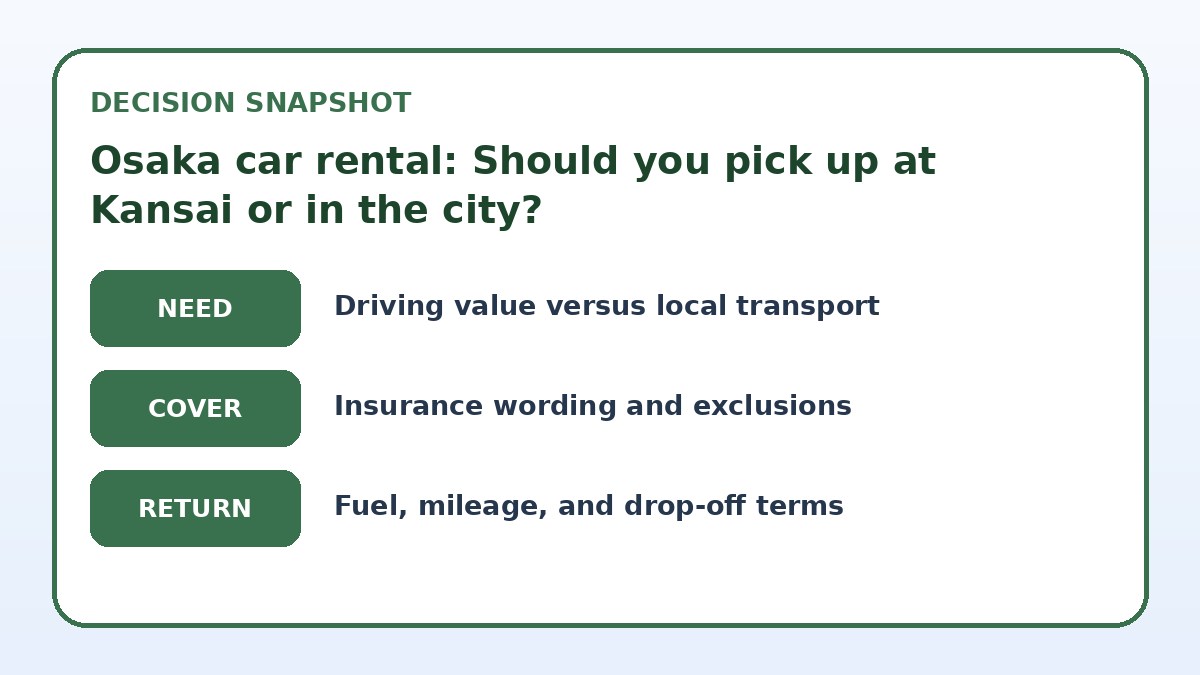
Insurance wording: what to verify before you sign
Japanese rental contracts use specific language about liability limits, collision damage waiver (CDW), and deductible (excess). Don’t rely on a summary from a booking site—read the provider’s final rental agreement details. Verify the exact deductible amount and whether damage to tires, undercarriage, windshield, GPS units, or theft are covered. If you plan cross-prefecture or overnight ferry travel, confirm whether the contract allows it and whether special coverage is required.
Also check who is an authorized driver and whether additional drivers are free or charged. If you’ll be driving on expressways, ask whether tolls are billed directly or through an ETC device charge. If you buy a supplemental ‘zero-excess’ product, confirm whether it removes the deductible entirely or only reduces your out-of-pocket maximum. These are contract specifics; always check the rental company’s final booking page and counter paperwork to match the policy language to your needs.
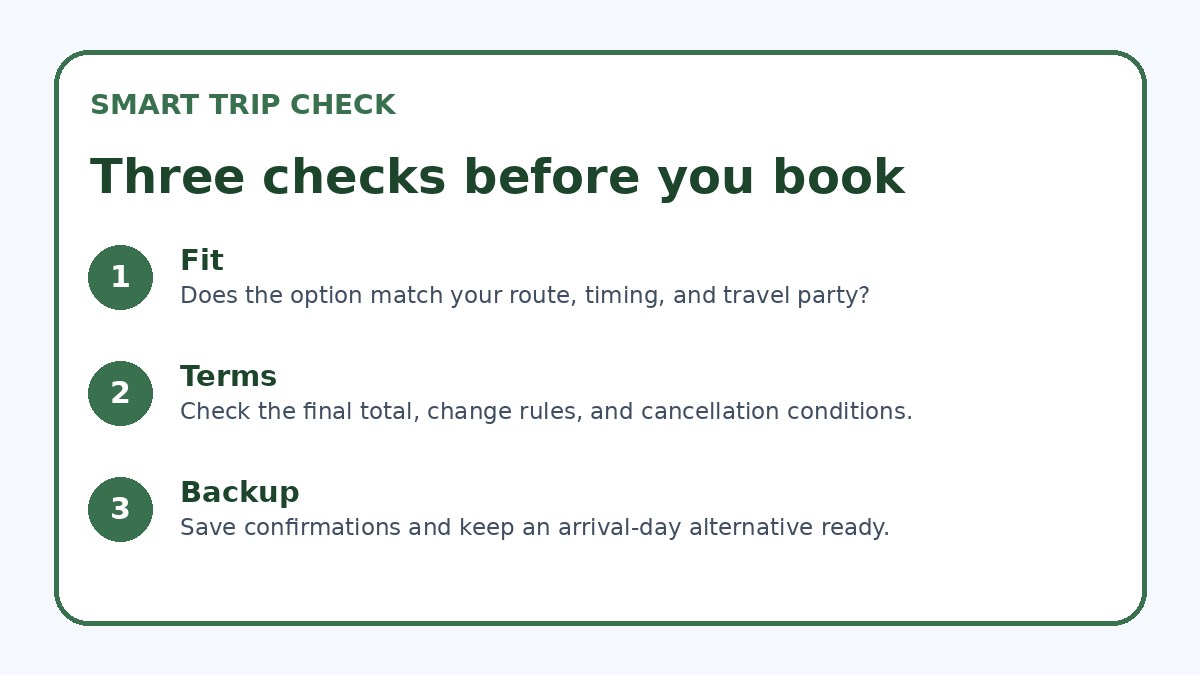
Compare the full rental conditions
Confirm insurance wording, exclusions, deposit, fuel, mileage, and return terms on the final page.
Pickup and return friction: airport vs city logistics
Airport pickup cuts out an extra taxi or rail leg after a long flight and gives you a vehicle before you hit open roads, which is handy if your first day is a long drive. However, major airports can mean long counters, shuttle buses between terminals and remote parking garages, and heavier traffic exiting the airport. If your arrival is late or you expect jet lag, the extra steps at an airport desk may be a real inconvenience. Consider the counter hours listed on the provider’s booking page and whether after-hours pickup is available.
City pickup often places you closer to your hotel and avoids airport exit traffic, but city offices can be small, have limited parking, and close earlier in the evening. Returning a car to a city location after a day of driving may require navigating congested streets and finding restrictive drop-off zones. If you plan one-way rentals, verify the provider’s policy and any drop fees for airport-to-city or city-to-airport returns on the final confirmation page. These logistics determine how much time you’ll spend on both ends of the rental.
Car rental terms to verify
- Map every planned stop and calculate door-to-door travel time using the same start and end addresses you’ll actually use.
- Read the final rental agreement on the provider’s booking page and note deductible, CDW scope, and exclusions in writing.
- Confirm pickup and counter hours for your chosen location and ask about after-hours procedures before you book.
- Verify whether an ETC toll device is included and how toll charges will be billed to you during the rental.
- Check one-way drop fees and which locations accept returns without added surcharges on the confirmation page.
- Backup plan: list train/bus alternatives for the two most remote days and note reservation requirements or shuttle options.
Non-driving fallback: getting around Kansai without a car
If you decide not to drive, a combination of rail, rapid buses, and taxis will still let you cover most popular Kansai itineraries. Major regional rail lines connect Osaka to Kyoto, Nara, Kobe, and Himeji with frequent services; many day-trip attractions near Osaka have direct local buses or short taxi rides from the nearest station. For more remote sites, check regional bus timetables and private shuttle services—their schedules often determine whether a rail-plus-bus day is practical.
When evaluating the non-driving option, plan itineraries around train and bus departure windows to avoid long waits. Reserve seat-required trains or long-distance buses in advance when possible, and use station lockers for baggage if you want to travel light during a day trip. If you would otherwise need a car for remote hiking access or flexible overnight stops, consider guided tours or private transfers as a middle ground—less control than a rental but no driving responsibility.
Car Rental & Road Trip questions travelers ask
Will I need an International Driving Permit (IDP) to rent and drive in Osaka?
Most non-Japanese drivers must carry the correct driving document for Japan—commonly an International Driving Permit based on the 1949 Geneva convention or a valid Japanese translation where applicable. Requirements depend on your home country and the rental company’s policies. Before booking, confirm the accepted license types on the rental provider’s final booking page and bring original documents, passport, and any required translations to the counter. If in doubt, contact the provider directly to avoid being unable to pick up the car.
How do tolls and expressway charges work if I pick up at the airport?
Expressway tolls in Kansai are normally paid via toll booths or an ETC device. Some rentals include an ETC card or device; others bill tolls to you later or require cash payments. When you book, check whether the rental lists an ETC device as included and how tolls are recorded and charged. If you expect to use expressways extensively for day trips, ensure the contract clearly explains toll billing to avoid unexpected post-rental charges. The provider’s final page will state the toll handling method.
Can I return the car to a different city office or the airport without problems?
One-way returns are commonly offered but often come with administrative or location-specific fees and limited availability. Some smaller city offices may not accept returns for certain vehicle classes, or may require advance notice. Always confirm allowable drop-off locations and any one-way charges on the rental confirmation page. If you need a specific airport or city return time, verify that the intended office accepts after-hours returns and what documentation or key drop procedures are required.
Final decision note
For most first-time visitors staying primarily inside Osaka, public transport and taxis will be simpler and less expensive than driving. Choose airport pickup when your itinerary includes extended rural driving right after arrival—this saves transfer time and puts you on the road sooner. Opt for city pickup if you plan to arrive by train, only need the car for a short regional leg, or want to avoid airport counter waits. Before you book, read the rental provider’s final agreement to verify insurance wording, authorized drivers, ETC/toll handling, and pickup/return hours. If anything is unclear, contact the provider or compare current options on Trip.com as one place to view availability and terms.
Continue planning
Check current options and final conditions
Use the provider page to confirm live availability, the final total, cancellation terms, and every condition that matters to your trip.
This evergreen planning guide was created with AI-assisted drafting and a structured quality review. It does not display live prices, schedules, availability, visa guidance, or provider rankings. Verify current details before booking. Some links are affiliate links; we may earn a commission at no additional cost to you.