Practical answer first: pick the Bali neighborhood that matches how you’ll spend most days, then choose hotels that explicitly offer free cancellation or flexible change windows that cover your travel dates. For solo travelers that usually means prioritizing either convenience to daily activities (semicentral spots like Seminyak or Ubud town center), low friction for transit and late arrivals (beachfront hubs with easy taxi access), or quiet stays that reduce the risk of needing to move mid-trip (suburban or resort pockets). Once you’ve shortlisted one or two areas, compare room types and booking terms side-by-side—verify exact cancellation deadlines, refundable vs. nonrefundable room rules, and whether a preauthorization or deposit applies. Always confirm final terms on the hotel or booking provider page before you pay; provider pages are the legal source for charges, cutoffs, and any change fees.

Check live stays in the areas that fit
Use your dates and party size to compare current rooms after you narrow the neighborhood fit.
Neighborhood fit: match your days to a stay area
Choose a neighborhood by thinking of a typical day: where you’ll eat, the activities you’ll return from, and whether you want evening life nearby. Solo travelers who plan many day tours or scooter outings often prefer areas with easy pickup and drop-off—places with wide roads, straightforward taxi access, and a concentration of tour desks. If your priority is nightlife or restaurant variety, a central beach town lets you walk home late without needing transport. If you imagine long mornings at a yoga studio and calmer afternoons, a cultural or inland town reduces noise and gives more reliable restful evenings.
Neighborhoods also differ in on-the-ground service options that affect flexibility: how easy it is to change a reservation, extend a stay, or move to another property last-minute. Areas with many small hotels and guesthouses can give you options to relocate within a short distance, but their booking terms may be stricter. Busier resort strips often feature larger properties that publish clearer refundable rules and have more standardized front-desk practices for late changes. Think about how much friction you tolerate for a same-day move when picking your area.
Choose an area-selection strategy
| Area approach | Best for | Tradeoff to check |
|---|---|---|
| Stay in central beach towns (Seminyak, Kuta-style) | Solo travelers who want nightlife, dining, and easy taxi access for late returns | Noisiest at night and higher demand can limit last-minute refundable availability |
| Base in cultural/inland towns (Ubud-style) | Travelers prioritizing calm, wellness activities, and walkable local services | Farther from beaches and transport hubs, which can complicate sudden day-trip changes |
| Choose resort clusters or quieter beach pockets | Solo travelers wanting low move-risk and clear hotel policies for flexibility | Resort rates may require longer minimum stays or stricter deposit rules |
| Pick guesthouse corridors and shared-hostel streets | Budget solo travelers who value the ability to relocate quickly inside a compact area | Smaller properties can have stricter nonrefundable options and less-standardized policies |
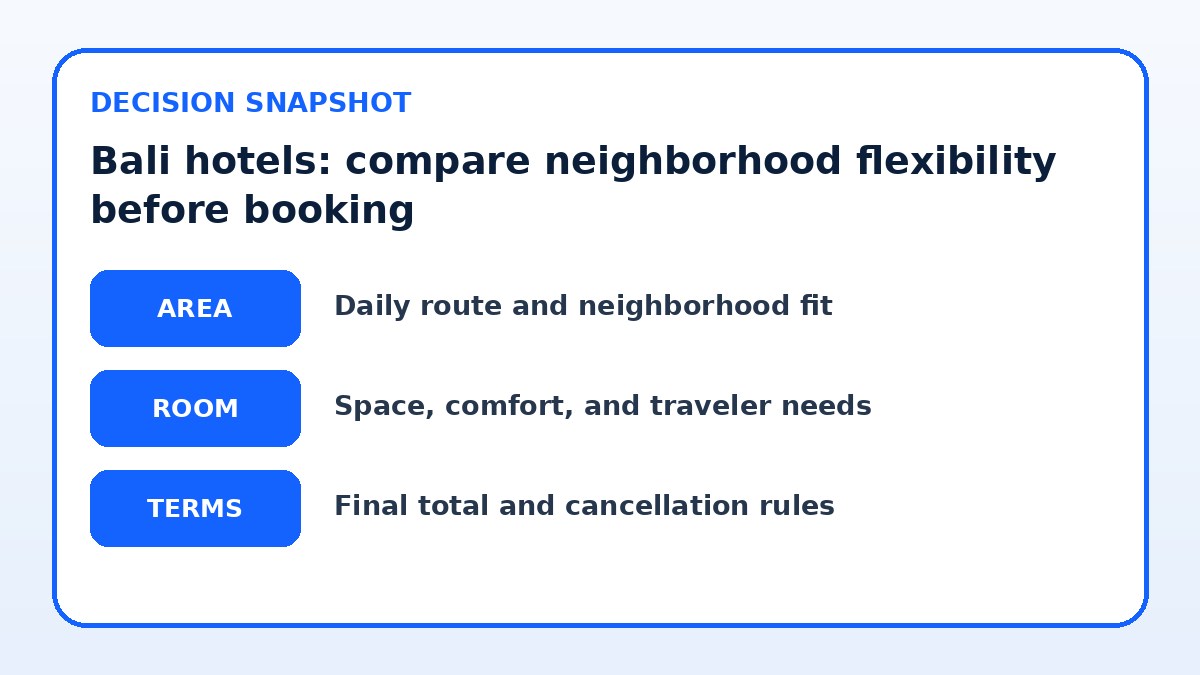
Daily-route friction: how transport and layout affect changes
Consider transport links and local layout when evaluating how painful a last-minute change would be. If your chosen area is spread out with narrow lanes—common in some beachside villages—moving hotels because of a schedule change can take longer and cost more in taxis or time. Areas centered on a main road with frequent taxi or ride-hailing availability reduce friction: you can arrive late, transfer, or extend a booking without complex logistics. Also check whether the neighborhood has reliable luggage storage options or 24-hour reception; those features matter if you need to leave your bags while changing rooms or properties.
For inter-island travel or day trips, proximity to transport hubs matters. If you plan to take fast boats, domestic flights, or shuttle pickups, staying near the port or airport route simplifies arrivals and cancellations. Evaluate how transfers are arranged: will a hotel hold your luggage if you’re delayed? Can staff help reschedule a shuttle? These are operational details you should confirm on the provider’s booking page or by messaging the hotel directly before you rely on them, since front-desk policies and local transport rhythms can change.
Now compare like with like
Keep the same dates, guests, room needs, and cancellation preferences while you compare the final choices.
Room and party needs: what flexibility your reservation must include
Decide what kind of room flexibility you need: fully refundable with free cancellation, free change within a window, or partially refundable that keeps a flexible balance between price and risk. Solo travelers who might extend their trip or change islands at short notice should prefer fully refundable or changeable rates with a clear, reasonable cutoff. If you’re comfortable committing but want a safety net, a refundable deposit or a short free-change window (for example, until a few days before arrival) can be a practical compromise. Also consider bedding and room type—if you expect to host a friend or join a tour group, book a room with flexible occupancy rules or confirm whether adding a night at the same rate is simple.
Room-level rules often differ from the property’s headline policy: a refundable room might require immediate full prepayment with a refund processed after cancellation, or it might hold the card and charge only on stay. Some booking platforms present refundable and nonrefundable rates side-by-side; read the rate conditions to spot differences in charge timing, deposit amounts, and whether third-party bookings impose additional nonrefundable fees. Always check whether taxes, service charges, or local community levies are refundable under the chosen rate, and verify these specifics on the provider’s confirmation page.

Hotel booking check before payment
- List the two Bali neighborhoods that best match how you’ll spend most days and why (activities, transport, noise tolerance).
- For three shortlisted hotels in your chosen area, copy their exact cancellation cutoff times and whether the policy references local time.
- Confirm whether refundable rates require full prepayment, a card preauthorization, or only a guarantee without charge.
- Ask the hotel directly (message or email) whether they will hold luggage and assist with transfers for late arrivals or same-day changes.
- Compare the booking channel: note whether the terms are enforced by the hotel or a third-party agency and save the final confirmation page.
- Before paying, screenshot the reservation terms and the confirmation page that states refund processing time and any deposits required.
Final booking terms: compare cancellation windows and provider details
When you shortlist properties in your chosen area, compare the exact cancellation and modification terms line-by-line. Look for the cancellation deadline in local time, whether the window is measured from local check-in time or calendar days, and whether the property treats early departures differently from cancellations. Some reservations allow free changes up to a set time but impose a fee for same-day cancellations; others permit transfers to another date without penalty but only if done through the original booking channel. These distinctions matter more than a generic “free cancellation” label.
Check who enforces the terms: is the booking directly with the hotel, or through an online travel agent? Third-party bookings sometimes add their own change fees or limit the hotel’s ability to waive penalties. If you need absolute flexibility, confirm whether the hotel itself accepts changes on its website or via direct message. Also verify any card preauthorization, deposit amount, and refund processing time shown on the booking or hotel confirmation. If you want, compare terms on Trip.com or another site, but always use the hotel’s own policy and the final booking page as the authoritative source before you commit.
Hotel Guide questions travelers ask
How much flexibility should a solo traveler expect when booking Bali hotels?
Expect a range: many mid-to-large properties offer refundable or changeable rates, but smaller guesthouses and some budget rooms may be nonrefundable. Don’t assume similar-sounding policies are identical—read the cancellation section for exact cutoffs, whether refunds take the card company’s processing time, and if any administrative or service fees are nonrefundable. If flexibility is vital, prioritize rates explicitly labeled refundable and confirm the hotel’s direct policy via message. Use the booking confirmation as the contract to check penalties, deposit rules, and refund timelines.
If I book a nonrefundable room but need to change dates, what options do I have?
Options depend on the hotel and booking channel. Some hotels will allow date changes for a fee; others may offer credit toward a future stay instead of a cash refund. Contact the property immediately to explain the situation—hotels with direct bookings may be more flexible than third-party reservations. If you booked through an agent, review their change-policy; the agent may be able to negotiate on your behalf. Consider travel insurance that covers certain cancellations, but first verify whether the hotel’s policy allows changes or issues credits before relying on insurance.
How do I compare booking terms across properties efficiently?
Create a short spreadsheet or note with columns for hotel name, neighborhood, refundable yes/no, cancellation cutoff (date/time), deposit/prepayment requirement, who enforces the policy (hotel vs. OTA), and any special conditions like nonrefundable taxes. For each property, copy the exact cancellation wording from the booking page so you can compare apples to apples. If you need help, message hotels with a concise question listing your dates and asking whether you can change or cancel without penalty and under what timeline, and save their replies with the booking confirmation.
Final decision note
Solo travelers can make Bali easy to manage by choosing a neighborhood that fits the rhythms of their planned days and then prioritizing hotel rates with explicit flexible booking terms. Decide whether you value proximity to nightlife, calm inland life, or quick access to transport hubs, then shortlist properties and compare exact cancellation and prepayment rules line-by-line. Small properties may offer local warmth but stricter terms; larger hotels often publish clearer refundable options. Always verify the provider’s final booking page for cutoff times, deposit details, and refund processing, and keep a screenshot of the confirmed policy before you travel.
Continue planning
Check current options and final conditions
Use the provider page to confirm live availability, the final total, cancellation terms, and every condition that matters to your trip.
This evergreen planning guide was created with AI-assisted drafting and a structured quality review. It does not display live prices, schedules, availability, visa guidance, or provider rankings. Verify current details before booking. Some links are affiliate links; we may earn a commission at no additional cost to you.