If you’re planning London to Paris flights and you’re traveling with extra luggage, the practical first decision is whether convenience (direct routing, longer check-in windows) or cost (cheaper fares with baggage limits) matters more. For many travelers with oversized or multiple bags, paying a bit more up front for a straightforward airport experience—simpler check-in, guaranteed hold baggage allowance, and realistic connection time—reduces stress and delays. Start this process by noting exact travel dates, the number and dimensions of each bag, whether any items are oversized or restricted, and who is traveling. Those details determine which fares actually work, whether you need cargo or sports-equipment handling, and how early you must arrive. The rest of this article explains routing choices, baggage and connection risk, schedule-fit strategies, and what fare conditions to verify before you click purchase.
See live routes for your exact travel day
Compare direct and connecting choices with the same baggage and traveler details.
Routing: direct flights versus connections
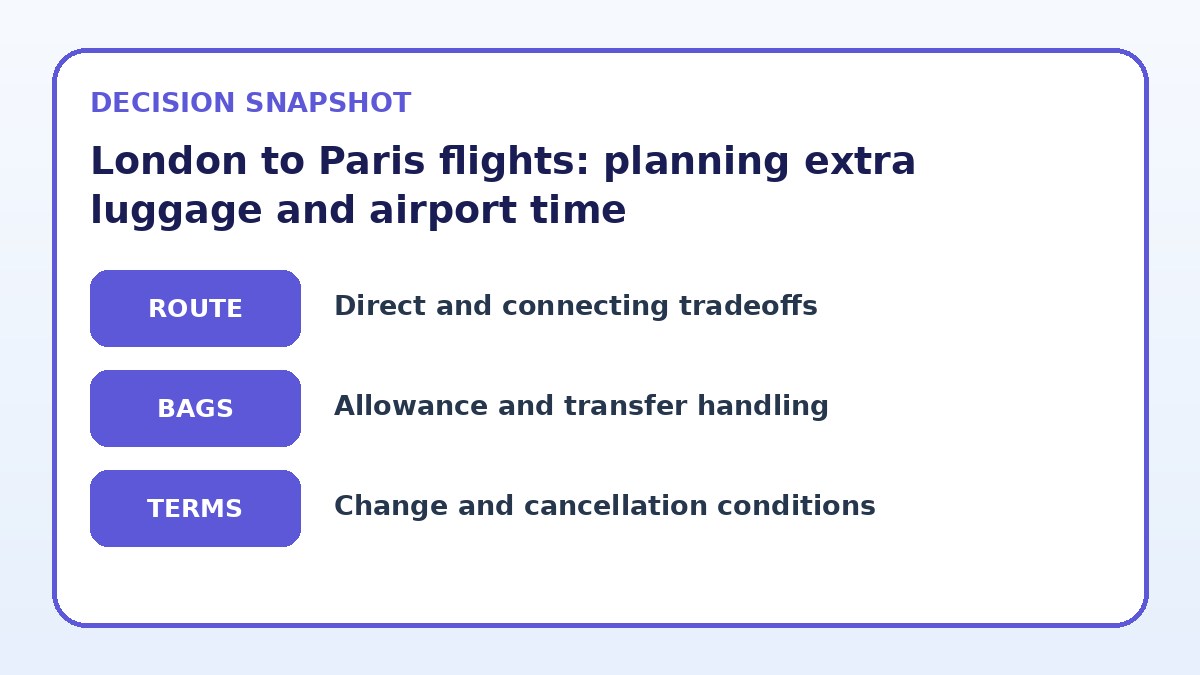
For travelers with extra luggage, routing choices matter more than for light-packers. Direct airport-to-airport options remove the need to move bags between aircraft and lower the chance of mishandled transfers, but they may use airports with longer security queues or further distance from city centers. Connecting itineraries can reduce fare cost or open more departure times, but each connection adds an additional transfer event for your bags and increases the chance of delay-related missed connections. When comparing options, list every leg, the transfer airport, and whether the connection is on the same ticket — same-ticket connections typically include protections for missed transfers, while separate bookings often do not.
Check the practicalities beyond just whether a flight is 'direct': review the terminal layout on the carrier’s site or airport maps and note whether transferring requires a terminal shuttle or a walk with luggage. Also consider multimodal routing: some travelers find flying into a different Paris-area airport and taking a fast train or taxi into Paris gives a better combined time-and-cost tradeoff when heavy baggage is involved. Always verify on the booking page how many hold bags are included, the permitted dimensions and weight, and whether any oversized sports or musical instruments require pre-notification or freight handling.
Baggage and connection risk: what to expect and how to reduce it
Extra luggage increases both handling steps and the risk that something will be delayed. Each checked bag will be loaded, unloaded, and possibly transferred, and a missed connection is the single biggest cause of delayed luggage on multi-leg itineraries. To reduce risk, prefer itineraries sold on one ticket so the airline takes responsibility for through-checked bags; when that isn’t possible, plan longer connection windows and avoid tight minimum connection times. Buy baggage protection or travel insurance that covers delayed or lost baggage if you carry high-value items or need guaranteed delivery.
Label every bag conspicuously with your contact details and include a luggage tag inside with your itinerary and arrival address in Paris. Use sturdy, lockable luggage and consider a bright strap or ribbon so handlers can spot your bags quickly. At check-in, ask the agent to confirm whether bags will be checked through to the final destination or need to be rechecked during a connection. If you have special items — sporting equipment, musical instruments, or fragile goods — contact the carrier in advance to learn whether they require advance booking, special handling fees, or documentation.
Compare flight-selection strategies
| Flight strategy | Best for | Risk to check |
|---|---|---|
| Book a direct flight on one ticket | Travelers who prioritize fewer handling steps and lower transfer risk | Often costs more and may limit departure time flexibility |
| Book connecting flights on one combined ticket | Those wanting more schedule options with airline protection for bags | Adds transfer time and still depends on minimum connection windows |
| Separate tickets to save fare cost | Flexible travelers willing to accept higher baggage-transfer risk | No through-check guarantee; you must recheck luggage and allow extra time |
| Fly into alternate Paris-area airport and transfer by ground | Travelers optimizing overall door-to-door time or airport handling quality | Requires planning for airport transfer time and potential recheck of bags |
Recheck the complete itinerary
Confirm airports, connection handling, baggage, and change conditions before deciding.
Schedule fit: how much airport time to build in
With extra luggage you generally need more airport time than the minimum suggested for carry-on-only passengers. Build time for check-in, possible oversized-baggage counters, security queues, and the extra minutes it takes to navigate terminals with heavy bags. For international departures from London, consider the extra time needed to reach the terminal from your starting point, allowing buffer for traffic, public-transport disruptions, and peak-hour crowds. Aim for a realistic buffer rather than the absolute minimum published check-in times — this reduces stress and gives room to handle unexpected baggage checks.
If you have a tight onward connection in Paris or must collect and recheck bags, build additional margin between flights. When you plan transfers inside Paris (for example, an arrival into one airport and departure from another), factor in travel time between airports, check-in reopening windows, and potential customs or border checks when re-entering the departure terminal. Use the carrier’s published check-in and bag-drop closing times to confirm you won’t be turned away; the agent’s final booking page will tell you the exact latest drop-off and boarding times for the fare you choose.
Flight details to verify
- Write down exact travel dates, full traveler names, passport numbers, and the number and dimensions of each checked bag before searching fares.
- Compare fare pages for included checked-bag count, per-piece weight limits, oversize rules, and the fee schedule for extra or overweight bags.
- If booking connecting flights, confirm on the booking page whether bags are checked through to the final destination or must be rechecked at the transfer airport.
- Allow additional buffer time beyond published check-in deadlines for oversized or multiple bags and plan transport to the airport accordingly.
- Notify the carrier in advance if you travel with sporting equipment, musical instruments, or fragile items and reserve any required special handling.
- Photograph each bag and its contents, keep receipts for high-value items, and register delayed or missing baggage immediately with the airline’s baggage desk.
Fare conditions and what to verify before booking
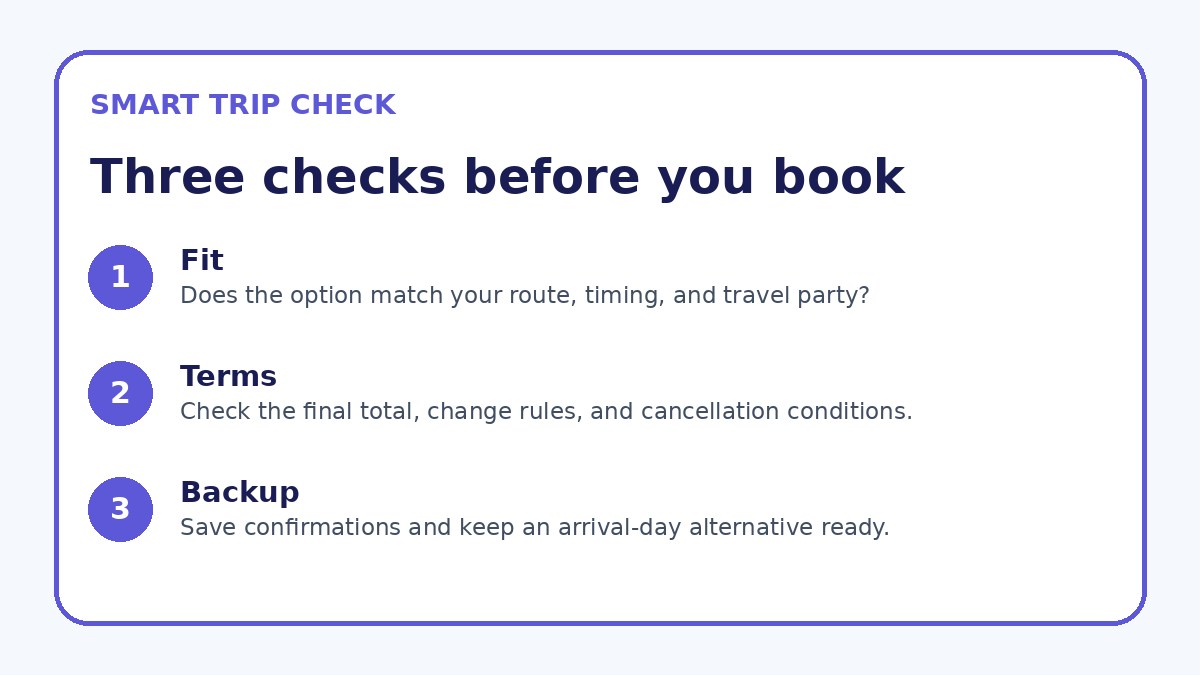
Fare details determine whether your extra luggage is included or charged extra, and they control change and refund flexibility — critical if your large bags require a different itinerary. Before booking, have your traveler names and bag counts ready to test each fare class’s baggage allowances on the airline or travel platform booking page. Verify whether the fare includes checked bags, the permitted weight per piece, and the fees for additional or overweight pieces. Also check whether any fare restrictions mean you must rebook through the same carrier for a protected connection or whether separate tickets break through-check protections.
When provider-specific facts could change, always verify exact baggage allowances, oversized-item policies, and on-the-day check-in or bag-drop deadlines on the carrier’s or agent’s final booking page. If you’re comparing multiple carriers or multi-airport options, create a short checklist of rights and fees for each itinerary — number of included bags, max weight, oversize rules, and whether you can pre-pay baggage to save time at the airport. Trip.com can be used once to compare current availability or rules, but rely on the carrier’s final page for the binding conditions.
Flight Guide questions travelers ask
How early should I arrive at the London airport for a flight to Paris with multiple checked bags?
For flights from London to Paris with several checked bags, aim for a larger buffer than the minimum check-in time. Build in time for long security lines, special bag-drop counters, and possible documentation checks for oversized items. If you’re using public transport, add extra commute margin for strikes or delays; if driving, add time for parking and shuttle transfers. Check the airline’s published bag-drop closing time on its booking page and confirm whether online check-in or pre-paid baggage can speed the process.
Can I check my bags through if I book separate tickets for each leg?
When flights are on separate tickets, most carriers will not check bags through to the final destination, meaning you typically need to collect and recheck them during a connection. That requires extra time, and you assume the risk if an earlier flight delays you. To be certain, review the airline’s baggage policy on its final booking page and ask the carrier’s customer service whether through-checking is possible with separate bookings. If through-checking is essential, book on a single ticket or change to a carrier that offers the protection.
Are there ways to reduce baggage fees and airport time for a heavy-packing traveler?
Yes. Consolidate and weigh bags before arriving so you can redistribute weight to avoid overweight fees, and pre-pay baggage online when the booking page offers lower rates. Use durable luggage with easy-identification markers to speed retrieval and ask at check-in if priority bag handling is available for purchase. Consider sending bulky items ahead via specialist freight or courier if they’re heavy and non-essential, and pack valuables and essentials in a carry-on in case a checked bag is delayed. Always verify fee amounts and rules on the carrier’s final booking page.
Final decision note
Organizing London to Paris flights when you travel with extra luggage means balancing route simplicity, baggage risk, and your tolerance for cost. Prioritize direct or single-ticket routings if you want fewer handling steps and lower transfer risk; accept connections only if you consciously lengthen transfer windows and confirm through-check protections. Prepare exact traveler and luggage details before you search fares, verify baggage allowances and oversized-item rules on the carrier’s booking page, and build realistic airport buffers for check-in and transfer. With a short checklist, a few pre-paid baggage decisions, and advance notification for special items, you’ll reduce the chance of delays and enjoy a smoother door-to-door journey.
Continue planning
Check current options and final conditions
Use the provider page to confirm live availability, the final total, cancellation terms, and every condition that matters to your trip.
This evergreen planning guide was created with AI-assisted drafting and a structured quality review. It does not display live prices, schedules, availability, visa guidance, or provider rankings. Verify current details before booking. Some links are affiliate links; we may earn a commission at no additional cost to you.