If you’ve landed in Korea and spent time in Gyeongju for meetings, your first-hour-after-landing decision is simple: pick the return method that guarantees predictable timing, fits your luggage and party, and leaves a buffer for disruptions. For business travelers the priority is minimizing uncertainty—clear meeting points, reliable provider communication, and contingency plans for delayed flights or trains. Start by confirming where you'll need to be (which airport), how many people and how much luggage you’ll have, and whether you must be at the airport by a specific check-in time. This article gives the practical pick first—then walks you through tradeoffs, what to check before booking, and how to manage a late or disrupted departure so you can close meetings without last-minute scrambling.
Check options for your arrival details
Use your flight, luggage, party size, and accommodation address to compare current choices.
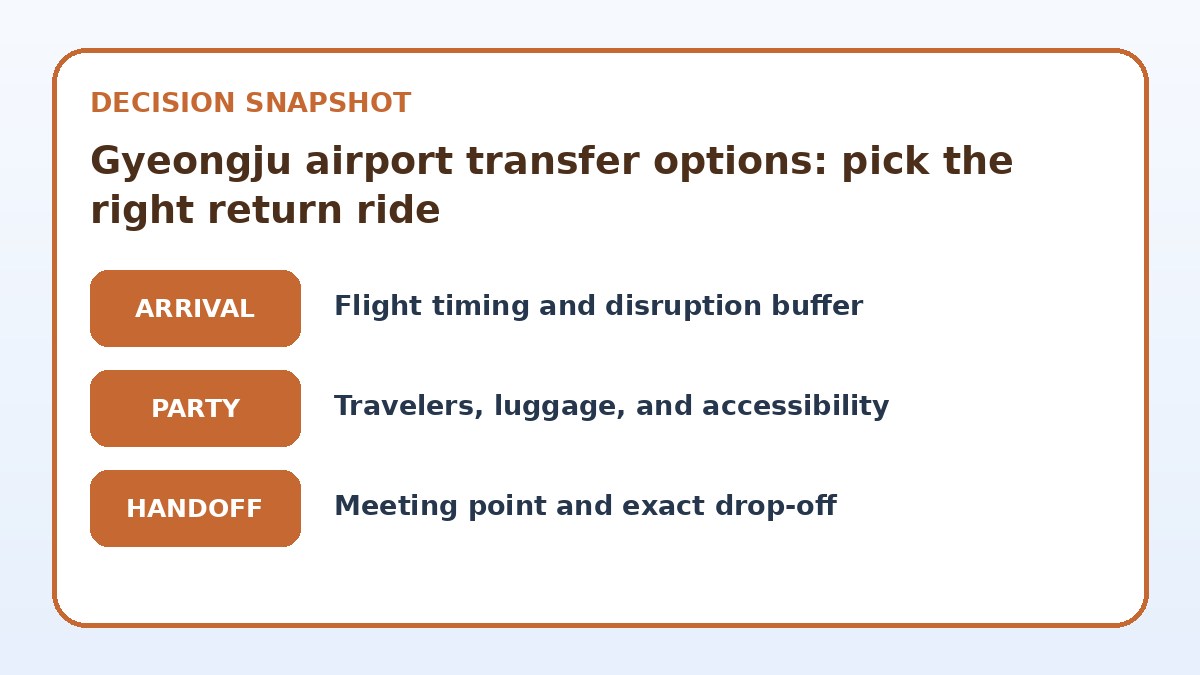
Luggage and party size: pick the right vehicle
The amount of luggage and number of people in your group should determine whether you choose a private car, shared shuttle, taxi, or rail-plus-taxi combo. Business travelers with two or fewer suitcases and one or two colleagues often find private cars or taxis simpler because they eliminate intermediate stops and reduce walking between vehicles. Larger groups, multiple large cases, or equipment like presentation crates usually justify a larger vehicle or a booked van. When you book, state the exact number of suitcases and any unusual items so the operator assigns appropriate capacity. Don’t assume a standard sedan will fit oversize cases or golf bags—confirm dimensions if capacity is critical.
If you plan to use mixed modes—train or bus for part of the journey and a taxi for the last mile—factor in transfer time between modes and the extra handling of luggage. Shared shuttles can be cost-effective for solo travelers with minimal luggage, but they add stops and less predictable arrival times. For a tight schedule, choose direct, door-to-door services that minimize transfers. Before you finalize any booking, check the provider’s rules for luggage, child seats if needed, and whether they assist with carry-on handling; written confirmation prevents misunderstandings at pickup.
Arrival details to have ready
- Confirm your airline and terminal, and note the recommended arrival time for international or domestic check-in.
- Count people and all pieces of luggage; communicate exact numbers and any oversized items when booking a vehicle.
- Request written pickup details: precise meeting point, driver name, vehicle description, and a local phone number.
- Allow a time buffer above minimum airport check-in recommendations and plan a fallback transfer method.
- Review the provider’s cancellation and change rules on their booking page before you finalize payment.
- Save digital copies of booking confirmations and emergency contact numbers to your phone and travel calendar.
Late or disrupted arrival: build contingencies
Delays and disruptions happen—meetings overrun, traffic snarls appear, or connecting transport runs late—so build contingency into your schedule. For critical international departures, plan to arrive at the airport with a buffer that covers common delays, and select a transfer option that can be rescheduled or held without penalty when possible. If your chosen transfer has a limited window, confirm cancellation and rescheduling policies at booking so you know the options if your meeting runs long. Written contact details for the operator and a local mobile number to call from Gyeongju will save precious minutes when plans change.
When disruption occurs close to departure, switch immediately to your backup: local taxi, an available nearby train station, or a later confirmed shuttle. Keep digital copies of booking confirmations and the driver’s contact in your phone, and if you use a company travel manager, update them right away. If you booked a private service, ask whether the driver can wait at a short hourly rate or return with a second vehicle; if you chose a shared shuttle, identify the next scheduled departure and any alternative providers in advance so you can move quickly without hunting for options under pressure.
Match the transfer to your arrival
| Arrival approach | Best for | Detail to verify |
|---|---|---|
| Private door-to-door car | Small business groups with tight schedules and significant luggage. | Higher cost but direct routing and flexible waiting or pickup changes. |
| Shared shuttle or scheduled transfer | Solo travelers with light luggage who can tolerate scheduled stops. | Lower cost but less flexible timing and additional stops increase travel time. |
| Taxi on request | Short-notice moves or when flexibility is needed without prior booking. | Variable availability and route predictability; luggage and vehicle size may be uncertain. |
| Rail or intercity bus plus local taxi | When airport terminals are well-connected by public transport and cost control matters. | Requires transfers and handling luggage; more vulnerable to schedule mismatches. |
Make the meeting plan clear
Check the final pickup instructions, waiting conditions, and exact drop-off coverage.
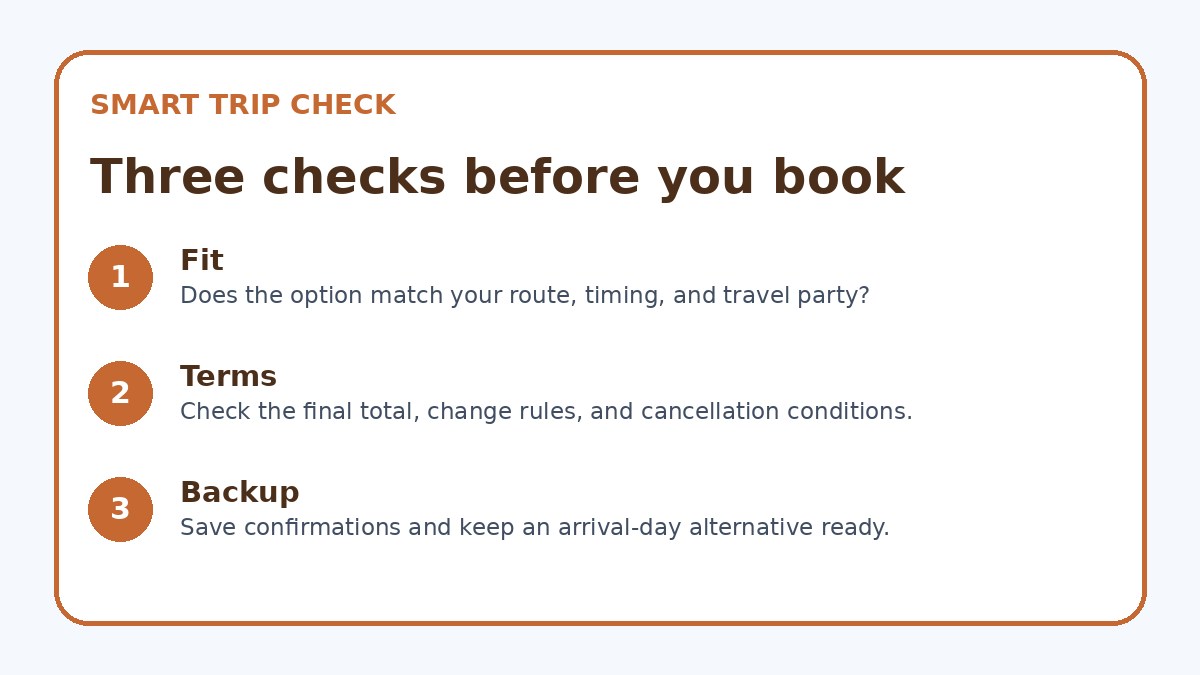
Meeting-point clarity: eliminate confusion
Ambiguous meeting points are the most common source of missed pickups. Specify precise locations: a recognizable landmark, the hotel front desk, a particular exit of a public building, or a named drop-off zone. Ask providers to confirm the pickup spot in writing and to provide the driver’s name and a local mobile number. If multiple hotels or conference venues are involved, consolidate a single pickup location when possible to reduce coordination complexity and ensure everyone knows exactly where to gather at the agreed time.
For airport arrivals, confirm which terminal and which curb or door the driver will use, and whether the pickup is curbside or requires meeting inside the terminal. Business travelers should request the driver’s expected arrival time window rather than a vague time to match it against meeting end times. If visibility is limited (night, heavy rain, or complex road layouts), agree on a backup meeting landmark and a short waiting policy so neither party waits indefinitely. Clear communication before the day prevents most on-the-ground headaches.
Destination-side drop-off fit: check airline and terminal details
Make sure your chosen drop-off location matches your airline’s check-in and terminal requirements. Some airports have multiple terminals serving domestic and international flights; confirm which terminal your airline uses and whether the transfer operator drops you at the curb for check-in or at a remote parking area that adds walking or an internal shuttle. If you need assistance with luggage or a quick check-in, request curbside drop-off and state that you require help when booking so the operator schedules accordingly.
Also consider passenger processing—security lines, immigration or customs if connecting internationally, and whether you need extra time for mobile check-in or document checks. For business travelers carrying presentation devices or work that needs setup before boarding, plan a few minutes at drop-off to reorganize or secure devices. If you must change terminals after drop-off, allow additional transfer time and verify whether internal airport transport is frequent and reliable for your schedule. Always confirm terminal assignments and any required parking or transfer procedures with the provider at booking.
Airport Transfer & Local Mobility questions travelers ask
How much buffer time should I allow when booking my Gyeongju airport transfer for an international flight?
For business travelers, build a buffer that covers both local delays and airline check-in cutoffs. Consider the worst common delays at your meeting location and add time for traffic, luggage handling, and airport procedures. If your itinerary includes an international departure with passport control, aim for a larger buffer than for domestic flights. Check your airline’s recommended arrival time and then add extra minutes based on how tight your meeting schedule is and whether you have colleagues to coordinate; verify transfer flexibility and rescheduling rules before booking.
If a meeting runs late, can I reschedule or hold my prebooked transfer in Gyeongju?
Many transfer providers offer rescheduling or short waiting periods but policies vary. Before you book, review the provider’s terms on their final booking page so you know allowed wait times, rescheduling procedures, and any fees. If waiting is not feasible, have a clear backup such as a local taxi service or the next available shuttle. Communicate with the operator as soon as you know you will be late; having a local contact number and the driver’s details helps you negotiate options quickly in real time.
Is it better to book a private car or use public transport from Gyeongju to the nearest airport for business travel?
The best choice depends on priorities: a private car gives door-to-door reliability and minimized transfer handling, which suits tight schedules and luggage-heavy travel. Public transport with a final taxi leg can be efficient and cost-effective but requires transfers and more time for luggage handling and connections. Compare total door-to-door travel time, the number of transfers, the predictability you need, and whether your meeting calendar tolerates variability. If you need live confirmations and flexible pickup, choose providers whose final booking pages show real-time options and clear change policies.
Final decision note
For business travelers leaving Gyeongju, the simplest planning step is to choose the transfer approach that matches your luggage and schedule constraints, then confirm precise meeting points and contingency options. Private transfers reduce uncertainty and work best for tight international departures, while shared shuttles or public transport can save cost if your schedule has leeway and luggage is minimal. Always check provider terms, request written pickup details, and keep a backup plan ready. Before you book, verify terminal assignments and any transfer rules on the operator’s final booking page; Trip.com can be one place to compare current availability, but always confirm details directly with the supplier. With a clear pickup plan and buffer time, you’ll finish meetings calmly and reach the airport prepared.
Continue planning
Check current options and final conditions
Use the provider page to confirm live availability, the final total, cancellation terms, and every condition that matters to your trip.
This evergreen planning guide was created with AI-assisted drafting and a structured quality review. It does not display live prices, schedules, availability, visa guidance, or provider rankings. Verify current details before booking. Some links are affiliate links; we may earn a commission at no additional cost to you.