Practical answer up front: before you search live fares for Amsterdam to Rome flights, have exact travel dates, the number and weight of every bag, traveler ages, and your final onward plan (hotel or train). These details determine whether you should favor a direct flight, allow a longer connection, or buy extra-baggage allowances in advance. The tradeoff is simple: convenience and lower connection risk usually cost more, while the cheapest fares often force strict baggage limits and tighter connections that raise the chance of transfer problems. This guide helps travelers with extra luggage decide which routing and fare options fit their tolerance for connection risk, whether to pre-pay baggage, and what to verify on the airline’s booking page. It also walks you through a step-by-step checklist so you can compare live options quickly and avoid surprises at check-in or the transfer gate.

See live routes for your exact travel day
Compare direct and connecting choices with the same baggage and traveler details.
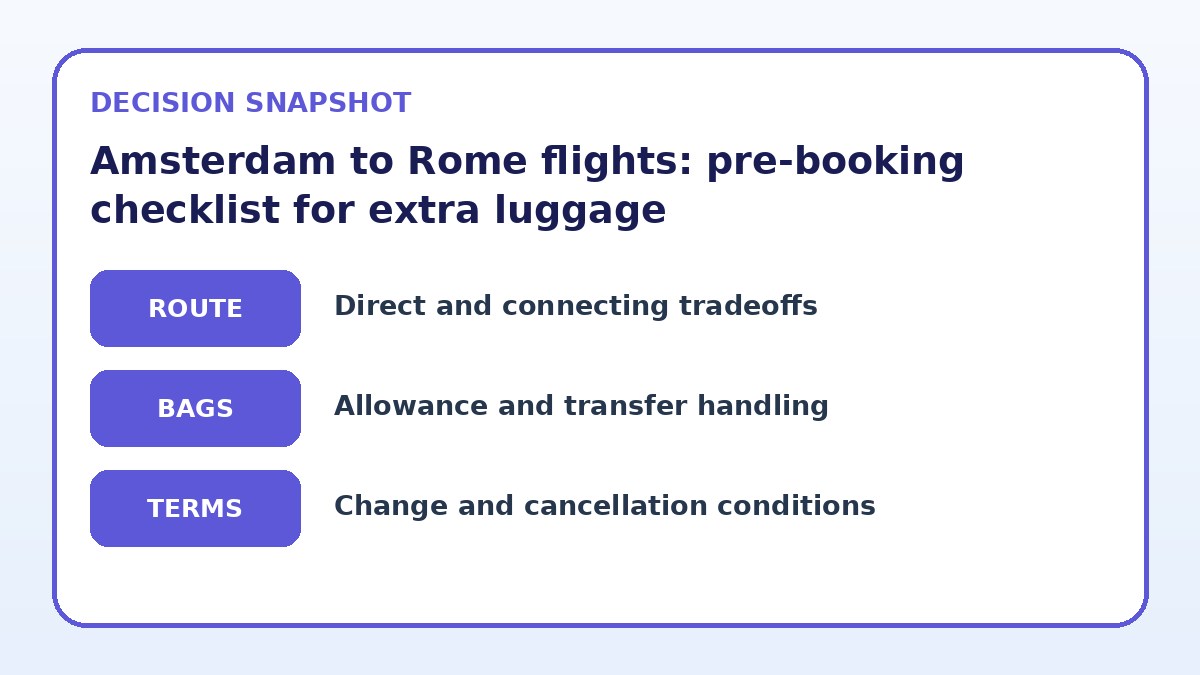
Routing: direct vs connecting and what to choose
When you have extra luggage, routing choice is the single biggest operational decision. Direct Amsterdam to Rome flights (if available on your dates) minimize touchpoints—one boarding, one baggage drop, one collection—so they reduce the chance of lost or delayed bags. Connecting itineraries can be cheaper or necessary depending on schedules, but they add baggage transfers, potential re-checks between partners or terminals, and a higher risk of missed bags if layovers are short. For travelers carrying heavy sports gear, multiple suitcases, or fragile items, prioritize routes with fewer transfers even if the fare is modestly higher.
To compare options, list all candidate itineraries and mark which are nonstop and which require a connection. For connecting flights, note the connection airport, minimum connection time offered on the booking page, and whether the same airline or alliance operates both legs. If different carriers are involved or you must change terminals, add at least one additional hour to the minimum connection time for baggage handling and security lines. This realistic mapping clarifies whether a cheap connection is a false economy when weighed against baggage risk.
Baggage and connection risk: what to verify before booking
Do not assume baggage rules across fares or carriers are the same: verify allowed weight, dimensions, number of free checked pieces, excess baggage fees, and how the airline treats oversized sports equipment. On the airline’s booking page, look for specific weight and size limits per piece and whether fees are charged per route or per flight leg. If the itinerary involves two different carriers—even under one reservation—check whether checked bags are tagged through to Rome or if you must collect and re-check them during a connection. That detail determines whether you need additional time, a visa for the transfer airport, or extra baggage paperwork.
Also consider the operational risk of a tight connection. Baggage mishandling most commonly happens during tight turnarounds or when flights use different ground-handling partners. If your transfer requires changing terminals or crossing a secure border, treat the connection as effectively longer and verify whether the airline will accept responsibility for through-checked baggage on interline bookings. If the booking page is unclear, contact the airline or check the carrier’s conditions of carriage; make notes to reference while comparing live fares.
Compare flight-selection strategies
| Flight strategy | Best for | Risk to check |
|---|---|---|
| Book a direct flight with baggage included | Travelers prioritizing low transfer risk and simple baggage handling | Usually higher fare but fewer potential points of failure for extra luggage |
| Choose a connecting itinerary to save fare cost | Price-sensitive travelers willing to accept more handling for savings | Higher chance of re-checking baggage and missed connections if layovers are tight |
| Buy a basic fare and add baggage later | Flexible planners who expect final baggage count to change | Risk of higher add-on fees and less certainty on baggage rules at check-in |
| Book a bundled or flexible fare with included bags | Travelers who want predictable costs and easier changes | Higher upfront cost but simpler logistics and fewer surprises at airport |
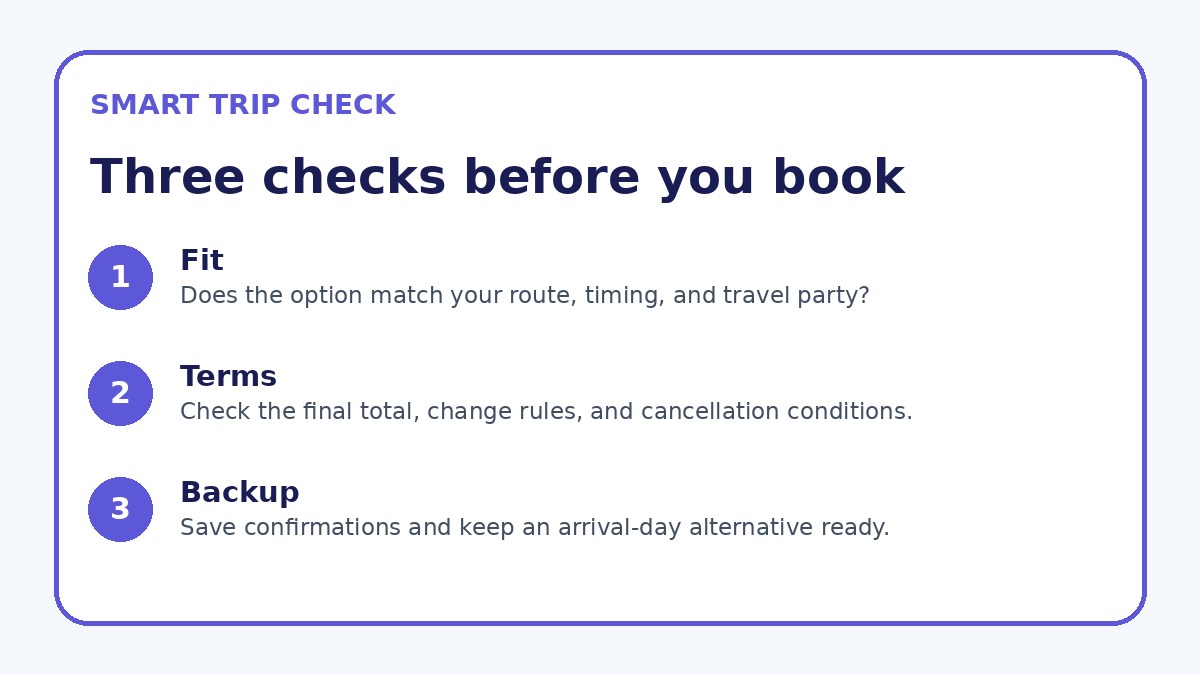
Recheck the complete itinerary
Confirm airports, connection handling, baggage, and change conditions before deciding.
Schedule fit and layover planning for bulky bags
Schedule fit goes beyond departure and arrival times: it’s about the whole door-to-door timeline including luggage handling. For early morning or late evening flights, consider airport processing times at Schiphol and Rome’s arrival airport—baggage handling can be slower during peaks or late shifts. If you have oversized items that require special handling, look for flights that arrive when ground staff are fully staffed to reduce the chance of delays in offloading and handling unusual items.
When you compare schedules, factor in realistic transfer padding. For single-bag travelers, a short connection might be fine; for extra-luggage travelers, add 60–120 minutes to any minimum connection time. If you plan to travel onward from Rome by train or another flight, ensure arrival time gives ample margin to collect baggage, clear customs, and reach your next transport. This practical approach ensures you don’t trade a lower fare for stressful transfers that may cost time or require additional paid services.
Flight details to verify
- Record exact travel dates, arrival/departure airports, passenger ages, and whether any traveler requires special assistance before checking fares.
- Count every bag and measure weight and dimensions; note any oversized, fragile, or sporting equipment and classify each item by size and weight.
- On the airline booking page, confirm whether baggage is included per passenger, fees for additional pieces, and whether fees apply per leg or per journey.
- For itineraries with connections, verify whether checked bags are tagged through to Rome or need to be collected and re-checked during transfer.
- Add realistic connection padding: increase the listed minimum connection time by 60–120 minutes for heavy or multiple bags, terminal changes, or international transfers.
- Save screenshots or PDF copies of the fare rules, baggage policy, and your reservation page; keep airline contact details and the booking reference handy.
Fare conditions: fees, flexibility and what to confirm
Fares differ widely in what they include. Before booking Amsterdam to Rome flights, read the fare rules on the carrier’s booking page: pay attention to which fares include checked bags and how many, the cost to add a bag later, and whether you can change travel dates or obtain a refund. If you need flexibility because of variable travel dates or uncertain final baggage count, a higher-fare bundle that includes one or two checked bags and flexible change options can be worth the extra cost compared with a stripped-down fare plus add-ons.
Also verify where baggage charges apply—per leg or per direction—and whether fees rise if you add baggage after purchase. If you plan to book separate tickets (e.g., low-cost carrier into a hub then another carrier onward), confirm baggage transfer rules and the implications for missed connections. Finally, note the carrier’s rules on compensation for delayed or damaged bags and what documentation they require; you’ll want that information easily accessible if anything goes wrong.
Flight Guide questions travelers ask
How much connection time should I allow when traveling with multiple checked bags?
For travelers with multiple or oversized checked bags, allow significantly more time than the published minimum connection. Add 60–120 minutes to the airline’s stated minimum when your itinerary requires a terminal change, customs re-entry, or a different carrier. If baggage must be collected and re-checked, allocate extra time for baggage claim, potential queueing, and re-check-in. When in doubt, choose a longer connection or a direct option to reduce risk—verify exact minimum connection policies on the airline’s final booking page before you complete purchase.
Should I pre-pay for checked baggage or pay at the airport?
Pre-paying for checked baggage during booking usually provides clarity on cost and helps avoid long airport queues or last-minute higher fees. If you expect to travel with extra luggage, compare the pre-paid baggage price on the booking page to the airport or call-center rate. Also confirm whether the fee covers the full journey or is charged per leg. If availability of refunds or changes matters, check fare conditions about baggage modifications before purchase so you’re not locked into an inflexible option.
What should I verify if my Amsterdam to Rome itinerary uses two different carriers?
If your journey combines two different airlines, confirm whether the booking is an interline/reserved itinerary that offers through-checked luggage; if it is not, you will likely need to collect and re-check bags between flights. Verify transfer terminal logistics, minimum connection time, and whether both carriers accept responsibility for delayed or mishandled baggage. Review both carriers’ baggage allowances and fees on their respective booking pages and secure contact details. If policies are unclear online, contact the airlines directly before finalizing the ticket.
Final decision note
When you travel from Amsterdam to Rome with extra luggage, the best booking choice balances routing simplicity, connection safety, and clear baggage rules. Start by collecting exact travel details and baggage counts, then compare direct and connecting options while factoring realistic connection padding. Prefer fares that include checked bags or allow affordable pre-paid add-ons if you want predictable costs and less airport stress. Always verify baggage allowances, whether bags will be through-tagged on connecting itineraries, and the fare’s change or cancellation terms on the airline’s final booking page. If you want a single place to compare live availability and conditions, you can check Trip.com, but always confirm provider-specific rules on the carrier’s own site before paying.
Continue planning
Check current options and final conditions
Use the provider page to confirm live availability, the final total, cancellation terms, and every condition that matters to your trip.
This evergreen planning guide was created with AI-assisted drafting and a structured quality review. It does not display live prices, schedules, availability, visa guidance, or provider rankings. Verify current details before booking. Some links are affiliate links; we may earn a commission at no additional cost to you.