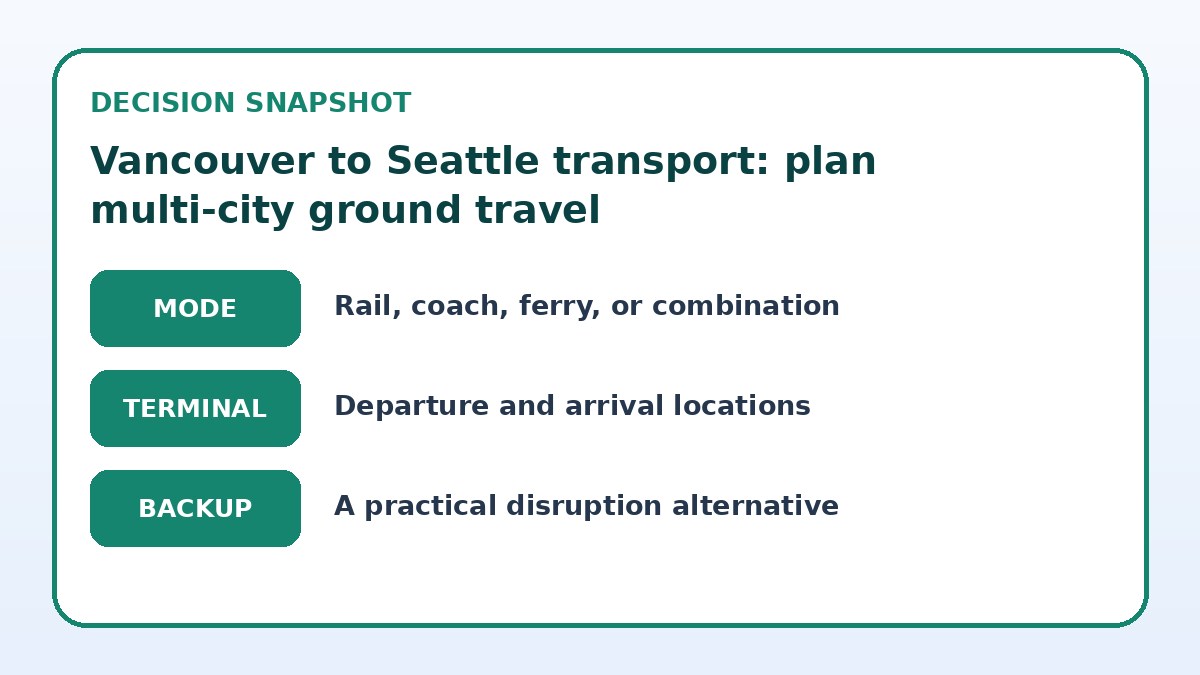
If you need a practical plan to get from Vancouver to Seattle by ground, start by choosing the travel mode that matches your priorities: fewer transfers, lower friction with luggage, scenic value, or flexible timing. For most first-time visitors the decision rests on four visible tradeoffs — terminal locations and how easy they are to reach, luggage and transfer friction, schedule flexibility, and a simple disruption backup. This article gives you the direct answer up front: weigh terminal fit and transfers first, then pick the mode (rail, coach, ferry, or a combination) that minimizes door-to-door travel time and hassle for your specific start and end points. After that I’ll walk you through how to compare routes, what to check before booking, and simple backups so one delay doesn’t derail the whole multi-city plan.
How to choose between rail, coach, ferry, or a combination
Start by mapping door-to-door time, not just the in-vehicle schedule. Locate where you’ll be sleeping in Vancouver and where you want to arrive in Seattle. A seemingly faster option can become slower once taxi or transit time to and from terminals is included. For example, a downtown-to-downtown coach or train could be more efficient than a scenic ferry that requires an extra shuttle. Make a short spreadsheet listing door-to-terminal, terminal wait, vehicle time, and terminal-to-destination to compare realistic total travel times for each mode.
Consider the nature of your trip. If you want scenery and can accept more transfers, a ferry combined with local transit and a bus might be appealing. If you prefer fewer decisions on travel day, a single-seat option or a coach with simple boarding is usually better. Also match luggage needs to the mode: trains typically accommodate bigger bags more easily than smaller intercity shuttle buses. Finally, factor in how much you value schedule flexibility versus a single booked seat — that choice will shape the rest of your planning.
Choose the end-to-end journey plan
| Journey approach | Best for | Friction to check |
|---|---|---|
| Single-mode direct service (train or coach) | Travelers wanting minimal transfers and simpler luggage handling. | May require earlier booking and could tie you to fixed departure times with fewer daily options. |
| Ferry-inclusive route | Those prioritizing scenery and a relaxed travel experience with a coastal segment. | Often adds transfer steps and can be less frequent, increasing risk of missed connections. |
| Mixed-mode combination (ferry + coach or rail) | Travelers building an itinerary with sightseeing stops or specific terminal preferences. | More planning required for luggage handling and transfer timing; higher chance of cascading delays. |
| Flexible multi-departure plan (buy flexible tickets or plan multiple options) | Uncertain schedules and travelers who value the ability to change plans day-of. | Often more expensive or requires additional time to rebook; may complicate multi-city logistics. |
Check live intercity options
Look beyond the ride itself and compare terminals, transfers, luggage, and arrival fit.
Terminal fit and luggage/transfer friction
Terminal fit is critical for first-time visitors. Check exact terminal addresses, typical transit times from your hotel, available drop-off lanes, and whether rideshare drivers are allowed to queue. Long walks between platforms, multiple shuttle transfers, or terminals located outside downtowns multiply friction. If your schedule is tight, prefer options with terminals close to where you need to be; a central coach or train station often beats a remote ferry terminal even if the crossing is quicker on paper.
Luggage rules differ between operators and will directly affect how smooth your day is. Identify where bags must be checked, whether there are size or weight limits, and if you’ll need to carry luggage up stairs or across platforms. Pack a small daypack with essentials in case your checked bag is delayed. If you plan a multi-stop itinerary after Seattle, choose a mode that handles multiple bags easily to avoid repeated curbside handling and long waits at baggage claim.
Timing flexibility and day-of disruption planning
Build timing cushions into your plan. For cross-border or multi-city travel, delays happen — traffic, weather, or service adjustments can alter schedules. Choose services with frequent departures if you think you may need to move your times; coaches and some trains often run multiple times per day, while ferries may have fewer sailings. If your itinerary includes fixed activities on arrival day, pick an earlier departure and allow comfortable buffer time after scheduled arrival for immigration, transfers, or a late ride to your accommodation.
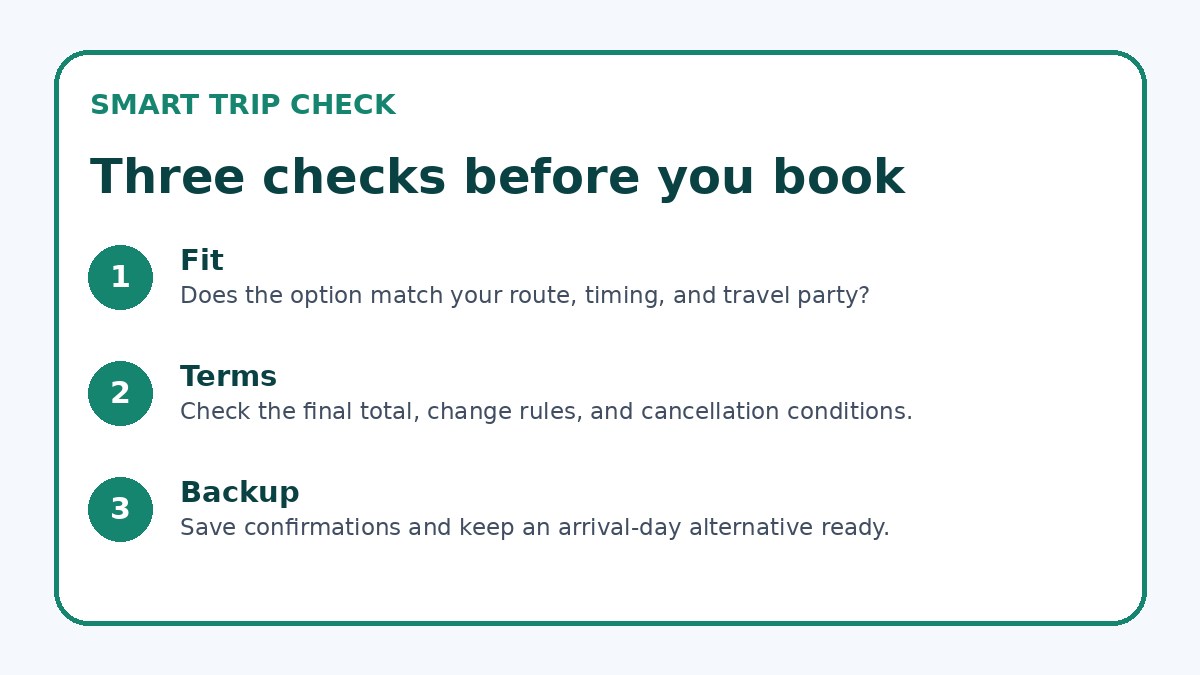
Create a simple disruption playbook before you go: a secondary service (later coach or train), a local bus or rideshare route to bridge gaps, and contact methods for customer service. Save the booking confirmation, terminal addresses, and local transit maps offline in case mobile data is limited. If crossing the border with a vehicle or on public transport, verify current border crossing wait information on official channels before departure and allow extra time for inspections.
Compare the practical alternatives
Use the final page to confirm what is actually offered on your dates and save a workable fallback.
Intercity travel checklist
- Confirm exact terminal addresses for departure and arrival and measure transit time from your accommodation using current local transit tools.
- Read luggage and boarding rules on the operator’s official booking page and pack accordingly to avoid check-in delays.
- Choose a primary route and at least one backup departure on a different operator or time in case of delays.
- Download offline directions and save booking confirmations, terminal photos, and customer service contacts on your phone.
- Allow extra buffer time for border crossing, transfers, and potential taxi or rideshare queues at both ends.
- If your plan uses multiple operators, verify connection windows on the day-of travel and buy flexible or refundable tickets if needed.
Putting it together: building a multi-city ground-transport plan
Start with your door-to-door spreadsheet and rank options by total travel time, convenience, and risk. Choose a primary leg and one or two backups that require minimal additional transfers. For example, pick a direct coach or train as your primary if it delivers you close to your Seattle stay; if the primary has limited departures, a slightly slower but more frequent coach might be a better overall choice. If a ferry appeals, combine it with a direct shuttle or local transit that minimizes walking and luggage handling.
Before booking, verify three things on operator pages: exact terminal addresses and pick-up instructions, luggage rules and check-in times, and the provider’s change/cancellation policy. If you rely on transfers, check connecting operator schedules on the same day. Use a comparison site such as Trip.com for a quick availability snapshot, but always confirm critical details on the carrier’s official booking page. Print or save step-by-step directions for the travel day to simplify transfers and reduce stress.
Rail & Intercity Transport questions travelers ask
Should I pick a train, coach, or ferry for the simplest door-to-door trip between Vancouver and Seattle?
For simplicity, prefer the option that requires the fewest transfers and places terminals near your start or end point. A single-seat coach or train that departs from and arrives near downtown locations usually reduces taxi time and luggage handling. Ferries can be scenic but often need extra shuttles or transit at each end. Evaluate the full door-to-door itinerary — walking and local transit can add significant time; the mode with fewer steps is usually the simplest for first-time visitors.
How much time should I allow for transfers and border crossing when planning ground travel?
Build comfortable buffers beyond published vehicle times. Allow time for check-in and boarding — some services require early arrival — plus extra for luggage handling and transferring between terminals. Border crossing can add unpredictability; allow additional time for inspections or queues. If your schedule is tight, choose a later appointment in Seattle or travel earlier in the day to reduce stress. Always check official border wait information and operator check-in recommendations before departure.
What’s the best disruption backup if my chosen service is delayed or canceled?
A practical backup is a secondary departure on a different operator or a later service with a different time window. If that’s not available, identify a local bus, rail alternative, or a reliable rideshare route that can bridge to an alternate terminal. Keep contact details for operators handy and know refund or rebooking policies. Save offline maps and directions so you can quickly pivot on the road without depending on real-time connections or mobile signals.
Final decision note
Planning Vancouver to Seattle ground travel for the first time is mostly about minimizing door-to-door friction. Choose the mode that places terminals close to where you start and end, match luggage rules to your packing, and prioritize options with reasonable schedule flexibility. Build clear backups and allow generous buffer time for transfers and border checks. Verify terminal addresses, luggage rules, and change policies on carrier pages — use comparison tools like Trip.com only to check availability, then confirm essential details directly. A short planning checklist will turn a multi-city route into a calm, predictable part of your trip.
Continue planning
Check current options and final conditions
Use the provider page to confirm live availability, the final total, cancellation terms, and every condition that matters to your trip.
This evergreen planning guide was created with AI-assisted drafting and a structured quality review. It does not display live prices, schedules, availability, visa guidance, or provider rankings. Verify current details before booking. Some links are affiliate links; we may earn a commission at no additional cost to you.