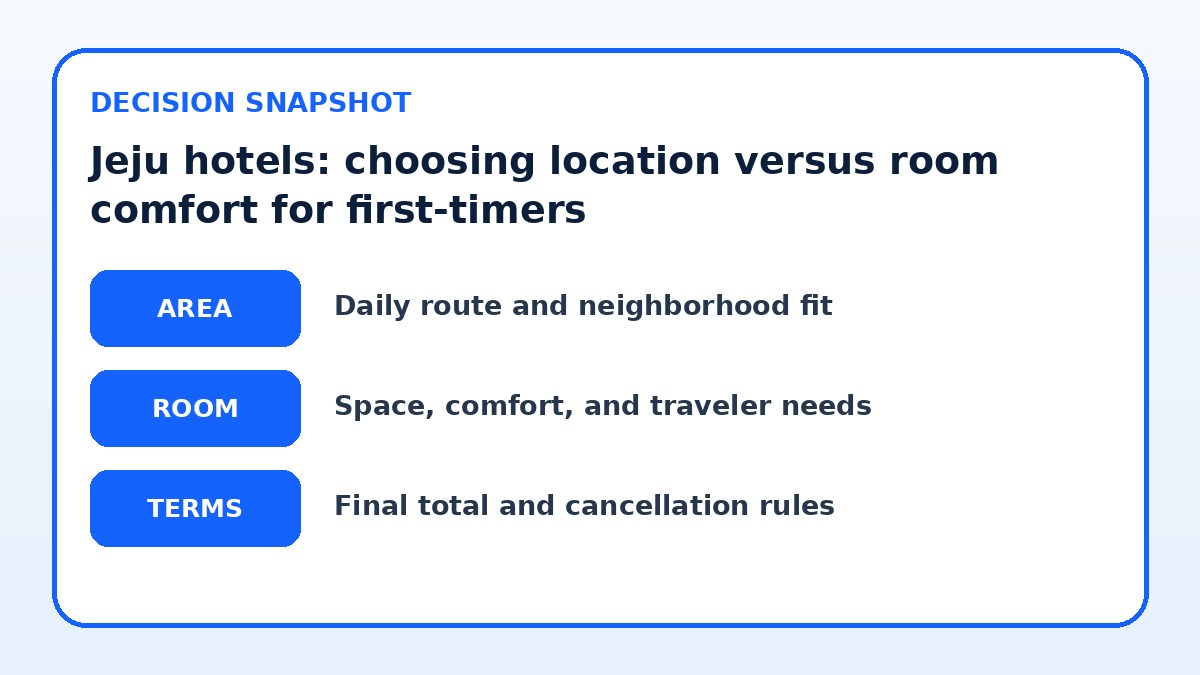
Practical answer first: choose your Jeju hotel by picking an area that minimizes daily travel for your planned activities, then match the room to how you’ll use it—sleep-only, workspace, family living, or long-stay comfort. For most first-time visitors that means deciding between a waterside base (for coastal sights and restaurants), a central base (for transport links and food markets), or a quieter countryside or eastern base (for nature and hiking). Once you’ve narrowed the area, pick a room with the right bed layout, noise control, and storage so your days on the island aren’t undone by poor rest or cramped quarters. This article walks you through the neighborhood fit, everyday-route friction, room and party needs, and the booking terms to verify before you hit confirm, allowing you to shortlist an area and confidently compare actual hotels on booking sites or Trip.com.

Check live stays in the areas that fit
Use your dates and party size to compare current rooms after you narrow the neighborhood fit.
Neighborhood fit: pick the right base for your first Jeju days
Start by mapping your must-dos—coastal drives, Hallasan hikes, museums, or Jeju City markets—and choose a neighborhood that clusters the majority of those activities. Seogwipo (south) is convenient for waterfalls and southern coast drives; Jeju City (north) offers ferry and airport access plus city shopping; eastern and western coastal towns suit those focused on natural trails and quieter beaches. If your list mixes far-flung sites, weigh whether you prefer one central base and day trips or splitting your stay between two areas to reduce daily driving.
Neighborhood choice also shapes daily conveniences: whether you want evening dining options within walking distance, easy access to bus routes or rental-car pickup points, and the availability of late grocery runs. For a first visit with limited days, prioritize proximity to the activities you’ll do most often rather than chasing a scenic room view that adds daily transit time. Shortlisting neighborhoods first makes comparing specific hotels straightforward because you’ll already know the travel tradeoffs each location imposes.
Choose an area-selection strategy
| Area approach | Best for | Tradeoff to check |
|---|---|---|
| Central hub approach: pick Jeju City or Seogwipo as a single base | Travelers who want straightforward transit access and evening dining options without moving hotels | Longer day trips to distant sights and potentially more tourist bustle at night |
| Split-stay approach: two short stays in different regions | Visitors aiming to reduce daily driving and tailor nights to nearby attractions | Extra time spent on one mid-trip hotel change and transferring luggage |
| Nature-first approach: base in eastern or western coastal towns | Hikers and beachgoers prioritizing immediate access to trails and quieter shores | Fewer dining and transport options; longer journeys to central tourist spots |
| Comfort-first approach: choose a hotel prioritizing room features over location | Travelers valuing rest, workspace, or family living space above daily proximity | May add daily travel time to many attractions, increasing transport costs or fatigue |
Daily-route friction: how travel time and transit shape your stay
Estimate typical door-to-door transit for a few sample days—hotel to breakfast to main attraction to dinner—and choose an area that keeps most days under an hour of combined travel. Jeju’s attractions are spread; roads can be scenic but slow if you need to wind between coast and interior. If you plan to rely on buses, prioritize Jeju City or Seogwipo where routes and frequency are denser. If you’ll rent a car, the entire island becomes accessible, but factor in parking availability at hotels and busy weekend traffic near popular sites.
Beyond raw time, consider friction: early starts for sunrise viewpoints, late dinners after performances, or luggage transfers between split stays. A short taxi ride can be cheaper than an hour on public transit when time matters, so check whether your area has reliable taxi service. If you expect uneven days—one long excursion and other relaxed days—balance convenience for the long days first, then accept a slightly less central but quieter hotel for recovery nights.
Now compare like with like
Keep the same dates, guests, room needs, and cancellation preferences while you compare the final choices.
Room and party needs: match the space to how you’ll live in it
Decide what you truly use a room for. If you’ll be out from dawn to late night, a compact room with a comfortable bed and good blackout curtains may suffice. If you need a place to work, choose rooms with a stable desk, fast Wi‑Fi (verify speed on the booking page), and good lighting. Families and groups should look for suites, multiple-bed configurations, connecting rooms, or rooms with a small kitchenette so meals and early breakfasts are easier. For mobility needs check that the hotel offers accessible rooms and verify features directly with the property.
Pay attention to noise control—request rooms away from elevators, bars, or busy streets if sensitive to sound. Storage matters more than it looks: ask about closet space, luggage racks, and the possibility of holding bags on arrival or after checkout. If you value a balcony or sea view, weigh that against potential exposure to wind and noise. Document your non‑negotiables before searching so you can filter rooms by the features that actually affect your comfort on the island.

Hotel booking check before payment
- List your top four daily activities and mark which Jeju neighborhoods cluster those sites together.
- Decide if you’ll rent a car or rely on public transit and confirm hotel parking or proximity to bus routes.
- Choose the minimum room features you require (bed size, desk, kitchenette, soundproofing) and filter results accordingly.
- Contact the hotel or view the booking page to confirm check-in/out times, cancellation policy, and extra-guest rules.
- If traveling with family, request connecting rooms or suite layouts and verify any extra-bed fees directly with the property.
- Save screenshots or confirmation emails of any service commitments (airport shuttle, late check-in) before final payment.
Booking terms and verification: what to check before you commit
Before booking, verify cancellation and change policies, exact check-in and check-out hours, early-arrival or late-departure rules, and whether the rate includes breakfast or taxes. Don’t rely on summary labels—open the hotel’s detailed policy or contact the property for clarifications. If you need airport transfers or private pick-ups, confirm availability and cost on the hotel’s own page. Where transport providers or special services are offered, check the final booking page for current scheduling and fees because those details change frequently.
Also confirm what’s included in the room: bed types, number of guests allowed without extra charge, and whether housekeeping is daily or on request. If you care about parking, EV charging, or pet policies, ask the hotel directly and record any confirmation. Use a reputable booking site to compare live availability and conditions—Trip.com is one option to view current options—but always verify the final terms on the property’s page before paying.
Hotel Guide questions travelers ask
Should first-time visitors stay in Jeju City or split their nights between north and south?
Pick Jeju City for a simpler trip with easier airport and ferry access and more urban dining options; it reduces the number of hotel changes. Split nights if you want to minimize daily driving to far-apart attractions—base one night in Jeju City or the north for airport convenience and another in Seogwipo or a coastal town for southern sights. Balance the extra time spent changing hotels against the time saved on the island each day.
How do I decide if I need a suite, connecting rooms, or a standard double?
Match room type to how you’ll use the space. Choose a standard double for short stays where you’ll mostly be out. Pick a suite or connecting rooms if you need living space, privacy for different sleep schedules, or a kitchenette for children. For work-focused stays, prioritize a proper desk and reliable Wi‑Fi. Always confirm bed configuration and the hotel’s policy on extra guests on the booking page before paying.
What transport considerations should influence my hotel area choice in Jeju?
Decide whether you’ll rent a car—this opens the island but requires parking; confirm parking with the hotel. If you prefer public transit, choose Jeju City or Seogwipo for denser bus networks and easier taxi access. Consider how early or late your planned activities are and whether taxis are available at those hours. For transfers and shuttles, verify schedules and costs on the hotel’s booking page so you’re not surprised on arrival.
Final decision note
For first-time visitors to Jeju, the most useful decision is area first, room second: pick the neighborhood that clusters your must-see activities to cut daily travel, then match the room to how you’ll spend time there—rest, work, or family life. Map sample days, decide on car versus public transit, and shortlist two or three neighborhoods before comparing hotels. When evaluating rooms, prioritize sleep quality, storage, and functional space over decorative extras unless views or a balcony matter to your trip. Finally, verify booking terms, transport options, and room details on the hotel’s own page (or compare live inventory on Trip.com) so the confirmation reflects the services you counted on.
Continue planning
Check current options and final conditions
Use the provider page to confirm live availability, the final total, cancellation terms, and every condition that matters to your trip.
This evergreen planning guide was created with AI-assisted drafting and a structured quality review. It does not display live prices, schedules, availability, visa guidance, or provider rankings. Verify current details before booking. Some links are affiliate links; we may earn a commission at no additional cost to you.