
If you’re booking Fukuoka travel deals for the first time, choose the cancellation policy that matches how firm your plans are. For short, fixed itineraries pick more restrictive rates if they’re noticeably cheaper and you’re confident; for uncertain arrival or departure times, prioritize refundable or flexible-change options even if they cost more. Before you finalize anything, compare the provider’s stated refund timing, change fees, and the method for receiving refunds (credit, voucher, or original payment). Also check whether third-party booking platforms have separate rebooking rules. This article walks through practical decision points, tradeoffs between price and flexibility, and a short checklist of exactly what to verify on the provider’s final booking page so you leave for Fukuoka with clear expectations.
See current options before you compare the details
Availability and final conditions change. Open Trip.com now or keep reading for the practical comparison.
Understand the basic cancellation types
Cancellation and change options typically fall into a few patterns: nonrefundable, partially refundable (often with a window), refundable, and change-permitted-with-fee. Nonrefundable rates are cheapest but offer no reimbursement if you cancel after the provider’s free-cancellation window; some tickets and room rates allow name or date changes for a fee instead of a refund. Refundable bookings allow a return of funds within the provider’s stated processing window, while more flexible bookings often waive or reduce change fees. For first-time visitors to Fukuoka, match the type to how fixed your travel dates are and how much you value the option of switching plans.
Beyond the headline type, read the fine print for exclusions and conditions. Does the refundable option refund to your card or issue a travel credit? Is there a separate administrative fee? Are cancellations allowed only for specific reasons (medical, government orders) under special policies? Also check whether taxes, service fees, or third-party fees are refundable—the gross paid amount is not always returned in full. These details determine how useful a supposedly 'flexible' booking will be if you need to cancel or reschedule.
How to compare flights and hotels when flexibility matters
Compare the practical outcomes, not just the label. For flights, consider the cost difference between a flexible fare and a base fare plus the likely cost to rebook if plans change. Flexible fares may allow same-day or date changes without paying the full price difference, but verify whether taxes and fare differences still apply. For hotels, determine the start and end of the free-cancellation window—some properties allow free cancellation up to a set number of days before check-in, others tie free cancellation to local time zones or specific cut-off times.
When comparing options, calculate the break-even point: if a flexible option costs X more than a nonrefundable one, how likely is a change that would otherwise cost X in rebooking or lost funds? Also check cross-product interactions: if a flight change forces a hotel cancellation, will the hotel treat the original booking as a no-show or permit a partial refund? Keep records of cancellation conditions and screenshots of the booking terms in case you must dispute a charge later.
| Approach | Best for | Tradeoff to check |
|---|---|---|
| Nonrefundable cheapest rate | Travelers with fixed dates and low likelihood of changes | Lowest upfront cost but no refund if plans change; penalties can exceed initial savings |
| Partially refundable / limited-window | Those who expect certainty but want a short cancellation window | Moderate cost with a defined free-cancellation cutoff; after that, penalties apply |
| Fully refundable rate | Travelers needing maximum flexibility and easy refunds | Higher price but refund to original payment method may take longer or be reduced by fees |
| Nonrefundable plus travel insurance | Risk-takers willing to self-insure against defined events | Cheaper ticket plus policy cost; insurance coverage varies and may not cover all cancellation reasons |
Ready to check the option that fits your plan?
Use your exact dates and traveler details so the provider page can show the current total and conditions.
Tradeoffs: money, convenience, and stress
Choosing flexibility usually reduces stress at the cost of higher upfront spend. If your itinerary is tentative because of work, family, or connecting travel, paying more for refundable tickets or flexible hotel rates can be worth it to avoid complicated rebooking fees and last-minute search stress. Conversely, if your schedule is locked—paid leave, fixed events, or confirmed meetings—opting for lower-cost nonrefundable rates can save money. The key is honest risk assessment: if the odds of change are low, accept the savings; if they’re high, value the convenience.
Another tradeoff is time and effort. Flexible fares sometimes allow easy self-service changes online, saving time on calls and emails. Nonrefundable bookings that require special waivers or third-party intervention can become time sinks and produce wait times or complex refund disputes. Also consider payment method: refunds to the original card may take weeks, while vouchers might be immediate but limited in use. Factor availability of customer service in your decision—providers with responsive support reduce the downside of last-minute changes.
Before you book
- Read and save the provider’s full cancellation and change policy from the final booking page before paying.
- Confirm whether refunds go back to your card, are issued as vouchers, or require calling customer service.
- Note the exact free-cancellation cut-off date and time in the property’s or carrier’s local time zone.
- Compare the price difference to a flexible option and calculate the break-even likelihood of needing a change.
- If booking via an aggregator, confirm whether cancellations route through them or the supplier and how fees differ.
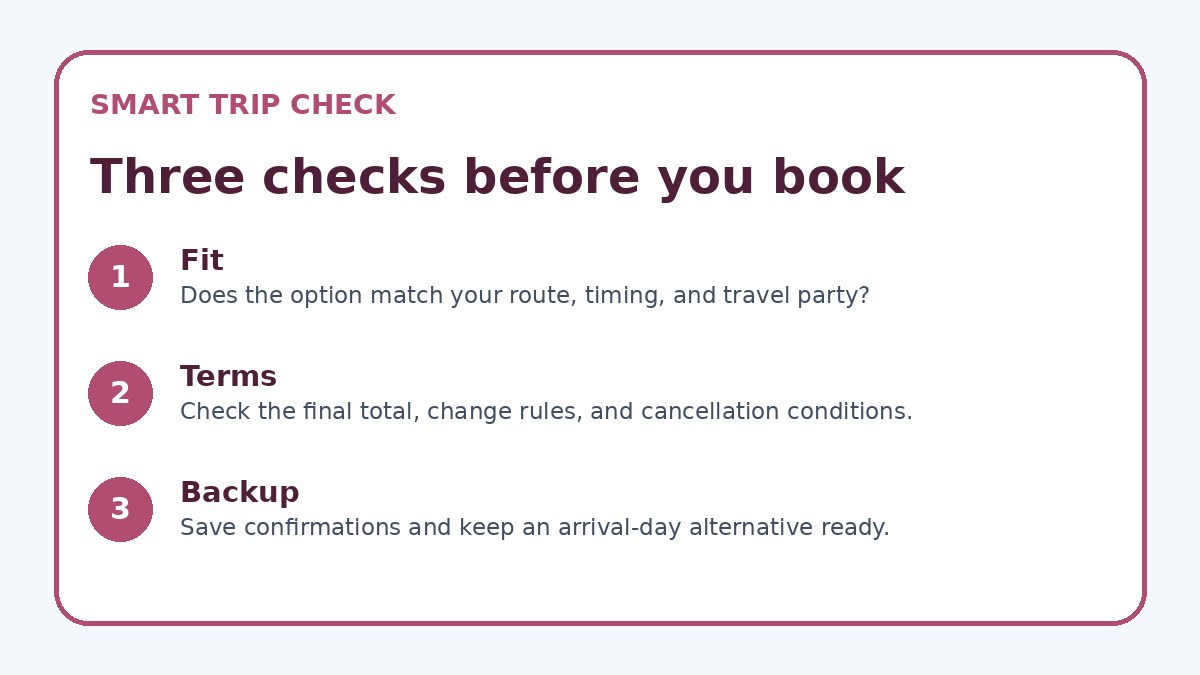
- Keep screenshots of the booking terms and the confirmation email so you can reference exact wording if needed.
What to verify on the provider’s final booking page
Before you click confirm, verify four critical items on the booking page: exact cancellation window (date and local time), refund method (card refund, voucher, or third-party credit), any fees or nonrefundable components, and the contact route for cancellations. Look for explicit examples—does the policy show when a full refund is returned versus when a penalty applies? If you used an aggregator or travel agent, confirm whether cancellations must go through them or directly to the airline or hotel.
If policies include special circumstances (illness, government travel advisories), note their required documentation and the submission process. Take screenshots or save PDFs of the final terms and the booking confirmation email; this saves time if you later need to contest a charge. Finally, if you rely on travel insurance for trip interruption, confirm how insurer coverage interacts with the provider’s cancellation terms and what receipts or proof you’ll need to file a claim.
Frequently asked questions
Is it worth paying extra for a refundable flight and hotel when visiting Fukuoka for the first time?
It depends on how firm your travel window is. If your dates may change because of work, domestic connections, or personal reasons, a refundable option reduces last-minute stress. If your schedule is fixed—confirmed events, fixed leave days, or immovable plans—you can save money with nonrefundable rates. Consider the total risk: add potential rebooking costs for missed connections or changed nights, and compare that to the incremental cost of flexibility. Always verify the provider’s exact refund process on the final booking page before deciding.
What should I look for in a hotel cancellation clause for Fukuoka stays?
Key items are the free-cancellation deadline (date and local time), whether deposit or taxes are refundable, and the penalty amount after the deadline. Check if the hotel allows date changes instead of cancellations, whether no-shows are treated differently, and if the property issues refunds back to your payment method or as hotel credit. If you have a tight arrival window or staggered connections, confirm whether early departures have separate charges. Capture the final booking terms and any confirmation emails to avoid confusion later.
How do aggregator rules affect my ability to cancel or change a Fukuoka booking?
Aggregators can add a layer between you and the supplier—some require you to cancel through their portal, while others forward your request to the airline or hotel. That may change timelines, add service fees, or complicate refunds. Before booking, check whether the aggregator’s policy matches the supplier’s and who is responsible for processing refunds. If the aggregator’s terms are stricter or slower, consider booking directly with the supplier or choosing a rate with greater built-in flexibility. If you use Trip.com or another platform, verify final cancellation steps on the supplier’s page as well.
Final planning note
For first-time visitors to Fukuoka, the best cancellation choice balances the probability of changes with your tolerance for hassle. If your trip is tentative, favor refundable or flexible-change options even at a premium; if plans are firm, nonrefundable rates can lower costs. Always verify four things on the final booking page: the exact cancellation window, refund method, any fees or exclusions, and who processes the cancellation. Save confirmation emails and policy screenshots, and consider travel insurance when appropriate. That preparation makes it easier to enjoy Fukuoka without unexpected financial or logistical surprises.
Continue planning
Check current options and final conditions
Use the provider page to confirm live availability, the final total, cancellation terms, and every condition that matters to your trip.
This evergreen planning guide was created with AI-assisted drafting and a structured quality review. It does not display live prices, schedules, availability, visa guidance, or provider rankings. Verify current details before booking. Some links are affiliate links; we may earn a commission at no additional cost to you.