If you’re planning Kyoto travel for a small group, the practical choice hinges on luggage, arrival airport, mobility, and how much door-to-door convenience you want. Start by identifying which airport you’ll use (Kansai International for international arrivals; Itami/Osaka for many domestic flights) and the size of your party—three people with two backpacks needs a different plan than five people with suitcases. For most first-time visitors traveling together, the quickest decision is to choose between public rail and a booked private transfer: rail offers predictability and cost-efficiency, while a private taxi or van gives door-to-door convenience and easier luggage handling. Below I explain how to weigh time, cost, comfort, and logistics so you can pick the right airport transfer for your group’s priorities and book with confidence.
See current options before you compare the details
Availability and final conditions change. Open Trip.com now or keep reading for the practical comparison.
Deciding between rail and road
Rail travel to Kyoto is often the most reliable baseline: regional express services run from the main airports into central Kyoto or nearby stations. For groups traveling light, trains are frequent and avoid traffic unpredictability; you can split onto two reserved seats if necessary. However, trains may mean stairs, platform transfers, and carrying luggage between carriages and station exits. Consider whether anyone in your group has limited mobility or very large suitcases—those factors push the choice toward a road transfer even if the train timetable looks convenient.
Road transfers—taxis, private vans, and shuttle buses—offer door-to-door delivery and much simpler luggage handling for groups. A private van that meets you at arrivals and drops you at your hotel removes the need to navigate stations, buy tickets, or wait for the right platform. The tradeoff is sensitivity to traffic and often a higher quoted fare per trip. If you’re arriving late at night or with children, the predictability of a direct vehicle can make nights and early mornings far less stressful than juggling transfers.
How group size and luggage shape the choice
Small groups of two or three with one small bag each are usually best served by rail plus a short taxi for the last mile; this blends speed and cost-effectiveness. As group size grows toward four or five, or when everyone has a full-sized suitcase, rail becomes more cumbersome unless you’re prepared to split into multiple seats or carriages. Carrying several large suitcases through crowded stations or up and down stairs adds time and fatigue, eroding the savings you might have gained with rail.
When your group hits five or more, or carries bulky equipment (sport gear, strollers, or sets of boxes), a single vehicle that accommodates both passengers and luggage is usually the simplest approach. Look for vehicles with explicit cargo capacity and confirm whether child seats or extra-large luggage can be fitted. If you choose a taxi or rental van, verify pickup logistics on the provider’s booking page—where the driver will meet you, how they handle flight delays, and whether porters or ramp assistance are available.
| Approach | Best for | Tradeoff to check |
|---|---|---|
| Express train to Kyoto plus local taxi | Small groups with light luggage seeking speed and lower cost | Requires carrying luggage through stations and may involve short transfer waits |
| Pre-booked private taxi or van | Groups prioritizing door-to-door convenience, heavy luggage, or mobility needs | Higher per-trip cost and susceptibility to road traffic delays |
| Shared airport shuttle bus | Budget-conscious groups willing to accept fixed stops and scheduled pickups | May add time with multiple drop-offs and less flexibility |
| Rent a car or minivan (self-drive) | Groups who plan flexible regional travel after arrival and are comfortable driving | Navigation, parking, and tolls add complexity; driving in unfamiliar areas may be stressful |
Ready to check the option that fits your plan?
Use your exact dates and traveler details so the provider page can show the current total and conditions.
Practical booking checklist and what to confirm
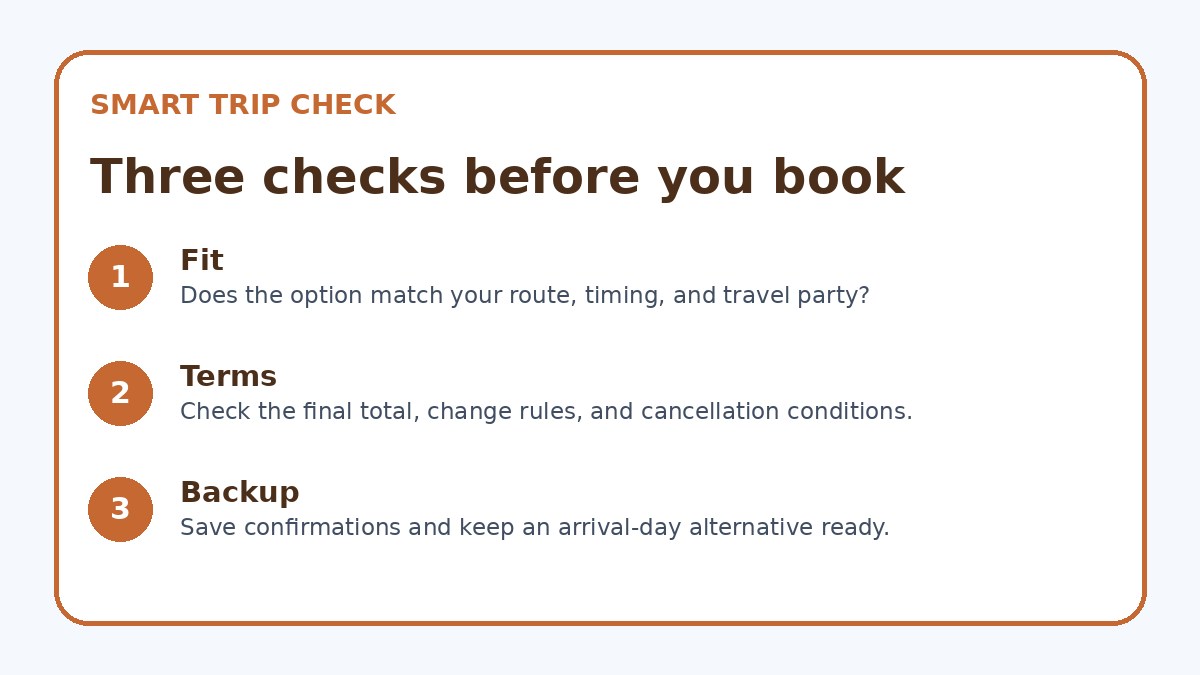
When you book, check four things on the final provider page: precise pickup location inside the arrivals area, the policy for flight delays or early arrivals, luggage allowances or vehicle size, and cancellation/changes terms. If a supplier offers meet-and-greet service, confirm whether a local phone number or meeting point photo will be provided. For rail options, verify where the station stop is relative to your hotel and whether you’ll need an additional taxi to reach your accommodation; don’t assume the station is within easy walking distance.
If booking privately, request a vehicle reservation that lists maximum passenger and luggage numbers and ask whether the driver waits through immigration and customs. With public transport, note whether tickets are refundable or time-limited; some regional passes require seat reservations for certain express trains. Trip.com can be a convenient place to compare current availability and transfer options, but always verify the final pickup, vehicle and luggage details on the operator’s official page before you commit.
Before you book
- Confirm which airport you’ll arrive at and research the direct rail or bus links to central Kyoto before booking any transfer.
- Count passengers and luggage pieces, then choose a vehicle or rail option that clearly states capacity for both people and baggage.
- If booking a private transfer, verify the driver’s meet-and-greet location, wait-time policy for delayed flights, and local phone contact.
- For rail options, check whether the final station is within walking distance of your hotel or if you need an onward taxi reservation.
- Ask whether child seats, wheelchair access, or oversized-luggage handling are available and request them explicitly on the booking page.
- Compare total door-to-door time and pickup flexibility, not only the headline fare, before you make a final reservation.
Cost, timing, and comfort tradeoffs
Balancing cost and convenience means being explicit about what you value. If minimizing price per person is the priority and your group can handle stairs and luggage, trains typically win. If your schedule is tight, or members value privacy and minimal walking, a private taxi or van is worth the extra no-nonsense convenience. Don’t base decisions solely on advertised fares—factor in the time and potential stress of moving luggage across stations or during peak travel hours.
Also factor in arrival times: very early or late flights change the calculus because train frequency and bus services can be limited, making private transfers proportionally more attractive. If traffic could be heavy during your arrival window, estimate how delays affect the group overall. The clearer you are about arrival time, party size, luggage volume, and mobility needs, the easier it will be to compare door-to-door travel times and pick the option that keeps the group comfortable and on schedule.
Frequently asked questions
Should a small group always book a private transfer to Kyoto?
Not always. Private transfers offer ease and door-to-door delivery, which is valuable for groups with heavy luggage, infants, or mobility needs. But for groups of two to three traveling light, rail plus a short taxi typically saves money and avoids road traffic. Consider arrival time too: late-night or very early flights reduce train options, making a private transfer more practical. Weigh the group’s tolerance for carrying bags and changing trains against the premium for convenience.
How do I decide between Kansai and Itami airports for my group’s transfer plan?
Choose based on your flight options and the balance of onward travel: Kansai handles most international flights and offers direct rail links via airport express trains; Itami serves many domestic flights and can be closer for some Osaka-area arrivals. Once your flights are set, compare the door-to-door time and number of transfers from each airport to your hotel. If you have a choice of flights, prefer the airport whose onward transfer route best matches your group’s needs for luggage handling and convenience.
What should I verify on a transfer provider’s booking page before paying?
Check the exact pickup point inside the arrivals hall, the vehicle’s passenger and luggage capacity, the policy for flight delays or early arrivals, and cancellation or change terms. If the service includes a meet-and-greet, confirm whether a local contact number, driver photo, or meeting-point map will be provided. For shared shuttles or trains, verify stop locations and any required seat reservations. These specifics prevent unpleasant surprises at the airport.
Final planning note
For first-time visitors traveling as a small group, start by matching your party size, luggage volume, and arrival time to the three core choices: rail, shared shuttle, or private vehicle. Rail usually gives predictable speed and lower cost if your group is light and mobile; private taxis or vans simplify arrivals for those with children or lots of bags. Use the checklist above to confirm pickup details, luggage capacity, and delay policies on the operator’s final booking page. Compare total door-to-door time, not only price, and consider Trip.com as one place to view current options—but always verify provider-specific pickup, vehicle size, and delay-handling terms before you commit.
Continue planning
Check current options and final conditions
Use the provider page to confirm live availability, the final total, cancellation terms, and every condition that matters to your trip.
This evergreen planning guide was created with AI-assisted drafting and a structured quality review. It does not display live prices, schedules, availability, visa guidance, or provider rankings. Verify current details before booking. Some links are affiliate links; we may earn a commission at no additional cost to you.