
If you need to travel from Los Angeles to San Francisco for work, the practical decision is this: pick the mode that balances door-to-door time, reliability, and your need to work during transit. For many business travelers that means comparing flights, intercity rail, and driving or rideshare—each has different tradeoffs in time predictability, security screening, and on-board productivity. Start by mapping where your day begins and ends in both cities, then prioritize direct options and clear buffer time for security, traffic, or connections. Prepare the essentials—documents, power and presentation backups, and a compact plan for last-mile transfers—so the travel day feels like a managed part of the workday rather than an unpredictable interruption.
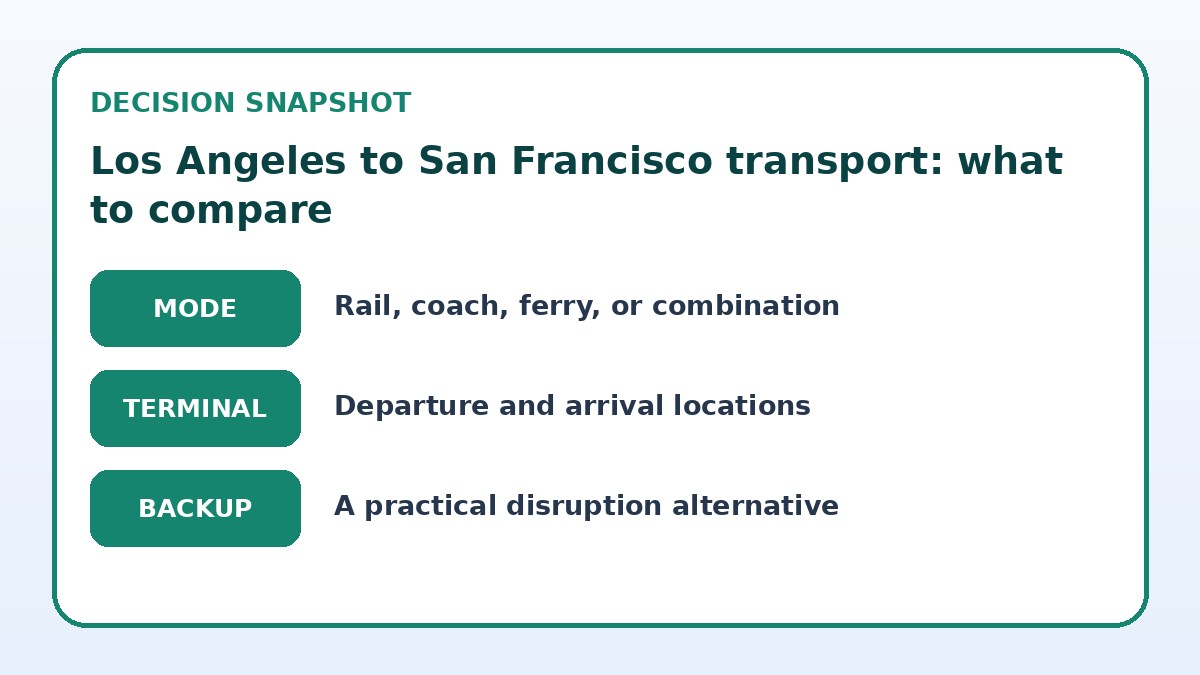
See current options before you compare the details
Availability and final conditions change. Open Trip.com now or keep reading for the practical comparison.
Choosing the best mode for your meeting schedule
Start by writing down the exact pickup and drop-off addresses and the appointment time. That simple step turns abstract travel times into concrete door-to-door math—train stations and airports are rarely in the same neighborhood as business addresses. For short mid-day meetings, prioritize minimizing time away from the office by selecting the option with the shortest reliable door-to-door time. For early-morning or late-evening travel, when traffic can be lighter, driving or rideshare might be competitive with air if your meeting is near freeway access points.
Think about how predictable each mode is for the date and time you need. Flights can be fastest in air but carry variability from security lines and ground delays; trains can be steadier because they avoid traffic but may have fewer departure times. If your work requires uninterrupted laptop time, favor options with stable seating and power outlets. If missing the first session would be costly, build in an extra buffer and choose an option with frequent departures or an easy same-day alternative.
Productivity and equipment for the travel day
Decide in advance whether you need to produce work en route or only be reachable. If the trip must be a productive block, prioritize modes that reliably offer a flat surface, power, and stable Wi‑Fi or cellular signal. Pack noise-cancelling headphones, a compact laptop stand or folio, and a travel router or hotspot if you frequently need stable connections. Keep files available offline and close all nonessential apps to preserve battery and performance during calls or presentations.
Create a short tech check routine before leaving: fully charge devices, test login credentials for VPN and conferencing tools, and save local copies of any slides or documents. Bring adapters for in-seat power or USB-C charging, and carry a small power bank with enough capacity to charge your phone and laptop at least once. Consider printing one handout for critical meetings in case a projector or screen connection fails, and save contact info for on-the-ground colleagues to smooth last-minute changes.
| Approach | Best for | Tradeoff to check |
|---|---|---|
| Air travel (commercial flights) | When airborne time plus fast ground transfers make total door-to-door time shortest | Adds airport security and check-in buffers; less predictable with ground delays |
| Intercity rail | When you need a comfortable workspace and stations are near meeting locations | Fewer departures and potential seat/power variability; check direct versus connecting trains |
| Driving or rideshare | When pick-up/drop-off points are near highways or you need flexible departure times | Subject to traffic variability; long drives can be tiring and reduce productivity |
| Hybrids (fly+rideshare, train+local taxi) | When optimizing specific legs for speed or convenience improves overall door-to-door time | More moving parts to coordinate; each leg’s delay can cascade into missed appointments |
Ready to check the option that fits your plan?
Use your exact dates and traveler details so the provider page can show the current total and conditions.
Managing transfers and time buffers
Transfer logistics determine whether a theoretically fast option actually wins. For flights, calculate time to your departure airport, recommended arrival buffer for security and boarding, and the ride from the arrival airport to your meeting. For trains, include time from your origin to the station and the station to your final address; intercity rail stations often sit nearer downtown areas and can shorten overall travel time. If you plan to drive or use a rideshare for the full route, check typical corridor congestion patterns for your travel window and plan departure times to avoid peak traffic periods.
Always add contingency minutes for the unexpected—traffic incidents, long security lines, or delayed connections. For high-stakes meetings, schedule a buffer that allows for an alternate same-day connection or a quick local backup meeting space. Keep a small folder or note with alternate route options, local taxi or car service contacts, and an explanation you can send to your host if you need to move a meeting by 15–30 minutes. Those small preparations reduce stress and maintain professionalism when disruptions occur.
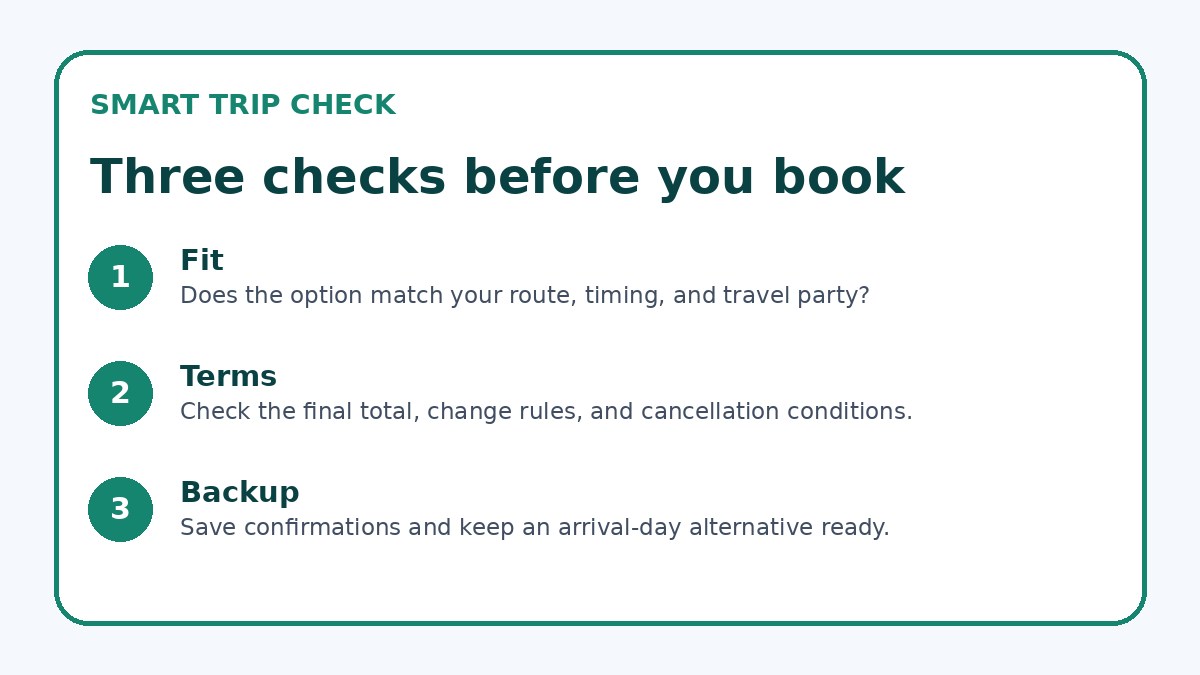
Before you book
- Map precise door-to-door itineraries and compare total travel times for each mode including transfers.
- Verify final booking page details: change/cancellation terms, luggage rules, and whether the service is direct.
- Charge and test all devices, enable offline copies of documents, and confirm VPN or conferencing logins.
- Pack a small tech kit: charger, power bank, dongles/adapters, noise-cancelling headphones, and a compact garment.
- Arrange last-mile transfers and save driver or station contact details in your calendar entry.
- Book refundable or flexible fares if schedule changes would cause significant disruption to your meeting.
Booking strategy and what to verify before purchase
When you’re ready to book, compare door-to-door times and ticket flexibility, not just headline travel time. Check the provider’s final booking page for change and cancellation terms, luggage rules, carry-on allowances, and any required identity checks. Confirm whether the train or flight is direct or requires a connection and, if connecting, how long the transfer time is—never assume a tight connection will work without explicit reassurance. If you rely on specific seat types or power outlets, verify those options at booking or by calling the carrier.
If you use a third-party site to view options, cross-check the carrier’s official site for last-step verification because policies and availability can differ. Trip.com can be useful to compare current availability and conditions, but always validate the final booking details where the carrier or rail operator confirms them. Finally, for high-importance trips, consider refundable or change-friendly fare classes and buy a small travel insurance policy that covers missed connections if your company permits it.
Frequently asked questions
Should I prioritize fastest scheduled travel time or most reliable option?
For business travel, reliability often beats the absolute fastest scheduled time because missed meetings carry a higher cost than a slightly longer transit. Evaluate the total door-to-door window—include time to your airport or station, check-in and security buffers, and likely traffic at both ends. If your meeting is tightly timed, choose the option with frequent departures or longer buffers rather than one fast option with a single tight departure. Build contingency time, and prefer fares that allow same-day changes if your schedule is volatile.
Can I work effectively on flights or trains between Los Angeles and San Francisco?
You can be productive on both modes, but they offer different environments. Trains usually provide more stable seating and easier laptop use, and you can often rely on quieter spaces and better legroom for focused work. Flights may offer less predictable onboard Wi‑Fi and limited workspace, and security checks add unset blocks of time. If critical calls or screen-sharing are needed, test the carrier’s Wi‑Fi policy and have local hotspots or offline alternatives ready to avoid connection surprises during the travel day.
How early should I arrive before departure on each mode to avoid stress?
Aim to arrive with enough time to handle variable security or boarding processes without rushing. For flights, allow the industry-recommended buffer for check-in and security plus extra time if you need to check bags or pass through busy terminals. For trains, plan for a shorter buffer but still enough to find your platform and settle in, especially if the station is unfamiliar. For driving or rideshare departures, check typical traffic patterns at your chosen departure time and leave a safety margin to absorb delays.
Final planning note
Preparing the travel day for a Los Angeles to San Francisco business trip means planning for the whole journey rather than the time in transit alone. Compare door-to-door schedules, consider where you can actually work en route, and choose the option that best protects your meeting time and productivity. Verify final booking terms on the carrier’s page—especially direct versus connecting services, change rules, and baggage allowances—before committing, and keep backup plans and contact info ready. With those steps done, the travel day becomes a controlled part of your work schedule instead of an unpredictable obstacle.
Continue planning
Check current options and final conditions
Use the provider page to confirm live availability, the final total, cancellation terms, and every condition that matters to your trip.
This evergreen planning guide was created with AI-assisted drafting and a structured quality review. It does not display live prices, schedules, availability, visa guidance, or provider rankings. Verify current details before booking. Some links are affiliate links; we may earn a commission at no additional cost to you.