If you’re arranging Seoul airport transfer for a small group, a practical decision framework will save time and stress the moment you land. For most groups of two to five people arriving together, choose between private car service, shared shuttle or public transport depending on luggage, mobility, budget, and your hotel location. Private cars give door-to-door convenience and simplify navigation with luggage, while shared shuttles reduce cost but add potential waits and stops. Public transport is often the most resilient option for central destinations and independent travelers but can be challenging with heavy bags or late-night arrivals. Below I’ll give clear guidance on when to pick each option, the tradeoffs to compare, and an easy checklist of what to confirm before you book. Also note: for live availability and provider details you can check Trip.com or the provider’s official booking page, and always verify final pickup instructions and cancellation terms there.
See current options before you compare the details
Availability and final conditions change. Open Trip.com now or keep reading for the practical comparison.
Decide by group profile: luggage, mobility, and schedule
Start by listing concrete facts about your group: number of people, amount and size of luggage, presence of children or mobility needs, and planned arrival time. These factors change the desirability of each transfer type. A compact group traveling light will find public transit or the airport express very convenient and reliable for central Seoul locations. Conversely, a group with strollers, oversized bags, or a late-night arrival usually benefits from a private car or minivan to avoid hauling bags through stations and shared shuttle logistics.
Also consider your timing flexibility. If you need to be in a meeting or hotel check-in window soon after landing, favor options that minimize wait and transfer time, such as a private car or direct taxi. If your arrival time is flexible and you value lower cost, scheduled shared shuttles or the airport rail can be sensible. Write down non-negotiable constraints up front — for example, “must be at hotel within one hour” or “cannot carry luggage up stairs” — then eliminate any option that fails those constraints.
Compare private car, shared shuttle, taxi, and public transport
Private car services deliver door-to-door pickup and are easiest for coordinating a small group with lots of luggage or specific meeting needs. When comparing private options, confirm vehicle size, how the driver meets you (airport terminal, arrivals hall, or curb), luggage allowance, and whether a meet-and-greet or flight-tracking is included. Because provider details change, verify these specifics on the supplier’s final booking page before you commit. If you value a single charge and predictable travel time, private cars are usually the simplest contract to manage for groups.
Shared shuttles and airport buses lower per-person cost but often include scheduled stops that increase transfer time. Taxis can be flexible but vary by vehicle size and are subject to local traffic; taxis may be practical for small groups with minimal luggage or when public transport isn’t convenient. The airport express train and Seoul metro connect many central neighborhoods quickly and avoid traffic risk — they’re a reliable fallback when your hotel is near a station and your group can handle luggage and short walks.
| Approach | Best for | Tradeoff to check |
|---|---|---|
| Private car / minivan | Small groups with lots of luggage or mobility needs | Higher per-vehicle cost and requires prebooking details like pickup point and vehicle size |
| Shared shuttle / hotel transfer | Cost-conscious groups willing to accept stops and possible waits | Longer door-to-door time and schedule dependency |
| Taxi or ride-hail | Flexible, immediate door-to-door travel for small groups with light luggage | Variable vehicle size and travel time dependent on traffic |
| Airport express + metro | Groups staying near central Seoul stations who travel light | Requires handling luggage on and off trains and short walks to accommodations |
Ready to check the option that fits your plan?
Use your exact dates and traveler details so the provider page can show the current total and conditions.
Practical booking checks and what to verify
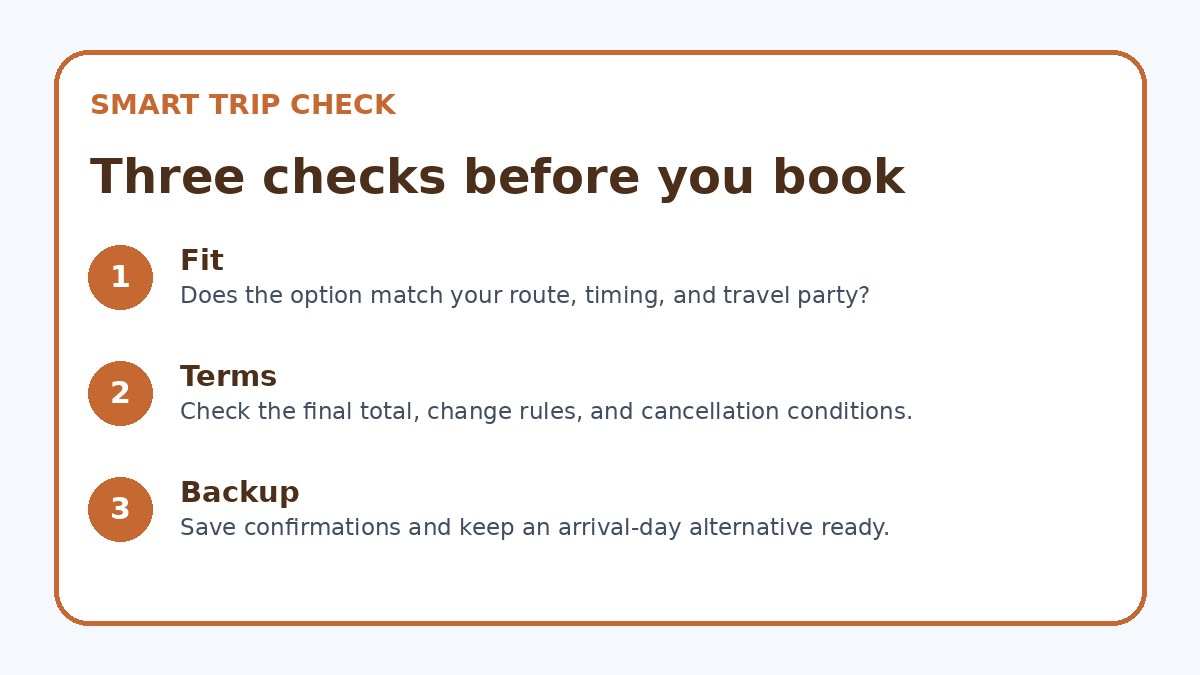
Before you book any transfer, confirm a handful of non-changing details on the provider’s final booking page: exact pickup location and how to identify the driver, vehicle size and luggage limits, cancellation and change policies, and whether the service tracks flight delays. Also check whether the quoted rate is total or per vehicle, and whether any local taxes or airport surcharges are included. If you read conflicting information across sites, contact the provider directly and save screenshots of confirmations and messages.
For shared services or public transport, check boarding points and final stop locations so you can plan a short last-mile walk or a quick taxi from a nearby station. If you prefer to compare current availability and recent user notes, Trip.com can be useful as one comparison point, but always use the transfer provider’s own booking page for the binding terms and final confirmation details. Keep a digital and a printed copy of your booking reference and the provider’s emergency contact for the day of travel.
Before you book
- Confirm your exact terminal arrival and record the arrivals-hall landmark where the driver will meet you.
- Verify vehicle size, luggage allowance, and whether the price quoted is per vehicle or per person.
- Check the provider’s flight-tracking and wait-time policy and whether extra waiting incurs a charge.
- Save the driver’s contact number and the booking reference; screenshot the confirmation and emergency contacts.
- Plan a backup option (local taxi app or nearest station route) in case the arranged transfer is delayed or canceled.
- Tell your group the meeting point and assign one person to handle communication and on-the-ground coordination.
Group etiquette and on-arrival coordination
Plan a simple meeting routine so everyone can reassemble if someone is delayed: agree on an arrivals hall landmark, a time buffer after deplaning, and how you’ll communicate inside the terminal where coverage can be spotty. Designate one person to manage luggage and bookings, and give that person the booking reference and driver contact. If you use a meet-and-greet service, confirm whether the driver will wait in the arrivals hall or meet you at the curb; different terminals and airlines can alter the meeting logistics.
Prepare for the unexpected by building a small buffer into your schedule and having backup options: a taxi app, a nearby train or bus route, or a second smaller private vehicle on standby if coordination fails. For groups split across flights, stagger bookings only if the provider explicitly allows waiting for late arrivals. Communicate clearly with your driver or operator about any changes, and keep everyone informed using a group chat or shared document so decisions are quick and visible when the group is tired after travel.
Frequently asked questions
Is prebooking a private transfer worth it for a small group arriving in Seoul?
Prebooking a private transfer is worth considering when you value convenience and predictability: it provides door-to-door service and usually handles luggage and mobility needs better than other options. If your arrival is during peak hours or late at night, a private booking eliminates guessing about local taxi availability or navigating public transport. However, compare cancellation and change policies and verify the provider’s pickup procedures on their booking page — if you have flexible arrival times and minimal luggage, public transport or a taxi on arrival may be sufficient.
Can public transport reliably serve a small group arriving at Seoul’s airports?
Public transport can be reliable and fast for groups whose hotels are near central Seoul stations and who travel light. The airport express and metro network serve many central districts with frequent service and predictable travel times unaffected by road traffic. That said, managing large suitcases, strollers, or mobility requirements on trains and between stations can be cumbersome. Before deciding, map your hotel’s walking distance from the nearest station and consider whether everyone in the group can comfortably handle the transfers with luggage.
How should a group coordinate pickups if members arrive on different flights?
If group members arrive on separate flights, decide whether to book a single waiting transfer or multiple transfers timed to each arrival. Some private providers will wait within a specified window if flights are delayed, but you must confirm the exact waiting policy and any additional charges on the provider’s booking page. Alternatively, stagger bookings to match each flight and plan a single rendezvous point at the hotel or a central station. Communicate clearly with all members about contingency plans and keep a group chat active to share real-time updates.
Final planning note
Choosing the right Seoul airport transfer for a small group comes down to matching your group’s profile to the practical tradeoffs of convenience, cost, and time. Private cars give the easiest door-to-door experience and reduce the stress of heavy luggage or limited mobility, while shared shuttles and public transport can save money when schedules and location align. Before you book, list your non-negotiables, verify pickup logistics and vehicle size on the provider’s booking page, and keep a backup plan ready in case schedules shift. With a simple plan, a designated coordinator, and clear meetup rules, your group can move from touchdown to hotel smoothly and start exploring Seoul without delay.
Continue planning
Check current options and final conditions
Use the provider page to confirm live availability, the final total, cancellation terms, and every condition that matters to your trip.
This evergreen planning guide was created with AI-assisted drafting and a structured quality review. It does not display live prices, schedules, availability, visa guidance, or provider rankings. Verify current details before booking. Some links are affiliate links; we may earn a commission at no additional cost to you.