If you’re arriving in Seoul with more or heavier luggage than usual, pick based on how much time, money, and physical effort you want to spend. For quick door-to-door convenience, a private transfer (pre-booked car or shuttle) reduces handling and walking; for lower cost and frequent departures, public options—airport express trains, metro, and airport limousine buses—work well if you can manage stairs, short walks, and luggage space limits. Decide by listing your priorities: minimize transfers, stick to a tight schedule, or keep costs down. Below I’ll explain the core tradeoffs, how to compare options at booking, what to ask providers, and a practical checklist so you leave the airport without last-minute surprises.
See current options before you compare the details
Availability and final conditions change. Open Trip.com now or keep reading for the practical comparison.
What private transfers offer for extra luggage
Private transfers—sedans, large vans, or airport shuttles—are designed around your itinerary and luggage needs. They reduce the number of times you need to lift or move bags because the driver meets you curbside or inside a designated arrivals area, loads luggage into a trunk or cargo space, and drops you at a door. That direct routing is helpful with bulky or delicate items, families with children, or when you need to arrive at a specific address like a guesthouse with limited stairs. Private transfers also let you control departure timing, which matters when your flight arrives late or you have tight connections.
Before booking, confirm vehicle size and how many pieces of luggage are included. Ask whether child seats, extra stops, or long-loading assistance are available and whether the driver meets you inside arrivals or at an outdoor curb—this affects waiting times and weather exposure. If you’re traveling across Seoul’s busy road network, factor in possible hold-ups caused by traffic; a private car still saves handling but doesn’t guarantee faster door-to-door times if congestion is heavy. Verify pickup location rules and driver contact details on the provider’s final booking page.
What public transport requires with heavy bags
Public transport in Seoul—airport express trains, subways, and airport buses—runs frequently and serves most neighborhoods. These options are usually straightforward when you travel light, but extra luggage changes the experience: you may need to lift bags onto racks, carry them across platforms via stairs or elevators, and manage crowded cars at peak times. Some trains have designated luggage areas, but space is not guaranteed. Airport buses offer easier boarding for large suitcases but may involve walking from the stop to certain hotels or accommodations without curbside service.
To use public options efficiently, choose routes with fewer transfers and check station layouts in advance to ensure elevator access where needed. If your bag is oversized or you have multiple large pieces, plan for short portage (trolleys, luggage straps) or ask the station information desk about elevator locations. Public transport can be the fastest option during heavy road traffic, especially the airport express train, but compare the number of transfers and the distance from the final station to your door before deciding.
| Approach | Best for | Tradeoff to check |
|---|---|---|
| Private transfer (pre-booked car or van) | Travelers with many or bulky bags, limited mobility, or tight schedules | Higher cost and potential traffic delays, requires verifying vehicle size and pickup details |
| Airport express train or metro | Travelers who want predictable travel times unaffected by road traffic | May involve stairs, carrying bags across platforms, and possibly one or more transfers |
| Airport limousine bus | Those carrying large suitcases who prefer fewer steps between bus and curb | Stops may be farther from some accommodations and buses can be affected by road congestion |
| Shared shuttle services | Smaller groups wanting a balance of cost and door-to-door service | Multiple stops add time; check luggage rules and where the shuttle will drop you |
Ready to check the option that fits your plan?
Use your exact dates and traveler details so the provider page can show the current total and conditions.
How to compare total door-to-door cost and time
When comparing public and private transfers, think in terms of total door-to-door cost and time, not just headline fares. For private transfers, include waiting time at arrivals, potential traffic delays, and the convenience value of minimal handling. For public transport, add time for getting between platforms, elevator waits, walking from the final station to your accommodation, and effort carrying luggage. If you have a strict schedule—early meeting, late-night check-in, or connecting transport—factor in buffer time for each step rather than relying on average travel times.
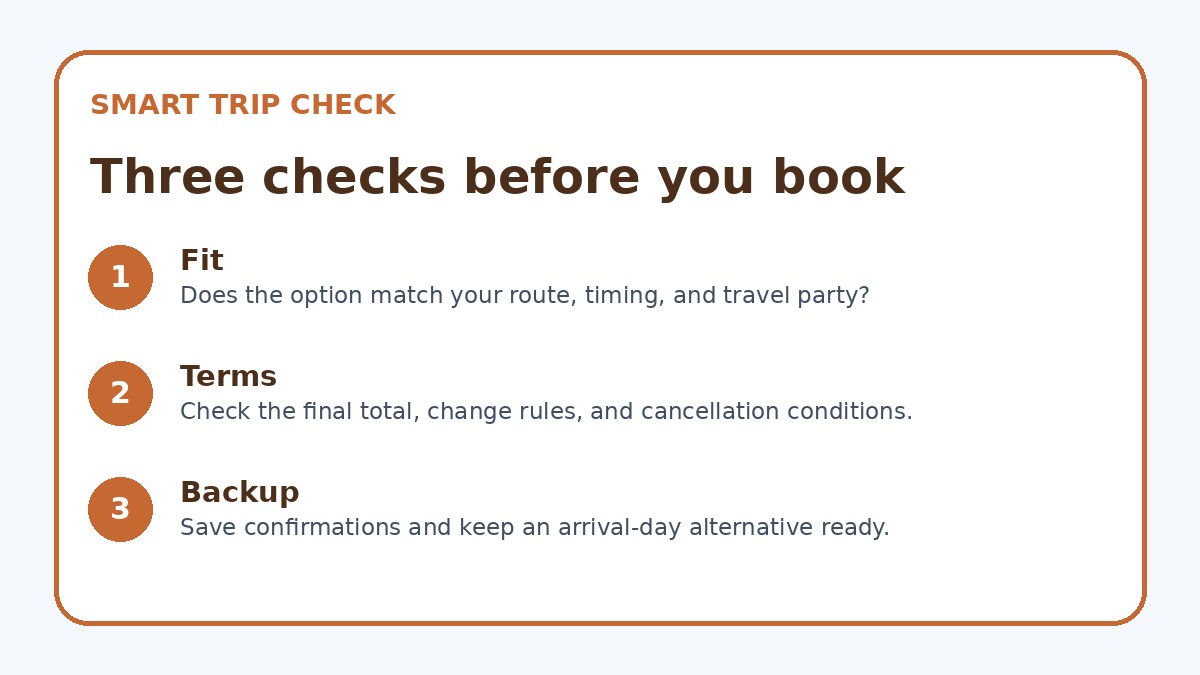
Practical comparison steps: map your specific arrival terminal to the nearest train/bus routes and estimate walking distances to hotels; next, request vehicle sizing and estimated pickup points from private providers. If multiple public routes are possible, compare the one-transfer versus two-transfer options and note where elevators are available. Use provider booking pages to confirm pickup locales, luggage counts allowed, and cancellation terms; Trip.com can be used to compare availability and conditions but always verify final details with the chosen provider.
Before you book
- Count your luggage pieces and note their dimensions and weight; ensure the chosen transfer allows that number and size.
- Check whether pickup is curbside, inside arrivals, or at a designated meeting point; get exact instructions from the provider.
- Confirm vehicle type and interior dimensions for private transfers, and request a van if you have oversized or multiple suitcases.
- If using public rail or metro, map elevator locations at transfer stations and plan routes with the fewest platform changes.
- Ask any private provider about assistance with loading/unloading and whether extra stops incur added charges.
- Save the driver or operator phone number, terminal arrival area, and your local accommodation address in both English and Korean.
When to favor one option over the other
Choose a private transfer if your luggage is heavy, bulky, or numerous; if you’re traveling with infants, elderly passengers, or mobility constraints; or if you need a specific arrival time and minimal physical effort. Private cars and vans also reduce stress when arriving late at night or after a long flight. If convenience and comfort rank higher than the extra cost and you want minimal walking or lifting, private transfers are the straightforward choice.
Opt for public transport when you’re comfortable managing luggage on trains or buses, when your destination is near a station or bus stop, or when you prioritize flexibility and frequent departure options. Public routes can be faster during rush hours because they aren’t affected by surface traffic and are worth considering if your accommodation is a short walk from a station with elevators. In every case, confirm luggage allowances, elevator access, and pickup details on operator pages before you book.
Frequently asked questions
Can I rely on Seoul subway elevators for heavy suitcases?
Many Seoul subway stations provide elevators and ramps, especially major interchange and airport stations, but not every entrance has step-free access. Check station maps online or the Korea Railroad/metro operator pages for elevator locations before you travel. At smaller stations you may need to use a different entrance or plan additional time for elevator waits. If you have an oversized bag, moving it via stairs or narrow passages can be difficult—consider a private transfer or airport bus that offers easier curbside boarding.
Is it easier to take a bus or the train when I have several large bags?
Buses often make loading and unloading simpler because luggage remains at curb level and there’s less vertical handling than trains. Airport limousine buses typically accommodate suitcases in underfloor compartments, reducing the need to carry bags through stations. However, buses may stop some distance from your final accommodation, requiring a short walk. Trains can be faster during peak road congestion but may require moving luggage across platforms and using elevators. Compare final drop-off proximity and elevator availability before choosing.
What should I verify on the booking page for a private transfer?
On a private transfer booking page, check the vehicle capacity (passengers and luggage), pickup location details (curb, arrivals hall, meeting point), driver contact procedures, and whether assistance with loading/unloading is included. Also confirm cancellation and modification terms, any waiting-time policies, and whether stops en route are permitted and charged. If you need a child seat or have mobility equipment, verify availability and any extra fees. Always keep a screenshot or confirmation email with the pickup instructions and contact number.
Final planning note
Choosing between public and private Seoul airport transfer comes down to a clear set of priorities: how much luggage you have, how much physical effort you can or want to handle, your schedule constraints, and whether you prefer cost savings or door-to-door convenience. Private transfers simplify handling and reduce walking, but check vehicle size and pickup details. Public transport is flexible and often efficient—especially in heavy traffic—but requires planning around elevators, platform transfers, and last-mile walking. Use the checklist above, verify specifics on the provider’s booking page, and consider Trip.com or operator websites to compare availability before you make a final booking.
Continue planning
Check current options and final conditions
Use the provider page to confirm live availability, the final total, cancellation terms, and every condition that matters to your trip.
This evergreen planning guide was created with AI-assisted drafting and a structured quality review. It does not display live prices, schedules, availability, visa guidance, or provider rankings. Verify current details before booking. Some links are affiliate links; we may earn a commission at no additional cost to you.