
If your trip to Jeju hinges on meeting changes, delayed flights, or a shifting schedule, the single most useful hotel selection factor is how flexible the booking terms really are. Start by filtering for refundable rates and clear free-cancellation cutoffs, then confirm whether the hotel allows date changes without penalties and what identification or corporate documentation is needed. For corporate bookings, also check group amendment rules and whether the rate allows late check-in and a hold on a guaranteed room. Read provider pages carefully: the exact cutoffs, permitted changes, and any fees are set on the booking confirmation and hotel policy page. Trip.com can be used to compare live availability and policy wording, but always verify the final terms shown by the hotel or booking platform before you commit.
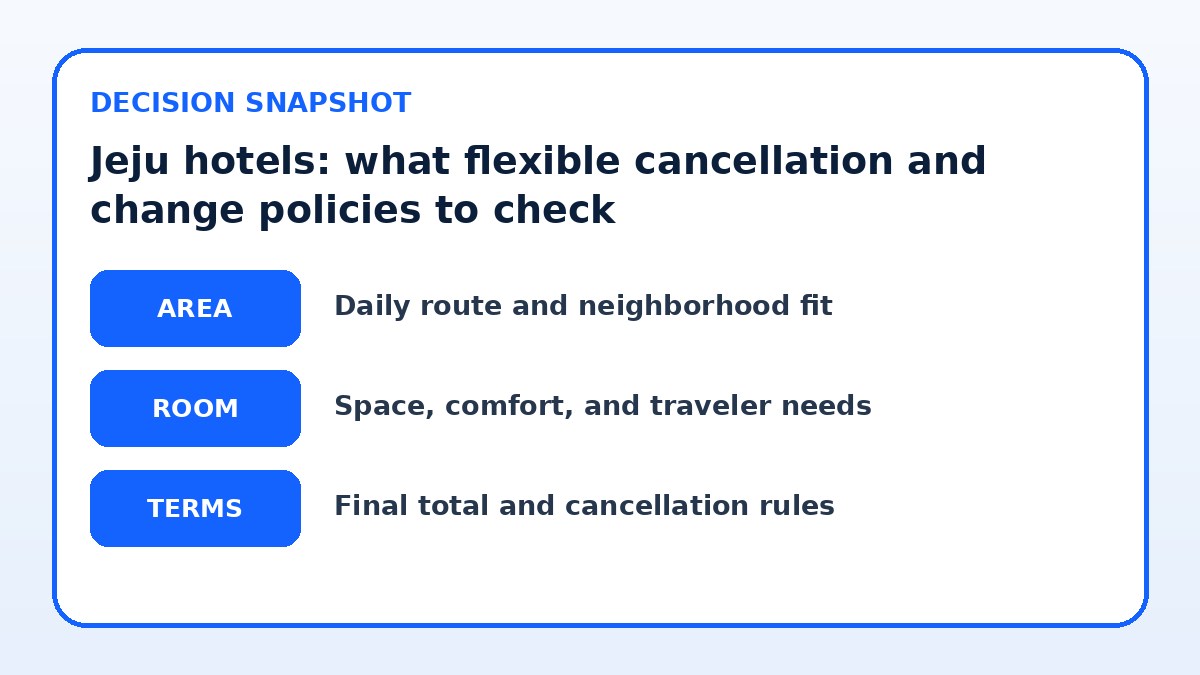
See current options before you compare the details
Availability and final conditions change. Open Trip.com now or keep reading for the practical comparison.
Which flexible terms matter most for business travelers
When you’re planning a short work trip to Jeju, the most practical flexible terms are clear: refundable payments, a reasonable free-cancellation window, and permitted date changes. Refundable rates let you cancel without unexpected charges if meetings are postponed. Free-cancellation windows expressed in days — for example, seven days before arrival — are easier to compare than vague phrases like ‘‘flexible’’ or ‘‘subject to hotel discretion.’’ Date-change policies matter if your meeting is rescheduled; some hotels allow moving nights within a fixed period, while others require rebooking to a new rate.
Other terms matter too: whether a reservation can be transferred to another name, the hotel’s policy on early arrival or late check-out, and whether corporate or group bookings have separate amendment rules. Loyalty program members should confirm whether nights booked on flexible corporate rates still count toward membership benefits. Always spot-check the small print for how refunds are processed — card refund timelines, administrative fees, and any hold placed on a corporate card can affect expense reconciliation.
How to compare policies without assuming uniform meanings
Booking platforms and hotels use different language for similar protections, so compare concrete terms rather than labels. Create a short matrix: column headings like ‘‘free-cancellation cutoff,’’ ‘‘refund method,’’ ‘‘date-change allowed,’’ and ‘‘fees for amendments.’’ Populate rows from the hotel confirmation or the booking page copy. If a page says ‘‘free cancellation until 24 hours before arrival,’’ note whether that references local check-in time; if it doesn’t say, contact the hotel to confirm. Don’t infer that ‘‘flexible’’ equals ‘‘fully refundable’’ — it may allow changes but not refunds.
Pay attention to exceptions and blackout dates. Corporate events, public holidays, or peak conference periods can trigger different rules even at the same property. If your trip coincides with a local event on Jeju, ask the hotel to confirm whether the listed flexible rate will still apply. Also verify how refunds are processed: some platforms refund immediately, while hotels may take several business days. For compliance with corporate expense policies, record the exact cancellation window and the refund method shown on the final booking page.
| Approach | Best for | Tradeoff to check |
|---|---|---|
| Fully refundable nightly rate | High schedule uncertainty or last-minute meeting changes | Typically higher rate and may lack bundled perks like breakfast or loyalty credit |
| Flexible rate with limited cancellation window | Moderate schedule flexibility when meetings are likely but not guaranteed | Lower cost than fully refundable but watch exact cutoff timing and time zone references |
| Nonrefundable prepaid rate | Fixed, confirmed itineraries where cost control is prioritized | Lowest price and sometimes extra perks, but no refund or date-change options |
| Corporate or negotiated rate with amendment clause | Travel booked by a company travel program seeking invoice and reporting consistency | May require group terms, minimum nights, or complex amendment fees despite appearing flexible |
Ready to check the option that fits your plan?
Use your exact dates and traveler details so the provider page can show the current total and conditions.
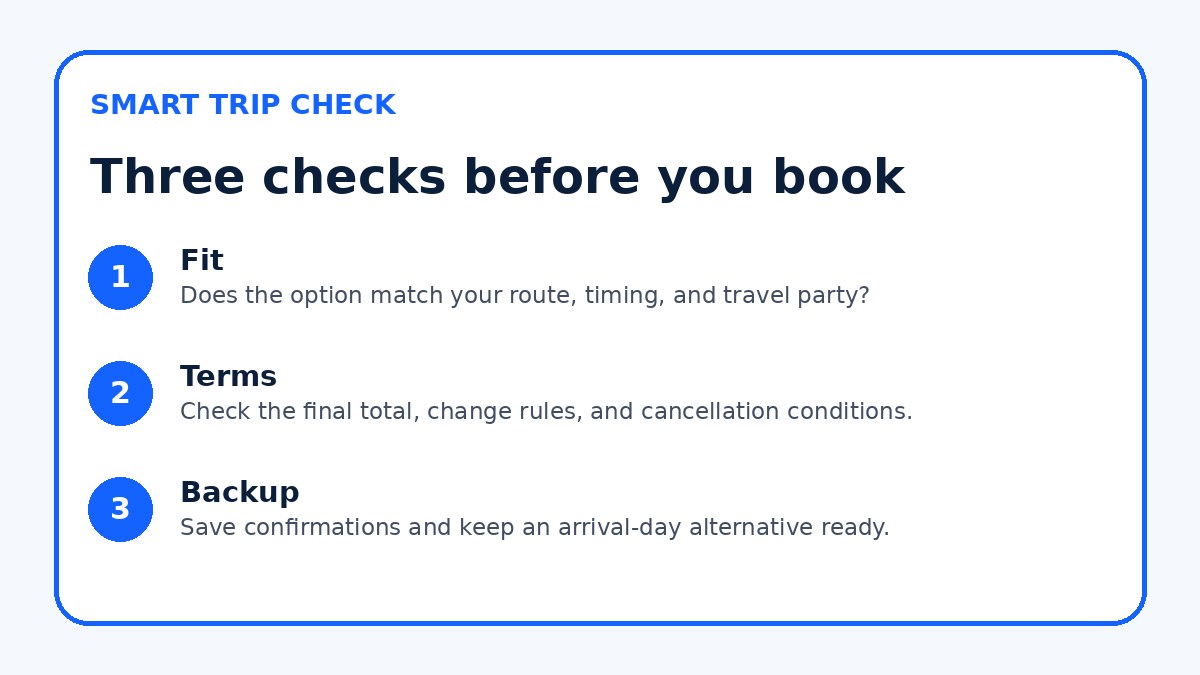
Tradeoffs: flexibility versus cost, location, and amenities
Flexible rates often cost more or come with fewer perks. A fully refundable rate might not include breakfast, complimentary parking, or loyalty points in the same way as a prepaid, nonrefundable deal. For business travelers this can be an acceptable tradeoff when schedule uncertainty is high; however, if meetings are locked in and your company requires lower cost bookings, a nonrefundable prepaid rate can be justified. Consider whether the convenience of a central city location or meeting-suite access outweighs the extra expense of flexibility.
Another common tradeoff is inventory — the most flexible rooms (cancellable, free-change policies) are limited in peak periods. If you need specific amenities like a dedicated meeting room or strong on-site business services, confirm whether those can be reserved with a flexible rate or require a separate deposit. For multi-night stays, check whether flexibility applies to the entire reservation or on a per-night basis, since partial penalties can complicate refund math when plans change mid-stay.
Before you book
- Filter for refundable or flexible rates and open the specific room policy to read the cancellation and amendment wording.
- Note the free-cancellation deadline including whether it uses local check-in time or a fixed hours-before-arrival rule.
- Confirm refund method and timing (credit card vs. hotel voucher) and save a screenshot of the booking terms.
- Call the hotel to verify date-change, name-transfer, and group-amendment policies and request email confirmation.
- Check whether corporate invoicing, expense codes, or loyalty benefits are compatible with the chosen flexible rate.
- If traveling during an event or holiday, ask whether blackout dates change flexibility or impose higher minimum-stay requirements.
Practical steps to lock a flexible corporate-friendly booking
Start by searching for ‘‘refundable’’ or ‘‘flexible’’ filters on booking sites, then open the hotel’s own policy page for the room type you prefer. Save screenshots of the rate rules shown at booking — these can help resolve disputes later. If you’re booking through a travel manager or corporate platform, confirm whether the agency’s negotiated rate preserves flexibility and whether corporate invoicing affects refund timing. For group bookings, get amendment and attrition terms in writing; verbal assurances are useful but not a substitute for a written clause on the confirmation.
Before finalizing, call the hotel to reconfirm three points: the free-cancellation cutoff (with time zone and check-in hour), how refunds will be issued and when, and whether date changes or name transfers will trigger fees. Ask for an email confirmation of what was discussed and compare that against the booking confirmation. If the site and hotel differ, the hotel’s written policy and the booking confirmation are the documents to rely on when seeking any refund or modification.
Frequently asked questions
Can I book a flexible rate and later switch to a cheaper nonrefundable rate if plans solidify?
Possibly, but it depends on the hotel’s policy and the booking channel. Some hotels allow rebooking to a different rate, but they may treat the original cancellation as a separate transaction and apply the new rate only for future dates. To avoid losing a refundable option you might need to cancel the flexible booking within its allowed window and then rebook a cheaper rate — confirm there’s no penalty for canceling and that the cheaper rate is still available. Before doing either action, document the terms on both reservations and check corporate expense rules on rate changes.
How should my company handle group bookings in Jeju to preserve flexibility?
Negotiate amendment and attrition clauses up front and get them written into the contract. Specify how many rooms can be changed without penalty, the cutoff for final guarantees, and the process for substituting names. Ask for written confirmation of whether complimentary meeting spaces, breakfast, or shuttle services are tied to the group rate and whether those perks survive date changes. Keep records of correspondence and the hotel’s signed contract page; verbal promises matter less than the contractual amendment terms when disputes arise.
What should I verify on the booking page versus the hotel confirmation email?
Compare three core items: the free-cancellation deadline (including time zone), the refund method and timeframe, and the allowed modification types (date changes, name swaps, room upgrades). The booking page may summarize policy, but the confirmation email or PDF should replicate the exact legal terms. If there’s any discrepancy, contact the hotel immediately and request corrected confirmation. Retain screenshots of the booking page and the confirmation email together with any phone or chat transcripts in case you need to dispute a charge later with your corporate card issuer.
Final planning note
Business travel to Jeju requires balancing schedule uncertainty with cost and convenience. Prioritize clear, written booking terms: refundable payment options, explicit free-cancellation cutoffs tied to local check-in time, and transparent date-change policies. Use a short comparison matrix to evaluate candidates, confirm details directly with the hotel, and save all confirmations and correspondence. Corporate travelers should also verify invoicing, loyalty eligibility, and group amendment rules before booking. For live availability and policy comparisons you can consult Trip.com, but always rely on the final booking confirmation and the hotel’s documented policy when making your decision.
Continue planning
Check current options and final conditions
Use the provider page to confirm live availability, the final total, cancellation terms, and every condition that matters to your trip.
This evergreen planning guide was created with AI-assisted drafting and a structured quality review. It does not display live prices, schedules, availability, visa guidance, or provider rankings. Verify current details before booking. Some links are affiliate links; we may earn a commission at no additional cost to you.