
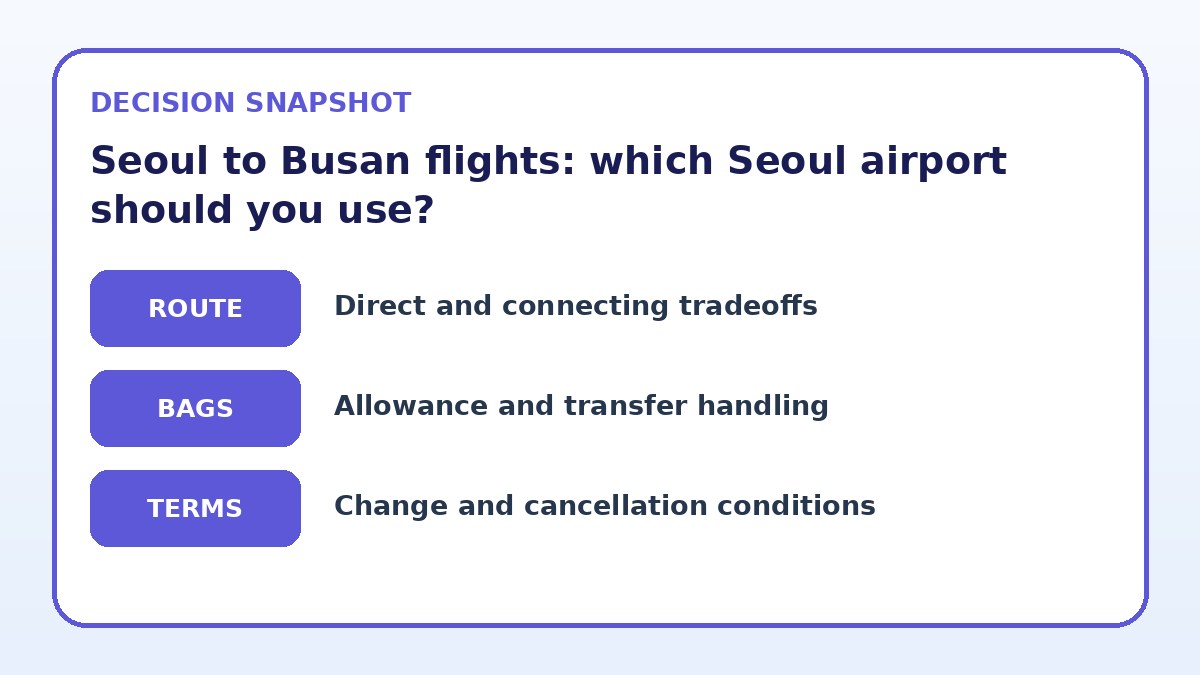
Practical answer up front: for most first-time visitors traveling from central Seoul to Busan, Gimpo Airport is usually the more convenient departure because it’s closer to the city, quicker to reach by subway or taxi, and handles most domestic flights. Incheon International handles some domestic services but is much farther west; it can make sense only if your international arrival or airline itinerary forces a connection there. When deciding, weigh door-to-door transfer time, how much luggage you have, your tolerance for extra transit, and whether you prefer a single airport for an international arrival and a domestic departure. Later sections explain how to compare schedules, where to confirm direct versus connecting flights, and the tradeoffs—cost, comfort, and risk—so you can pick the airport that reduces stress on travel day.
See current options before you compare the details
Availability and final conditions change. Open Trip.com now or keep reading for the practical comparison.
How proximity and transfers affect your choice
Distance from where you’ll be in Seoul matters more than airport facilities. Gimpo sits much closer to central districts like Hongdae, Gangnam (by transit connections), and Seoul Station, so travelers with limited time or heavy luggage typically reach it faster. Use the subway lines that serve Gimpo—look up the exact journey by station and time of day—because rush-hour traffic can change a taxi estimate. If your itinerary lands you in a different neighborhood, map the door-to-door transfer for both airports to see which saves you time and stress on departure day.
Incheon is optimized for international arrivals and has more shops and services, but its distance from central Seoul usually adds at least 40–60 minutes extra travel one way under normal traffic. That extra transfer time can erase the difference between a later departure and an earlier one, especially if your schedule is tight. If you plan to connect from an international to a domestic flight, check whether your bags are checked through and whether you must clear immigration and collect luggage—these steps can make using the same airport a practical choice despite the longer transit.
Flight frequency, directness, and what to confirm
Compare the number of flights and how direct they are from each airport. Gimpo traditionally handles frequent domestic services to Busan, often with direct flights that are short and convenient. Incheon may offer fewer domestic services, and some options listed could involve connections or different routing. Because schedules and routings change, always verify on the airline’s or booking platform’s final page whether a flight is direct, how many stops are involved, and the total journey time including connections.
When a provider lists a short flight time, double-check whether it includes ground time for a connection. For itineraries that look convenient but route through another city, review the transfer time and whether the connection is on a single ticket (which affects protection if you miss a connection) or two separate bookings. If you plan to compare providers, you can use Trip.com as one place to view current availability and schedules, but verify all key details—directness, baggage rules, and connection conditions—on the carrier’s booking confirmation before buying.
| Approach | Best for | Tradeoff to check |
|---|---|---|
| Depart from Gimpo (closer to central Seoul) | Travelers prioritizing short transfers and quick domestic connections | Fewer international services and smaller terminal facilities compared with Incheon |
| Depart from Incheon (if already arriving there) | People who want to avoid re-checking baggage after an international arrival | Longer transfer time from central Seoul and greater commute risk |
| Choose based on a single-ticket international-to-domestic itinerary | Passengers seeking protection for missed connections and simplified baggage handling | May limit schedule options or require specific carrier alliances |
| Pick by door-to-door travel time and total convenience | First-time visitors with tight schedules or heavy luggage | Might pay slightly more for a quicker, simpler journey |
Ready to check the option that fits your plan?
Use your exact dates and traveler details so the provider page can show the current total and conditions.
Luggage, check-in, and airport services to weigh
If you have oversized or excess luggage, the practical differences between airports become clearer. Gimpo staff and counters are set up around frequent domestic flows, often enabling faster check-in and baggage drop for short-haul flights. However, if you need specific services—like extra language assistance, duty-free handling from an incoming international flight, or specialized baggage processing—Incheon’s larger infrastructure may be helpful. Before committing, check the airline’s baggage allowance, where to drop bags for domestic legs, and whether you can check through from an international arrival.
Special needs such as traveling with children, medical equipment, or pets can sway your choice. Larger airports may offer more lounges, nursing rooms, and medical facilities, while a smaller, closer airport reduces transfer time and the complexity of moving between terminals. Confirm facility availability and any required advance arrangements (for wheelchair assistance, pet handling, or oversized gear) on the airline or airport pages; those operational details can change and must be verified at booking.
Before you book
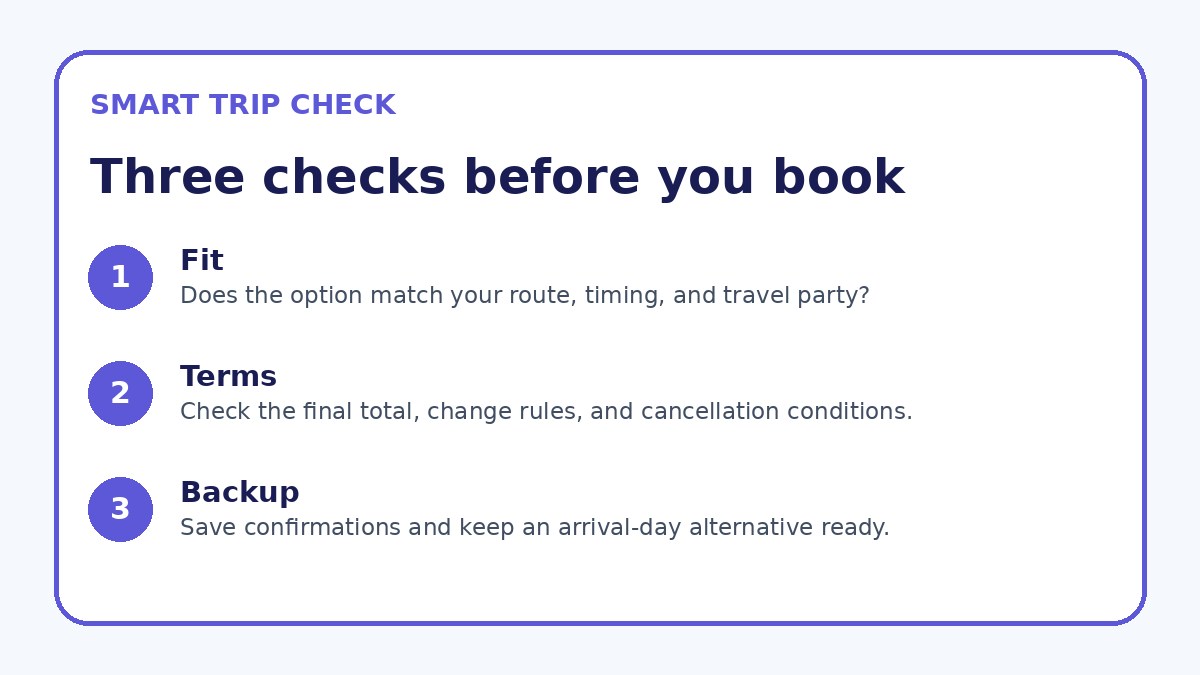
- Map door-to-door transfer time and cost for both Gimpo and Incheon from your Seoul accommodation at your planned travel hour.
- On the airline’s booking page, confirm whether the selected Seoul–Busan flight is direct and check total journey time if it’s not.
- Verify baggage rules and whether you can check luggage through from an international arrival to a domestic departure.
- Compare the earliest and latest feasible flight times versus your on-the-ground schedule and any fixed commitments in Busan.
- If you have mobility, child-care, or pet needs, contact the airline and airport to confirm required assistance or facilities in advance.
- Keep printed or screenshot copies of confirmations and check-in requirements; re-check live departure terminal and gate information before leaving.
Cost, risk, and the simple decision framework
Ticket price can influence where you depart, but the practical decision is rarely just about the fare. Add the expected cost of transfers, the value of your time, and potential missed-connection risk to the equation. A cheaper flight from Incheon might be more expensive overall once you include taxi or train fares, transfer time, and the stress of longer commutes. Also consider the risk tolerance: if you have a fixed event in Busan, prioritize the option with buffer time between arrival at the airport and your intended departure.
A straightforward framework: estimate door-to-door transfer times and costs for both airports, check whether the flight is direct, confirm baggage handling rules, and pick the option that minimizes total travel time and logistical complexity for your situation. If unsure, choose Gimpo for convenience unless your international itinerary or a clear operational reason points you to Incheon. Keep all confirmations and re-check details on the airline’s booking page before you finalize the purchase.
Frequently asked questions
Is Gimpo always the fastest option from central Seoul to Busan?
Gimpo is frequently the faster choice because of its proximity and direct subway links to central Seoul, but “fastest” depends on your exact location, time of day, and whether you must transfer from an international flight. If you’re staying near Seoul Station, Hongdae, or Yeouido, Gimpo will often beat Incheon on transfer time. However, if you arrive internationally at Incheon and cannot check bags through, the time needed to clear immigration and transfer could make Incheon the practical choice. Always map your real door-to-door times before booking.
How do I verify a flight is direct and not a connecting itinerary?
When comparing options, inspect the airline’s final booking page for explicit routing details: look for the number of flight segments, intermediate stops if any, and layover durations. A direct flight will show a single flight number for the Seoul to Busan leg and no scheduled stopovers. If the listing shows multiple flight numbers or a layover city, treat it as a connecting itinerary. Confirm whether different legs are on the same ticket, since single-ticket connections usually include protection if delays cause missed connections.
Should I book the same airport for arrival and departure if I have an international inbound flight?
Booking both arrival and domestic departure at Incheon can simplify baggage handling and reduce the need to transfer between airports—useful if you have heavy luggage or prefer to minimize extra transit. But staying in central Seoul and departing from Gimpo may still be preferable if you want to sightsee or need a shorter commute. Decide by checking whether your airline will check bags through to Busan, the time required to clear immigration, and whether you’re comfortable the same-day transfers allow enough buffer for unexpected delays.
Final planning note
For first-time visitors weighing Seoul to Busan flights, the practical default is to use Gimpo unless your international arrival, baggage flow, or an operational constraint points you to Incheon. Gimpo minimizes transfer time from central Seoul and often offers the most straightforward domestic schedules, which reduces stress on a short trip. Still, always perform a short checklist before booking: map door-to-door time, confirm whether the flight is direct, verify baggage handling, and check assistance options if you need them. Re-check the airline’s final booking page for real-time routing and baggage rules; Trip.com can be a useful comparison tool but confirm details with the carrier before purchase.
Continue planning
Check current options and final conditions
Use the provider page to confirm live availability, the final total, cancellation terms, and every condition that matters to your trip.
This evergreen planning guide was created with AI-assisted drafting and a structured quality review. It does not display live prices, schedules, availability, visa guidance, or provider rankings. Verify current details before booking. Some links are affiliate links; we may earn a commission at no additional cost to you.