Practical answer up front: pick the transfer mode that matches your schedule risk, luggage, and meeting location — private car for tight schedules, taxi for door‑to‑door convenience, train for predictable city‑center runs when timing is flexible. For Rome business travelers the core tradeoffs are reliability versus cost and flexibility versus predictability. Decide whether you need a booked service with a flight‑monitoring or cancellation policy, or whether you can rely on taxis or public transport with contingency time built in. Before you book any provider, verify pickup terms, meet‑and‑greet details, luggage rules, and cancellation/refund conditions on the supplier’s final booking page. If you want an easy place to compare current availability and conditions, you can also check Trip.com as one comparison point.
See current options before you compare the details
Availability and final conditions change. Open Trip.com now or keep reading for the practical comparison.
Choose the right transfer type for your schedule
Start by mapping your time constraints: when is your flight scheduled, when do you need to be at the airport, and how much buffer do you want for security and unexpected delays? Business travelers frequently want a firm plan with margins for traffic, lines, and last‑minute tasks. If you must be at the gate well before departure, a prebooked private sedan or executive transfer gives a specific pickup time and driver assignment, which simplifies coordination and often includes flight monitoring so the driver adjusts for delays.
If your schedule is flexible and you prefer to save money, compare scheduled airport shuttles, express trains, and taxis. Trains from Roma Termini to Fiumicino are usually regular and remove traffic risk but require you to handle luggage and a short taxi or metro leg depending on your hotel location. Taxis are convenient for door‑to‑door service without advance scheduling, but during peak hours or events there can be waits. For mid‑week, predictable meetings, weigh the cost of certainty (private transfer) against the simplicity and lower cost of rail or shared shuttles.
Compare reliability factors, not just price
Reliability for a business traveler means predictable arrival time at the airport and clear contingency plans. When evaluating options, ask whether the provider monitors flights, their policy on waiting or extra stops, whether they commit to a pickup window, and how they communicate last‑minute changes. For formulas of risk, consider traffic patterns around Rome’s ring roads, likely taxi availability at your hotel, and whether your chosen route depends on a single connection (for example, hotel to metro to train) that could fail and cost you time.
Also check what “reliability” costs in practice: a private transfer can be priced higher but may include waiting time and a direct route that removes an uncertain connection. A scheduled shuttle or train removes road congestion risk but ties you to a timetable and to carrying your luggage yourself. For every option, verify on the provider’s booking page or with the hotel any late‑pickup fees, missed‑service policies, or required confirmations — these details change and should inform the decision more than advertised base fares.
| Approach | Best for | Tradeoff to check |
|---|---|---|
| Prebooked private transfer | Tight schedules and multiple passengers with luggage | Higher cost but direct pickup and driver assignment reduce uncertainty |
| Taxi on demand | Door-to-door convenience without advance planning | Variable wait times and potential surge or traffic delays |
| Train plus short taxi | Predictable, traffic-free city-center to Fiumicino runs | Requires handling luggage and a final short transfer |
| Shared shuttle or hotel transfer | Moderate budgets with flexible schedules | May include stops and a fixed timetable—less flexible for late changes |
Ready to check the option that fits your plan?
Use your exact dates and traveler details so the provider page can show the current total and conditions.
How to coordinate pickup logistics with hotels and drivers
If your hotel handles bookings, get the driver’s estimated arrival time, the meeting point (lobby, curb, or a named exit), and the driver’s phone number or the reservation reference. Clarify how much waiting time is included if your meeting runs late, and what happens if you are delayed beyond the agreed pickup window. For street pickups, ask the hotel whether there are recommended taxi ranks or permitted loading zones — Rome has restricted traffic areas (ZTL) in many central neighborhoods that affect where drivers can approach a building.
When using a prebooked service, confirm whether the driver will display a nameboard and where they will meet you if the hotel’s lobby is crowded. If you plan to step out to meet the car, check security protocols at your hotel and carry a printed or digital confirmation. If you’re using public transport plus a short taxi, build an extra 20–45 minutes into your schedule for transfers between modes; for private cars, ask what alternate routes the driver will take in heavy traffic and whether the service adjusts for morning or evening congestion.
Before you book
- Confirm which Rome airport your flight uses (FCO or CIA) and match your ground transfer booking to that airport.
- Save the driver’s or supplier’s contact number, vehicle details, and booking reference in two easy-to-access places.
- Build a time buffer: add at least 60–90 minutes for domestic or Schengen flights and more for non‑Schengen or long‑haul departures.
- Verify pickup logistics with your hotel concierge: exact meeting point, permitted loading zones, and any ZTL restrictions.
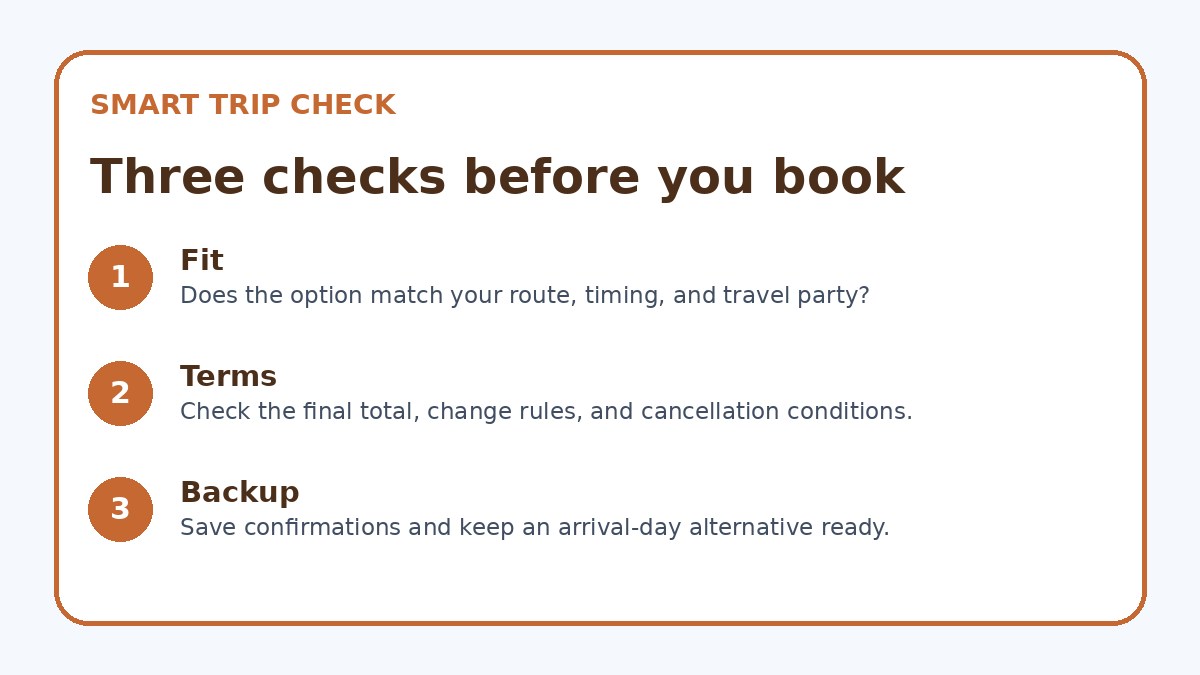
- Check the supplier’s waiting time, cancellation, and no‑show policies on the final booking page before you confirm.
- Have a backup plan: a taxi app ready, the hotel front desk number, and an alternate transfer supplier on speed dial.
Final booking checklist and contingency planning
Before you confirm any booking, collect and save key information: pickup time and location, driver contact or dispatcher number, vehicle type and license plate (if provided), booking reference, and the supplier’s cancellation and delay policies. For trains or shuttles, note the station name, platform conventions, and how to handle luggage on board. Triple‑check your flight terminal and whether the airport listed in your booking (FCO or CIA) matches your airline’s terminal information. If you have connecting flights, consider leaving extra buffer both for inbound delays and for airport security processing.
Build simple contingencies: a backup taxi app downloaded and funded, the hotel’s front desk number for last‑minute coordination, and an alternate transfer supplier’s contact. If an important meeting runs late, inform the driver or transfer company as early as possible; many providers will hold for a fee or reschedule pickup. Keep digital copies of confirmations and allow time to rebook if necessary. Confirming these points before your last meeting avoids rushed decisions and reduces the risk of missing a flight.
Frequently asked questions
Which Rome airport transfer option is best if I have a very early flight?
For very early flights, a prebooked private transfer or arranged hotel taxi is usually the most reliable because it guarantees a vehicle and driver at a set time. Trains and shared shuttles may not run early enough and taxi ranks can be empty, making street hailing risky. Before you finalize, confirm pickup time, any early‑hour surcharge, and how long the driver will wait. Verify these details on the booking confirmation to avoid surprises and ask the hotel to confirm the pickup the night before.
How much time should I leave between a business meeting in central Rome and my international flight?
Allow time for travel to the airport, check‑in, security, and an extra buffer for traffic or delays. For international flights consider leaving at least 2.5 to 3.5 hours from the end of your meeting to your flight’s departure time, though the exact margin depends on terminal, airline check‑in rules, and whether you’re already checked in. If you’re using public transport, add time for the transfer from your meeting venue to the station. Always check the airline’s recommended arrival time and adapt your transfer choice accordingly.
Can I rely on a hotel concierge to arrange my Rome airport transfer?
Hotel concierges are a convenient option and can coordinate timing, pickup points, and driver details, but you should still verify the reservation details yourself. Ask for the driver’s name or company, confirmation number, pickup window, and any fees or waiting time allowances. For critical departure times, request a written confirmation and keep the concierge’s contact number handy on the day of travel. This reduces misunderstandings and gives you direct contact if plans change at the last minute.
Final planning note
Planning the return trip to Rome’s airports as a business traveler means deciding how much schedule certainty you need and then matching a transfer type to that need. Private transfers buy predictability and convenience, taxis give simple door‑to‑door service, and trains or shuttles can cut costs if you accept a fixed timetable and manage your luggage. Confirm pickup details, waiting policies, and backup options on the provider’s booking page before you commit. With a clear contingency plan and the right buffer, you can leave your last meeting confident that you’ll get to FCO or CIA on time and with minimal stress.
Continue planning
Check current options and final conditions
Use the provider page to confirm live availability, the final total, cancellation terms, and every condition that matters to your trip.
This evergreen planning guide was created with AI-assisted drafting and a structured quality review. It does not display live prices, schedules, availability, visa guidance, or provider rankings. Verify current details before booking. Some links are affiliate links; we may earn a commission at no additional cost to you.